
The End of Leanne Wood’s Tenure
A crossroads in the career of a political giant
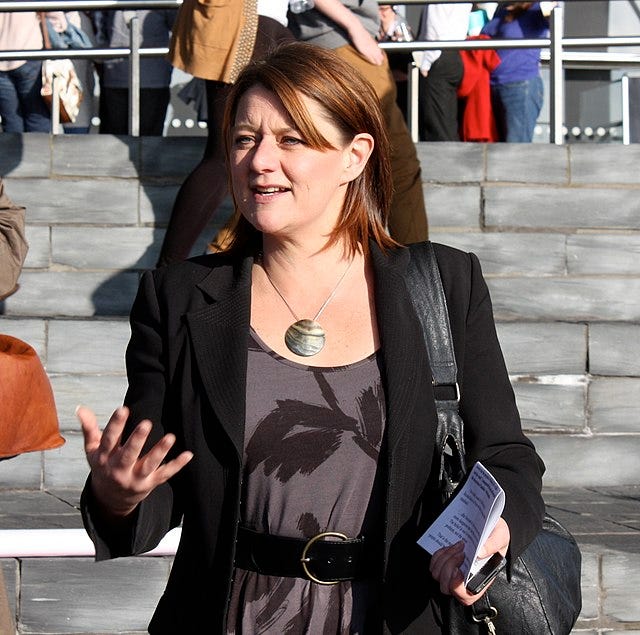
After any election, there’s always a lot to digest. But in the aftermath of Wales’ 2021 Senedd Elections, I’m finding one result difficult to comprehend. Like many people in Wales, I’m a committed socialist, and as far as I’m concerned the Senedd has just lost the best of us.
Leanne Wood has easily been one of the most principled and committed politicians in the UK for almost two decades. The Senedd Member for the Rhondda since winning her home seat in 2016, she has served as a South Wales Central representative since 2003.
She’s the reason I became interested in politics, and I’m far from alone in claiming this. She has been a beacon of light in an era of negative politics, changing the agenda for Wales time and time again. She spoke out against austerity when other parties deemed it ‘necessary’, helped to push the climate debate to the fore and has worked tirelessly for the rights of minorities, the working class, her community and Wales as a whole.
Often describing herself as a political activist rather than a politician, she is proudly socialist, feminist, anti-fascist, an environmentalist and a republican. Those who espouse xenophobia, misogyny, fascist ideology and all forms of bigotry consistently make time to attack her — this, to me, is as much of an endorsement as any. They may be happy with this result, but together we’re all worse off.
In 2016 she had the safety net of her name on the list — had she failed to win her own Rhondda valleys she was almost certain to retain her place in the Senedd, thanks to Wales’ mishmash of a political system (still undeniably better than inherently unfair First Past the Post favoured by Westminster).
In the end, she pulled off an incredible victory for Plaid Cymru in what was thought of as a Labour stronghold, and didn’t need it. This time, however, her name was missing from the list. I don’t know the reason behind this, but with hindsight it was clearly a mistake.
History
The Welsh Political Landscape isn’t the same as England’s. This has also been true throughout the history of democracy on these islands, but it is undeniable that the patterns have been converging. The neoliberalism that Westminster helped develop and export has become an omnipresent feature of English politics, and it is tainting the loyalties of the Welsh electorate.
There seems to be no scandal big enough to seriously dent the popularity of Boris Johnson’s Tory party, and they’re trying their hardest to find the limit. In this light, the fact that Wales bucks the trend by continuing to reject them can only be seen as a positive. But things could be so much better.
I was three years old during the 1984 Miners’ Strike and grew up in its aftermath in one of the worst hit areas. The word ‘Tory’ was a vicious insult, and while I wasn’t sure what a ‘Thatcher’ was, I knew I wasn’t allowed to say it.
The idea that one of the seats in the valleys would ever turn blue was unthinkable — this I understood. For my grandparents, this was because the Tories sought to destroy every ideal our communities stood for. But the unions were defeated, beginning the erosion of our sense of togetherness.
So for my generation things have been very different. My first memory of an election came in 1997 when Tony Blair swept to power; he did so, apparently, by rejecting socialism. I knew nothing of politics beyond the two certainties: red was good; blue, bad. So I celebrated the defeat of evil and looked forward to the good times.
Socialism was little more than a vaguely familiar word linked to a bygone era, like communism, disproven and consigned to history with the felling of the Berlin Wall. There is a reason Margaret Thatcher declared New Labour and Tony Blair to be her greatest accomplishment. Neoliberal to the core, they did little to undo the worst of her policies and enthusiastically expanded on others. Blair declared that we were ‘all middle-class now’ as economic decline engulfed my community.
Then I came across Leanne Wood. At a time when hope in politics seemed no more than puerile fantasy, she spoke with ambition and positivity. Her Greenprint for the valleys contained the sort of vision that other politicians were unwilling to express. And she kept using that word: socialism. I was hooked.
My concerns were at a community level so it took time for me to understand her insistence on prioritising the environment. I had considered it a niche concern before her rhetoric led me to educate myself. That word, niche, become a weapon to attack her as she consistently championed the causes that other politicians refuse to touch.
I joined her party, Plaid Cymru, to vote for her to become leader. She used that position not just to achieve an unprecedented voice for Wales on a UK level, but to offer a voice to those within Wales who were struggling to be heard.
The 2021 Senedd Elections
Fast forward to 2021 where, under Keir Starmer, Labour have attacked the most right-wing government in modern UK history from the right. Leanne is no longer leader but has been a powerful advocate for her community up until this election. Under the media’s threat of a Tory surge in Wales, the Rhondda reverted to type.
‘Vote Plaid, get Tories’ is a mantra that has always worked well for Labour, no matter how far removed from reality it has become. But I struggle with the knowledge that many committed socialists in the Rhondda voted not for Leanne but for the party who offer them Chris Bryant, their Westminster representative.
Parachuted into a safe Labour seat during the Blair years, the former Tory party member made £650,000 from selling flats the taxpayer helped to fund. A war-enthusiast, Bryant has close ties with the neoconservative Henry Jackson Society. As Leanne Wood campaigned to help the victims of flooding in the Rhondda, he opposed her calls for an independent inquiry because he knew it would reveal his party were at fault.
Naturally, he was the first to gloat, even before the results were in. He said she had ‘blown it’ in an attempt to belittle her achievements, but I’ve yet to hear a negative word said about her from any of her constituents. The actual reasons, however, will need some dissecting.
As ever, in Wales, it’s likely more to do with identity than anything Leanne could have done differently. The best theory I have come across on Twitter stems from how Labour and Plaid Cymru are viewed in the valleys.
The Welsh valleys don’t just vote Labour because ostensibly they share they same values. We made Labour. Keir Hardy won their first seat fighting for Merthyr Tydfil as the movement was built on the support of miners. Labour is ours, it belongs to us, we are one and the same.
Plaid Cymru began life in the Welsh-speaking heartlands with the initial priority of empowering the Welsh language. Built on this foundation of fighting injustice, they grew into a political party with democratic socialism at its core.
The similarities have resulted in a fondness for Plaid in the valleys, but they have never convinced the majority that they’re ours in the same way that Labour has. Despite Westminster dictating the actions of their parachuted candidates, the symbolism retains its power.
Leanne is ‘one of us’ — of this there is no question. But for many, her party remains Other — which was fine, when she led them. In 2016 we were more than happy for ‘one of us’ to tell ‘them’ how it should be done. This time, without that certainty, the Rhondda sought safety in a colour.
This is of course an overly reductive breakdown, and myriad other factors always come into play during elections. The only things that are certain is that Wales has lost a committed public servant, and Plaid need to understand what needs to be done to breakthrough in the valleys.
Leanne has a lot left to offer Welsh politics, and if anyone can increase the appeal of voters in the valleys, it’s her — the prospect of her returning to take on Bryant for his Westminster seat is tantalising. But in the meantime, I’m sure she won’t stay out of the public sphere. To paraphrase Tony Benn, one of Labour’s last prominent, genuine socialists, she could take time out from being a politician to devote more time to politics.


.jpg)