
‘The End of Eternity’ by Isaac Asimov and the Manifest Destiny of America
Isaac Asimov (1920–1992) was one of the central writers of the formative period of science fiction and among the very first to highlight the political and societal importance of the genre. The key works in Asimov’s oeuvre were the Robot and Foundation series published in the Astounding Science-Fiction magazine in the 1940’s and the 1950’s. In these Asimov dealt with themes of history, frontier expansion and guardianship. However these stories were all based in space. But with the publication of The End of Eternity in 1955 he placed his context not in space but in time. (It is interesting that the cover artwork to the 1975 Panther edition features a spaceship. How wrong can you get?) It is a stand-alone book and is considered by many to be his single best SF novel.
Andrew Harlan is an Eternal, a member of the elite of the future. One of the few who live in Eternity, a location outside of place and time, Harlan’s job is to create carefully controlled and enacted Reality Changes. These Changes are small, exactingly calculated shifts in the course of history made for the benefit of humankind. Though each Change has been made for the greater good, there are always costs. In particular, space flight never happens because of the changes they make.
During one of his assignments, Harlan meets and falls in love with Noÿs Lambent, a woman who lives in real time and space. Then Harlan learns that Noÿs will cease to exist after the next change, and risks everything to sneak her into Eternity. Unfortunately, they are caught. Harlan’s punishment? His next assignment: kill the woman he loves before the paradox they have created results in the destruction of Eternity. But there is a twist at the end as Harlan discovers that he has been part of a much bigger plan. A plan that involves Noÿs and will affect the ultimate direction of humanity as Harlan will have to choose whether to save or end Eternity.
Asimov’s novel engages us on many different levels. We have a love story and a detective novel in one. On the next level we have an insight into how the interrelationship between men, computers and information were viewed by people of the mid-1950’s. On the next, a time-travel story that particularly at the end, involves philosophic considerations of free will, social planning, evolution and human advancement. The time-travel story cleverly sidesteps most of the clichés that had become associated with time-travel: there is no interfering with a particular historical event such as returning to assassinate Hitler or the hero becoming trapped in a strange time, or that evil overlord conspiring to take over the Universe by controlling time.
In Asimov’s story, time travel was invented in the twenty-third century, and Eternity was founded a few centuries later. Eternity stands outside Time, observing and messing about with it, to make the one and only reality the best of all possible worlds. Eternals are drafted from Time — they are people whose absence from history makes no difference. Eternity and the dimension they use sits outside of time like a subway that has its stations at each century of real existence and time passes for these Eternals the same way it does for everyone. The various Paradoxes involved in time-travel and the issue of meeting yourself cannot occur as this can only happen within Time.
The End of Eternity, with its all-male fraternity of paternalistic meddlers, seems almost painfully sexist, and Noÿs, the beautiful love interest from the decadent 575th century, seems like a bit of plot mechanism more than a character. However, when all is revealed — on what is practically the last page — it turns out that Noÿs is from the far future and has been manipulating everything else to get what she wanted, a future of humanity in the stars. In swapping Eternity for Infinity, time-travel is expressly rejected in favour of space travel.
One change is made — and not one that would be made today to bring about a brighter future! They give the people of the primitive era of 1932 a hint about atomics, which of course will lead to mankind going to the stars at the earliest possible opportunity. Asimov said that the inspiration for the story came from a photo he had seen in 28th March 1932 issue of Time that he thought showed a mushroom cloud produced by an atomic bomb.
This book is very much a product of its time. Written during the Cold war, it displays the controlled (five years plus?) planned centuries of Eternity and explicitly contrasts this with a free chaotic future expanding out into the boundless frontier of the Universe in a way that feels shaped by the political dialectic of the ‘Free’ world versus the ‘Communist’ world. Harlan and Noÿs choose for humanity to give up hundreds of thousands of years of safe future on Earth for the possibility of freedom among the stars.
That Asimov chose to forego the safe future on Earth and reject the benign paternalism at the very heart of his story given that it was also a continuation of the antidemocratic pragmatism of Campbell’s Astounding, shows that he was still searching for an answer to questions that had been asked by one of the first and greatest modern champions of the notion of a benevolent elite ruling over mankind, H.G. Wells.
This ideal of a meritocracy of capable men can be clearly observed in the Golden Age valorisation of engineers and other experts who were successful utilising scientific and rational methods. Although Wells was its precursor, this stereotype became an important trope in American science-fiction and describes Andrew Harlan precisely. Indeed it could be argued that many works by H.G. Wells which proselytized his interpretation of history, and a Darwinian view of biology and evolution, with an emphasis on behaviourism, were a formative part of Asimov’s education and are present in many of his work’s.
We know that Asimov had read by age sixteen Well’s Outline of History (1920) and Science of Life (1930), which encapsulated Well’s vision of how ‘‘human history becomes more and more a race between education and catastrophe’’ (Outline 1100), a situation Wells believed would be remedied by a World State administered by an enlightened elite. Eternity are that enlightened elite.
Wells was very much a man of his time. A man born into an Empire that would at his death, having faced its existential crisis in the form of Nazi Germany and Japan and surviving, just, would then very slowly fade away into nostalgia and finally into the history books. Yet Asimov was writing this novel at the height of a new Empire flexing its muscles upon the world stage but facing the same issues that all Empires face, but this time, with a serious rival for global hegemony, unlike the British.
Both rival Empires were sustained by antithetical economic and political systems and what is evident, is that in his story Asimov does capture that antagonism between individualism and collectivism and between democratic accountability and shared decision making and its very absence, as highlighted in the story of Eternity.
Andrew Harlan is an enlightened human carrying out small changes to reality on behalf of a secretive organisation that only a few, are aware, actually exists. A very secretive Big Brotherhood, controlling, organising and planning the future of humanity and by definition the future of every single being in existence. Now that is way beyond anything that the temporal Big Brother can achieve.
The End of Eternity to me seems as if Asimov has written an American version of 1984 through the lens of a futurist and a technocrat much like H.G.Wells but with the optimism of an American scientist who knows that creating Utopia is easy as long as you have all the information of Eternity at your fingertips. So has Asimov written a utopian version of 1984? In spirit most certainly, but in reality, far from it.
Of course the tone of Orwell’s 1984 is dystopian whereas Asimov’s version seems on first reading to be utopian, or does it? However, the end of the story does offer some genuine hope for humanity (unlike 1984) as we see Harlan and Noys reject time travel and eternal safety (eternal stagnation?) in favour of the uncharted and wild frontier of infinite space exploration, as Asimov makes his political position clear.
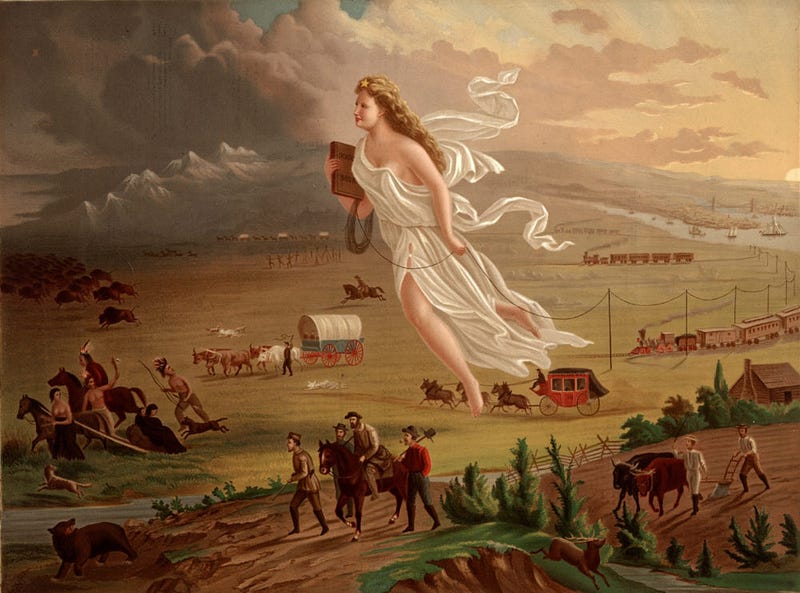
Freedom is paramount. The freedom for humanity to explore the cosmos, to be challenged, to be tested and in the process be made strong and resilient. Utopia isn’t a place, it is a state of mind. For Asimov, like so many writers of the Golden Age, the Manifest Destiny of mankind is to be among the stars and this is the Manifest Destiny of America.
Yet when we look at John Gast’s painting a warning sign is clearly included within this constructed vision and version of American ‘progress’. Columbia, the female figure of America, leads Americans into the West and into the future by carrying the values of republicanism (as seen through her Roman garb) and progress (shown through the inclusion of technological innovations like the telegraph) and clearing native peoples and animals, seen being pushed into the darkness. Genocide and extinction has never been so clearly foreshadowed.


