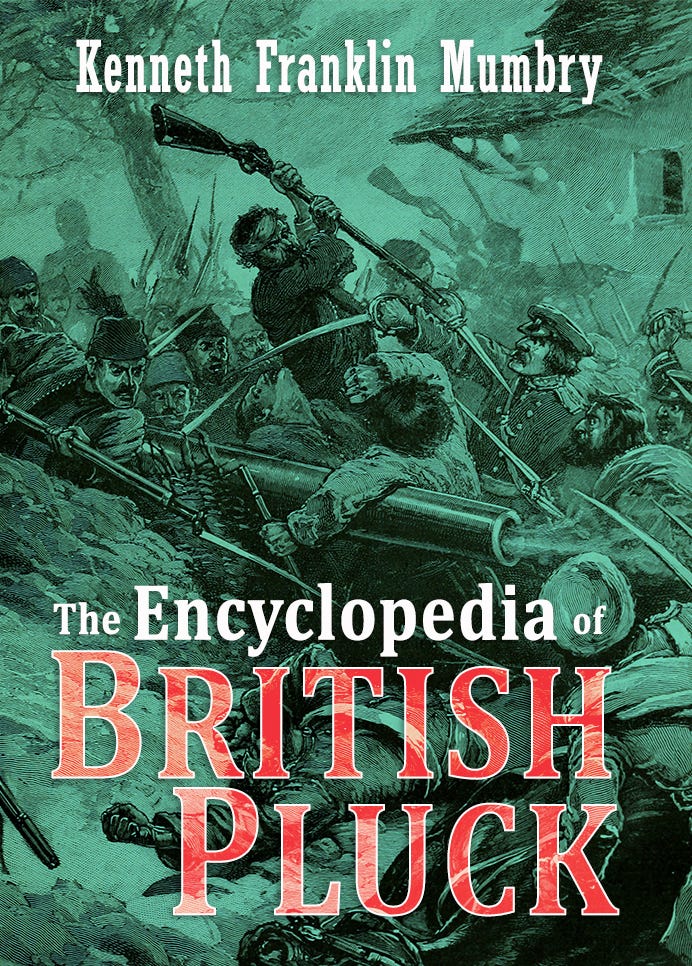
‘The Encyclopedia of British Pluck’ by Kenneth Franklin Mumbry
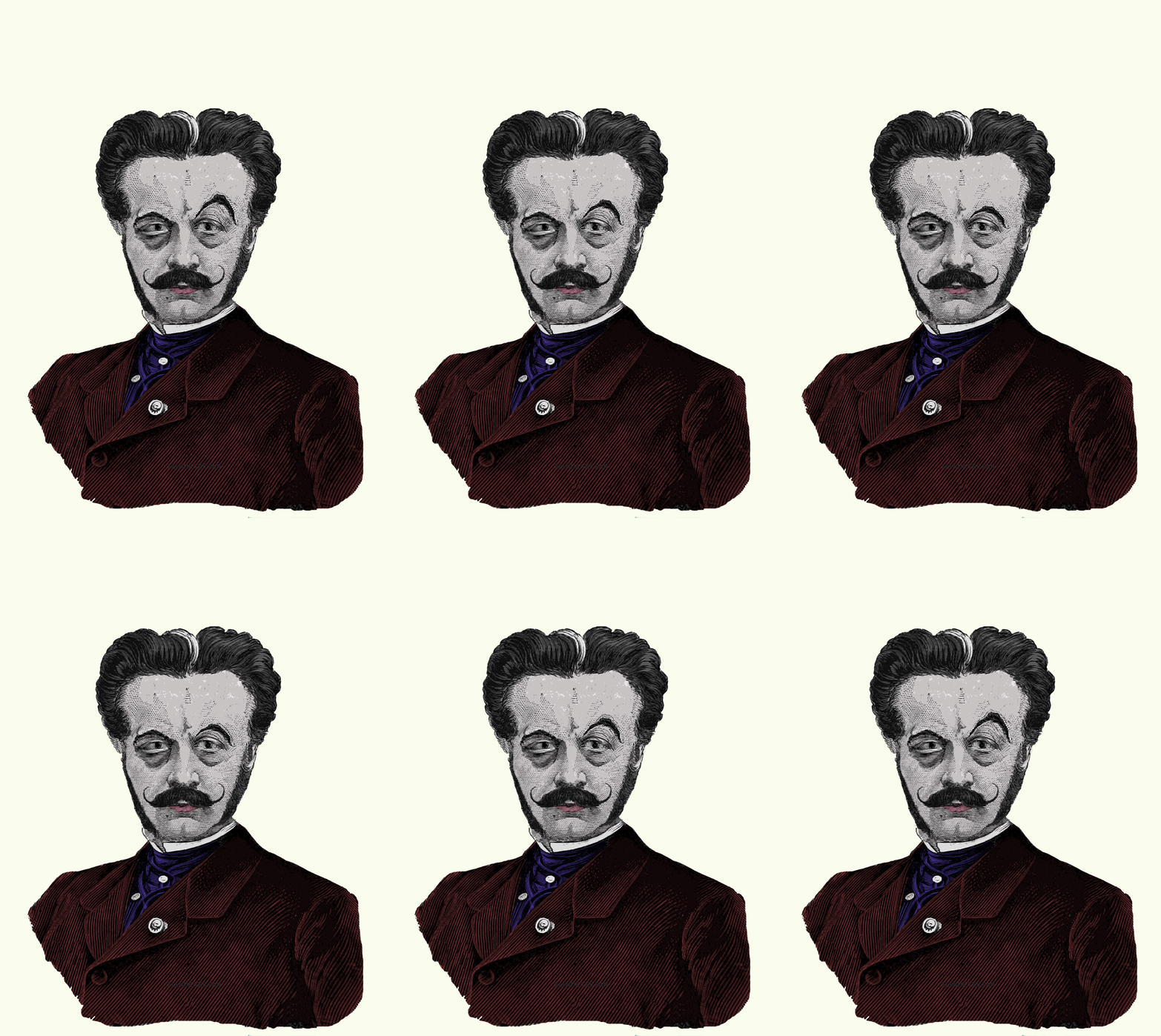
Captain Gordon Grapeshot
Gordon Hilary Genghis Khan Grapeshot was born in Nympsfield, Gloucester in 1850.
He was the only child of the famous war hero, Colonel Beaumont ‘Hell’s Teeth’ Grapeshot, the darling of the Fighting 51st of Foot, known as the Tartan Prancers.
Lauded for his part in the First Anglo-Frisian Wars with the 2nd Battalion, Beaumont famously manufactured a trebuchet in the face of overwhelming odds, raining down wheels of flaming Gouda on the advancing Frisians.
Loved by his men, feared by his enemies, Beaumont was a mighty if distant figure to the young Gordon, who lived a wild and idyllic existence in the Cotswolds under the watchful eye of his bohemian mother, Persephone.
However, after she died suddenly when the hem of her gown caught in a cider masher, Gordon’s happy childhood was brutally cut short.
He was aged just eight.
So it was, under the behest of his father, and just days after Persephone’s funeral, Gordon was summarily sent to his Aunt Griselda who presided over Noose Hall, the chilly family seat in Grunnett, East Perthshire.
Griselda was fierce-eyed, cruel-mouthed, and intolerant, treating her young nephew little better than one of her beloved deerhounds, of which she had seven.
Indeed, if ever Gordon was in any way insolent or indolent, Griselda would have her butler, Snatters, beat the poor lad with a badminton racket while the old woman eyed him coldly through her lorgnette.
Of course, being a Grapeshot, this only served to manufacture a defiant streak in the thrusting, young man.
And with his father as inspiration — who was still fighting overseas — Gordon would continue to break his aunt’s numerous rules if it suited him, either finding ways to avoid punishment or taking it with an impertinent smile.
But then — more bad news.
A letter reached Noose Hall that Gordon’s father had finally run out of luck.
He had been killed by a rogue firework in the Second Tea Leaf Wars.
Adrift and grief-stricken Gordon immediately ran away, spending a brief period with some urchins making besoms.
He was once quoted as saying: ‘This was one of the most joyous periods of my young life,’ finding the transient existence of these raggamuffins suited his sensibilities.
But it wasn’t to be, for a policeman spotted him wearing a head scarf and dancing in Dungunnie Hall’s Town Square with a tambourine, and he was hauled back to Noose Hall.
Locked in the cellar for over a week as punishment, Gordon found his only comfort in a necklace made of cockle shells given to him by a young urchin girl, and a squeeze box he made from a bellows pump he found in an old coal scuttle.
Nevertheless, eventually, he was finally allowed out of the filth and darkness to resume his duties and position.
And from there, it was all a matter of waiting.
The young Gordon’s ambition was to follow in his father’s footsteps and make something of himself in the military. And when it emerged that Aunt Griselda had squandered more or less all of the family fortunes on the Begonia Mania of the late 1850s, Gordon finally left the family seat at the age of eighteen, quickly passing his exams and joining the Prancers as his father had done.
Just three days later he had word that Aunt Griselda was also dead. Noose Hall had burned to the ground when her lorgnette concentrated the sunlight while attending to her begonias in the solarium and caught one of her deerhounds alight.
It seemed that Gordon’s riches were no more.
Not that this stopped him from amassing a fortune in other ways.
Having secured himself a commission as a lieutenant, he began his life as a young army officer, plunging head-first into the Anglo-Turkic wars.
Here he was famously awarded the Gallantry Cross for Exceptional Ingenuity in Battle after saving several officers in the face of a manufactured rockslide by employing the dance moves he had learned as an honorary urchin.
From there he led a relatively unblemished career, being present at the Timorese Revolt, and attaining the rank of Captain during the Battle of Orford Field. He won praise and more accolades for his part in Perkins Nose, until finally he left his service with his trusted batsman, Billings, and they embarked on numerous adventures together all around the world.
Here, there and everywhere, they made money and lost it; found loves and left them behind, cementing Captain Grapeshot’s reputation as one of the greatest lovers and fortune hunters of The Age.
His expeditions into the interior of Africa became legend.
His treks throughout the Americas were spoken of in admiring whispers by even others of his profession.
And his journeys throughout the Himalayas, India, and even as far afield as Tasmania, were pored over in ‘Fizz & Froth Quarterly’ at home, and abroad across the far-flung corners of the Empire.


