
The Empty Promises of Kanye’s Stem Player

Last Week, Ye announced that his highly anticipated follow-up to Donda would be released exclusively on ‘Stem Player’, a product developed by YEEZY TECH. The product offers a fun and innovative way to engage with music through its ability to isolate elements of songs and have users create their own remixes.
“I turned down a hundred-million-dollar Apple deal. No one can pay me to be disrespected”, Kanye said in an Instagram caption. Kanye directly called out Apple and other streaming services for taking a lion-share of artist’s profits through streaming models, and the stem player is his proposed solution. Kanye’s mention of Apple in the post seems fitting, as the stem player device looks like something designed straight from an Apple handbook; a simplistic, playful and innovative device that markets itself as a “New way to experience music”.
One of the fundamental ways Apple has historically sold products is by selling a value. People don’t tend to buy Apple products because of their exciting features, but because they like the idea of Apple. Apple products have a reputation as being for the ‘innovators’ and ‘creative-types’. It’s no secret that Kanye takes great inspiration from Apple’s tight-knit branding, referring to himself as the “Steve Jobs of popular culture”. Take one glance through the @stemplayer Instagram account and you’ll come to understand that it is also trying to sell you on values. One post caption says: “Skeptics can doubt the power of the people. And say that they ‘won’t get it.’ But that’s only because they didn’t have the tools. Until now. When the people have control — the world can finally change.” The confusing part of the device’s marketing is what any of this means, and how this ideology actually relates to the device.
The main boggling aspect of the Stem Player marketing comes from this post:
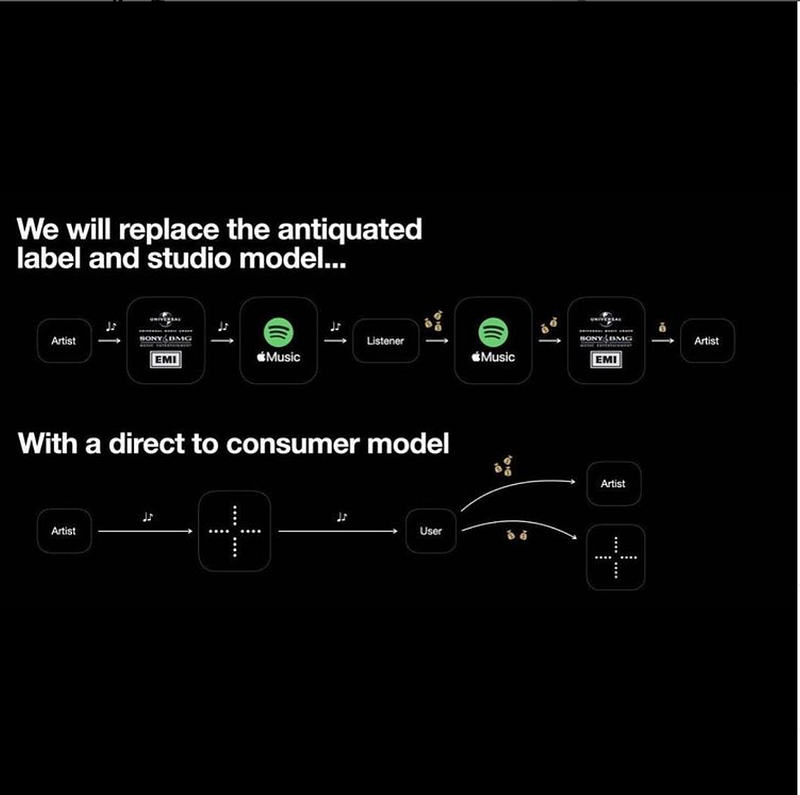
There’s a lot to be confused about by this Instagram post, and this confusion is reflected in the comments. One comment by user @joelkeithparisoe reads: “Direct to consumer is live, all music is. Spotify used Direct-to-fan when they first started”, and he’s right! It has always been possible to upload your music directly to Spotify without being signed to a label. Is this just a smoke screen to swindle users into buying a glorified £200 mixing device under the guise of financially liberating artists? Does this post exist simply to market an ideology of the stem player ‘being on the artists side’ against mega corporations such as Spotify? If any other billionaire mogul such as Jeff Bezos were to prop up this idea, people would immediately take the view that he was offering empty promises to increase his own profits.
I urge you to take the mindset of a Kanye fan and consider a charitable interpretation of his actions here. Kanye has a vested interest in artists seeing more of the profits from their music, mainly through the fact that he himself would benefit from this. Spotify pays artists an insanely low $0.003 per stream. Compare that to the pre-streaming era in which consumers had to commit to purchasing an entire album if they wanted to listen to their favourite artists music, and you can see why Kanye would want to shape a future in which artists are paid what they are worth.
So how exactly would the stem player fit in to all of this? It’s ultimately unclear — but from this post we could infer a few ways in which it could alleviate the problems caused by streaming models. Here’s a version of the post I’ve made that would compare a ‘direct-to-consumer’ Spotify model with the direct-to-consumer model proposed by the stem player:
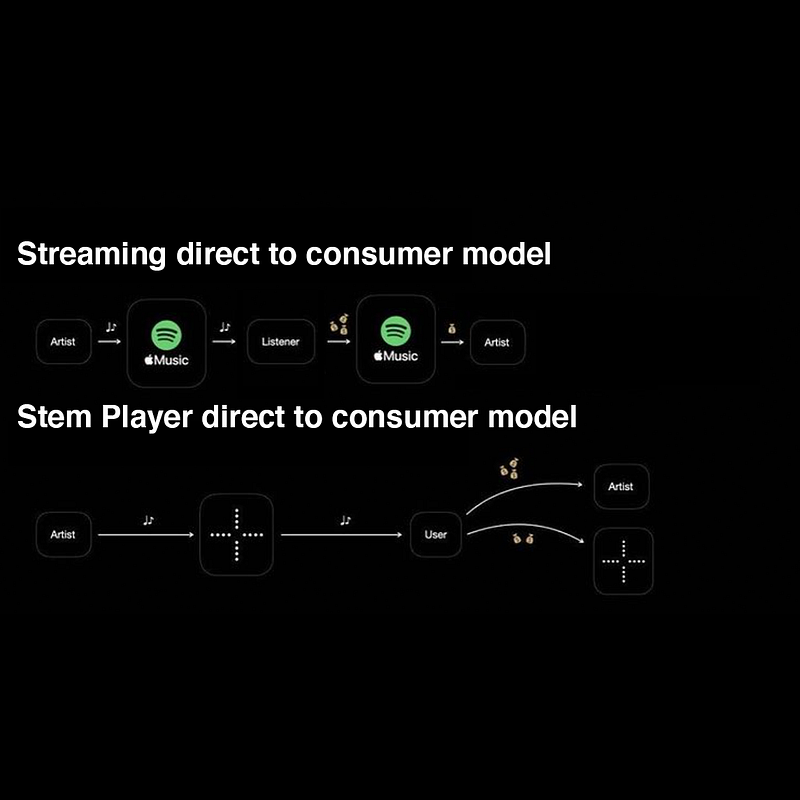
Now that we’ve got an even playing field between the models, we can see there are a couple of essential differences between them. The first essential difference is that the listener gives their music directly to Spotify in their direct-to-consumer model, and then they take the pie and leave the artist with the crumbs worth $0.003 per stream.
In the Stem Player model, it seems that the only way in which the company itself makes profits is through people purchasing the product itself and likely through customer data. The user would then buy an album to play on the stem player through which the artist would ideally see most of the profits.
This model rings some alarm bells. Isn’t this just reverting back to pre-streaming services mp3 players? The only thing that separates the stem player from a traditional mp3 player is the ability to remix your songs. Admittedly, it would be great if consumers had access to high quality individual stems of projects upon purchase of albums and songs through the stem player. But as of now, unless you are remixing Donda or the upcoming Donda 2, you are required to use a web converter which does a subpar job of isolating each musical element. Even if the plan is to offer high quality stems, this seems to me a feature that will only keep the prolonged attention of a niche market of DJs and music producers and can’t create enough demand for the average consumer to give up their cheap and easy streaming subscriptions to listen to music solely through a £200 dedicated device.
I think the way in which Ye intends the Stem Player to solve the problems of streaming is comparable to ethical clothing brands. While it’s fantastic that they offer a clean and guilt-free way to buy clothes free from exploitation, as long as people can’t justify spending £30 on a t-shirt, they continue to purchase fast-fashion. In the same vein, while purchasing a stem player would provide users with a way to listen to music in a way that supports artists, so long as it is more expensive and more inconvenient than Spotify, artists will still get exploited.
But what do I know? As Scarface so exuberantly declared in Act 1 of Kanye’s new documentary Jeen-Yuhs, “That goddamn Kanye be pulling rabbits out the hat, man!” Kanye certainly has a knack for fighting the odds and achieving the impossible, and maybe the Stem Player will pan out to be another success story in Ye’s roster. But for now, more is needed to sell me on the idea.


