
How to Conquer Your Blind Spots
The Elephant in Your Life.

“The greatest deception men suffer is from their own opinions.”― Leonardo da Vinci
What we see clouds our judgment; what we don’t see bias our behaviors.
Six men in a village went to observe an elephant. It was their first time — all of them were blind.
“It’s a pillar.” said the man who touched the elephant’s leg.
“No, it’s like a rope.” — said other after touching the tail.
The blind men began to argue; everyone believed he was right. After observing the elephant, the rest thought that it was either a snake, spear, hand fan or branch.
A wise man who was passing by calmly explained: “You are all right. Everyone noticed something different because each of you touched a different part; the elephant has all the features you all said.”
Our reality is like the elephant in this Indian parable: everyone observes parts of it. That’s why others can see aspects of yourself that you are missing.
The problem with blind spots is that you don’t know what you don’t know.
To get the whole picture of who you are, you need to consider other people’s perspectives, not just yours.
The Elephant in Your Life
“What the human being is best at doing is interpreting all new information so that their prior conclusions remain intact.” — Warren Buffet
Your blind spots might not be noticeable, but they are anything but small.
Carl Sagan said: “The absence of evidence is not evidence of absence.”
Wrong perceptions can lead to misinterpretations. Your assessment of your behaviors is limited by what you don’t know. However, your blind spots are always visible to others.
What you don’t know you don’t know gets you into trouble.
Former U.S. Secretary of Defense Donald Rumsfeld famously referred to the “known knowns,” “known unknowns,” and “unknown unknowns.” The first two are easy: you have clarity on both what you know and on what you need to find out.
The “unknown unknowns” are your blind spots. It’s hard to acknowledge that, regardless how well you believe you know yourself, you are clueless about some of your traits. Increasing self-awareness is critical to see your whole picture. Not realizing what you don’t know drives confusion.
Delusion creates delusion: that’s why we keep lying to ourselves.
Your blind spots are the inner-space from where you operate. Some call it the “inner bias;” deep inside, you might refuse to acknowledge what you don’t like (but know) about yourself.
For example, people often think they’re talking to each other when they’re really talking past each other. The more we talk, the better we feel. This blind spot is created by reward hormones that are released when our bodies feel great. That’s why we keep talking without noticing that others get frustrated when we interrupt them.
Address the elephant in your life. Challenge the notion that you know yourself well. There’s always room for surprises.
Not All Blind Spots Are The Same
“Getting rid of a delusion makes us wiser than getting hold of a truth.” — Ludwig Borne
Most blind spots are based on assumptions.
We believe that we know ourselves better than we actually do. We overrate or underestimate others. We miss understanding the impact we have on other people, or the one others have on us.
Understanding the four main types of blind spots will accelerate your discovery journey.
1. Knowledge blindness
This cognitive bias occurs when people of low ability suffer from ‘illusory superiority.’ The Dunning-Kruger effect is the inability to evaluate our own competence objectively— think of a test, sports match or interview. We mistakenly assess our cognitive ability as more fabulous than it actually is.
Knowledge blindness makes you feel overconfident until others prove you wrong.
2. Beliefs blindness
Of the many types of faulty thinking, confirmation bias is the most deceiving. Your brain mostly registers the information and evidence that supports your core beliefs. If you think that global warming is for real, you will either discard or ignore any information that doesn’t match what you think. Beliefs encourage you to take sides, rather than to ‘see’ what you are missing, as I wrote here.
Your beliefs are a tainted lens: they cloud everything you see.
3. Emotional Blindness
Emotions can cloud your perception — both what you feel about what you are afraid of feeling. If you hate your boss, you will never learn anything from her/him. What you feel expresses part of yourself, but they don’t have to define who you are or your behaviors. You are not your emotions.
Your emotions make you focus on one aspect of reality.
4. Thoughts blindness
There’s nothing wrong with thinking. The issue emerges when you look ‘from’ your thoughts — they cloud your judgment. Believing that you are always right is living in denial. Being judgmental about yourself plays the same deceiving effect.
Your thoughts can eat you alive if you don’t stop them from taking over.
When you overestimate your abilities or only pay attention to the information that matches your beliefs, you become a victim of your blind spots. If your emotions or thoughts take over, you can’t address the elephant in your life — you don’t know what you don’t know.
Open The Window, Set Your Blind Spots Free
“The real voyage of discovery consists not in seeking new landscapes, but in having new eyes.” — Marcel Proust
Realizing what you don’t know requires both self-discovery and external feedback.
Your blind spots lie at the intersection of how you perceive yourself and how others perceive you. That’s precisely what ‘The Johari Window’ helps uncover. This tool was developed by Psychologists Joseph Luft and Harry Ingham to help you understand what you are unaware of.
Don’t let the simplicity of this model deceive you. I’ve applied it various times when coaching teams to increase both self and team awareness. The Johari Window exercise is potent — it uncovers the gap between the team’s realities and everyone’s assumptions.
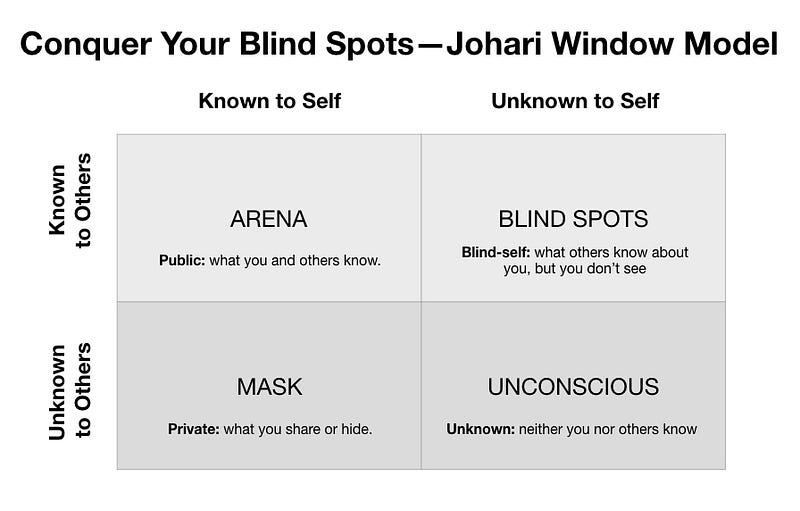
ARENA: Traits and behaviors that both yourself and others are aware. It includes anything about yourself that you are willing to share. This area drives clarity and builds trust.
MASK: Aspects about yourself that you are aware of but might not want others to know. It can also include traits that you are not sharing with others without you being aware. What you show to others is a mask that hides your authentic being as I wrote here.
BLIND SPOTS: What others perceive, but you don’t. Important to note: not valuing your strengths can also be a blind spot. Feedback from others can make you more aware of your negative traits but also of the positive ones you are missing.
UNCONSCIOUS: What’s unknown to both you and anyone else.
Though this matrix has four quadrants, the size of each is not necessarily equal. The openness of each window pane will vary depending on:
- How much you share with other people
- How well others (try to) know you
- How well you know yourself
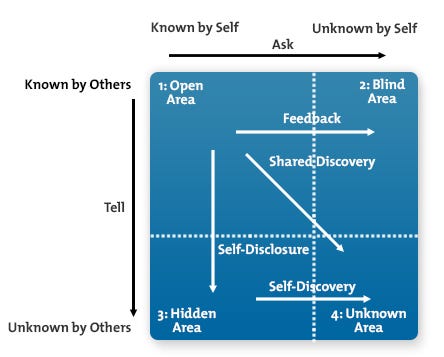
You can expand your “Arena” area by:
- Disclosing more about yourself, thus reducing the “Mask” area
- Uncovering more about your “Unconscious” area
- Becoming aware of your “Blind” area
Others’ feedback is the most powerful way to uncover your blind spots.
Do you get defensive when someone asks you something personal? Do you tend to interrupt people before they have finished making their point? Are emotions clouding your ability to make decisions? Do you regularly get caught by self-criticism?
Sometimes you don’t realize your behaviors unless someone tells you.
You can also uncover your blind spots through a shared discovery — question your assumptions and invite others to do the same. Challenge how well you know yourself.
A Simple Exercise to Uncover Your Blind Spots
“Appearance blinds, whereas words reveal.” — Oscar Wilde
Write five words that describe you.
Ask nine people to do the same (3 family members, 3 co-workers, and 3 friends).
Compare the answers with your own assessment:
What are the similarities? What are the differences?
What are the things that you like about yourself but others don’t notice?
Is there something that you like about yourself that others hate?
How do opinions from family and co-workers differ from each other? What does that tell you about how you behave in different environments?
What surprised you about everyone’s feedback? Why?
Your blind spots are the elephant in your life. You know it is in the room, but you prefer not to confront or talk about it.
Self-awareness is a never-ending journey. When you believe you truly know yourself, you become blind — as it happened to the villagers. Observing one part doesn’t mean that you understand the whole ‘animal.’
Your emotions, thoughts, beliefs and what you know can get you into trouble. Use feedback — both solicited and unexpected — to challenge your assumptions.
Address the elephant in your life; conquer your blind spots.
Gustavo Razzetti is a change instigator who helps purpose-driven organizations create positive change. He advises, writes, and speaks on team development and cultural transformation. Follow Gustavo on LinkedIn, Twitter, or Medium.


