The Eight Stages of Death
Have you ever wondered what happens after you die, or even what happens as you are dying?
Death is a Difficult Topic for our Materialistic Society
Perhaps not. Death is not a popular topic of discussion at cocktail parties or social gatherings.
Who wants to be reminded of the grim reaper when we’re still young and alive, or maybe even old and alive?
In many ancient cultures death was seen as a natural part of life, and not to be feared as it is in our modern materialistic society.
Science has disproven the literal interpretations of our religions, so many people take that to mean any belief in a non-material or spiritual reality is hocus pocus.
A lot of my previous articles have debunked this materialistic worldview, in particular my two-part series entitled, “The Myth of Materialism” and my latest two articles entitled, “What is Reality?” and “Death and the Pure Mind”. I don’t want to rehash that content again, so if you are interested, please check them out.
Those ideas, supporting a non-materialistic view of life, are important because if you do believe there is something beyond the physical world, and that we already inhabit those realms unconsciously, then you might also be interested in becoming more conscious of those realms by studying the eight stages of death outlined in The Tibetan Book of the Dead.
We Have Experience Going Through the Stages of Death
We do have some familiarity with these stages since we go through them every night when we fall asleep and enter into deep dreamless sleep.
The information on the eight stages of death comes from people who have gone through these eight stages consciously and reported back their experiences.
We can even go through them while alive. I gave a couple of quotes to that effect in my last article, “Death and the Pure Mind”.
Plato himself said the purpose of philosophy was to die before you die.
Another quote I used was:
“If you die before you die, then when you die, you won’t die.”
So, why wait until you die, to die?
The Stages of Death are Just a Template
To help us accomplish this goal, I wanted to briefly outline the eight stages of the dying process.
This should be seen as a road map for our journey. It’s a framework, a template we can use as we or a loved one moves through the dying process. It gives some idea of what to expect.
We are advised not take these eight stages too literally. In other words, don’t expect your death experience to follow these eight stages exactly. One thing I have learned in studying this material is you must be flexible.
Use the eight stages as a guide, but also let your death experience unfold as it will. To fight it because it doesn’t exactly match the eight stages will only make your death experience more difficult.
I will give you a brief outline of the eight stages. There is so much more detail to these stages than what I am presenting here, but I don’t want to overwhelm with too many details. The idea here is to give a brief taste of the process.
The Three Bodies of Tibetan Buddhism
Before I begin, I want to cover briefly the three bodies or Trikaya of Tibetan Buddhism. They are the outer gross physical body, the inner subtle body and the very subtle body which is the state of pure awareness.
The first five stages of the dying process focus on the dissolution of our gross physical body and the five senses. We lose one sense in each of the five stages. As an overview, we lose, sight, sound, smell, taste, and touch in that order.
The last three stages of dissolution occur in our inner subtle body, leaving us residing in the very subtle body of pure awareness, the end state of our journey.
Just to be clear. I have not traversed these stages myself. I am just reporting what The Tibetan Book of the Dead reports.
The Eight Stages of Death
So let’s start.
Stage 1: Earth Dissolves into Water.
At this stage the naval chakra dissolves
Our sense of sight ends as images become blurry. Since the visual cortex is not accustomed to seeing nothing, it creates hallucinations to stay active
In addition, our body loses strength and it might be hard to keep our eyes open. The body feels like it is melting from solid earth into liquid water.
Stage 2: Water Dissolves into Fire
At this stage, the heart chakra dissolves. It gets harder to hear as that sense dies.
We lose control of our bodily fluids. Our noses run and we become incontinent.
At first, we feel like we are immersed in water, then everything dries out.
Our inner vision is of being in a hazy smoke filled room We feel internal heat.
Stage 3: Fire Dissolves into Wind
The smoky inner vision gives way to visions of flashing lights, like groups of fire flies flickering on and off.
The throat chakra dissolves, and our sense of smell deteriorates
At first we feel hot and feverish and then cold. The mouth and nose dry up completely
Stage 4: Wind Dissolves into Space Consciousness
The root chakra dissolves. Our sense of taste disappears and our breathing becomes labored with more emphasis on the exhale, as if returning our breath to the cosmos.
It is here we get the “final breath”, then silence. This is a profound moment, particularly if we are with someone going through the dying process. Now the person is clinically dead and unaware of the outside world.
Inwardly, however, there is the glow of a candle flame. One’s vision is filled with it. We are advised to let ourselves melt into it.
The point to keep in mind, as we go through this entire process, is to flow with it, don’t fight it. Allow ourselves to melt into the glowing candle.
Our internal awareness is now at its strongest. It’s like being in a sensory deprivation tank. Our dualistic mind of the inner and outer worlds is gone. Now only the inner remains.
Stage 5: Space Consciousness Dissolves into a Luminous Space
The inner vision is of bright moonlight. It’s not like you are floating in a body observing it, you are it. No duality between subject and object.
Here, the crown chakra dissolves and the sense of touch departs.
We only have our mind to relate to now because there is nothing else. It’s an enforced meditation that leads us to non-duality.
That completes the dissolution of our physical body. We now move to our inner subtle body for the final three stages of the process.
Stage 6: The Luminous Dissolves into Radiance
The bright moonlight becomes orangish or reddish like a cloudless sky flooded with sunlight. It’s very bright. It’s so bright we can’t bear it and this leads to the next stage.
Stage 7: The Bright Light Dissolves into Darkness
To escape the brightness of the light, we retreat into darkness and very likely lose consciousness if we are not trained in this process.
This is the state of deep dreamless sleep in which we are normally unconscious. This is the “nothingness” that many believe is the end state of death, but it is not the last stage.
Stage 8: The Darkness Dissolves into Transparency
The darkness gives way to clear light. This should not be confused with the bright light from earlier.
Clear light is a merging of the dark and the light which gives way to transparency.
Here the energies of the subtle inner body dissipate, leaving us in the very subtle body of pure awareness.
The End State
This is the end state, and if we have remained conscious throughout this whole process, we will have attained enlightenment.
There are many practices to train you to move through this process consciously. Google it online. Andrew Holecek and Robert Thurman are two good names to start with. In addition, I highly recommend reading The Tibetan Book of the Dead and Andrew Holecek’s Dream Yoga to get you started. If you decide to explore this further, let me know how its going. Good Luck!
To learn more: Click this link: The Magical Universe.
Also you can visit my website and sign up for my email list: https://www.bruce-mcgraw.com/
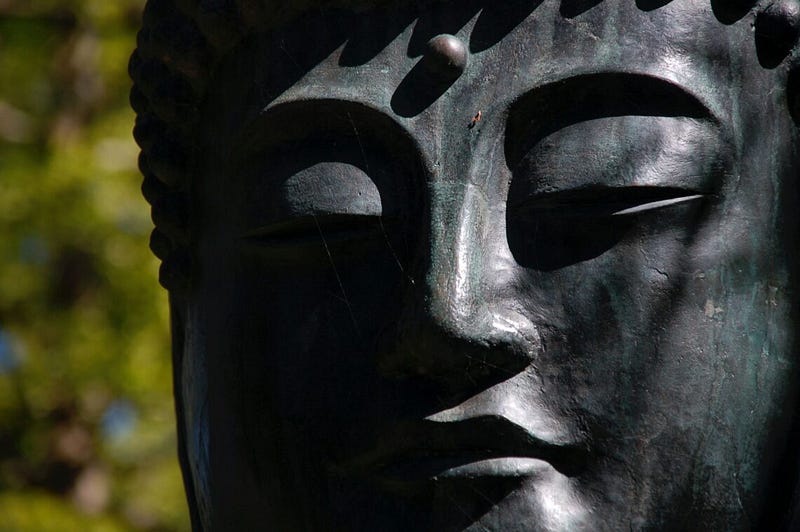
Photo by Thomas John on Unsplash
Originally published at https://www.bruce-mcgraw.com.


