
The Economics of Star Trek’s Replicators
The November 2023 writing prompt for the Make It So publication asked which Star Trek technology would I like to have in my life. I immediately thought of the replicators (faster than light travel is a fascinating concept, but what am I feasibly going to do with a warp drive bolted on to my 2014 Toyota Corolla?). That said, the impact of this technology changes depending on whether this is a device that only I have access to or whether it’s an invention that’s set loose upon the entire world.
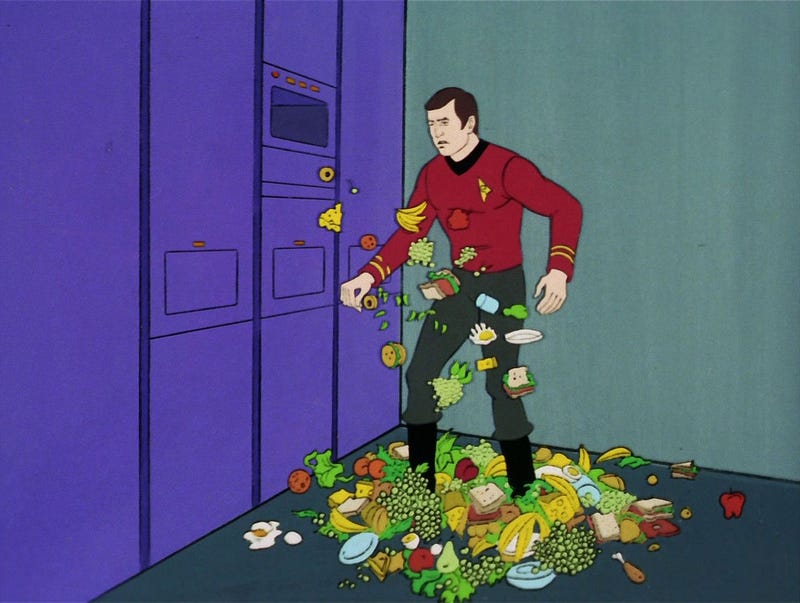
Certainly, if I had a personal replicator, my individual life changes immediately. I can replicate all the food and clothing I want. I would never have to pay for any material possession again and even if I did, replicating solid gold bars would quickly cover any cost.
But if replicator technology was invented today in 2023, it’s hard to think of any other event that would so profoundly change life on Earth as we know it.
Star Trek has always been vague about what the replicator can’t create. There are certain materials (latinum for example) that cannot be replicated. But there’s nothing to suggest that a replicator couldn’t replicate the parts to manufacture more replicators. So once one replicator exists, it’s likely that it could create as many replicators as there are people. The only limit would be the energy cost. But given that in the Star Trek universe, it’s possible to use dilithium crystals and antimatter reactions to propel enormous metal starships many times faster than the speed of light, it’s likely that the energy costs for mere replicators are relatively inexpensive.
So what’s the first thing that happens if everyone has a replicator. Well, suddenly no one has to pay for food. Which would seem to be bad news for the farmers. But the farmers themselves would also have replicators and wouldn’t need to pay for their food or clothing or any material objects either.
If everyone’s food and clothing costs are now essentially free, what other necessities do we have to pay for? Shelter? Star Trek has mentioned “industrial replicators” so presumably replicating whole buildings is also possible.
Now the only limit to housing is property, i.e. the actual land that the newly replicated structures will need to stand on. It’s possible to imagine political parties completely altering their approach to housing. Since it would be essentially free, you can imagine the politicians falling over themselves to pivot from arguing about whether the government should be involved in housing at all to how their party could offer the best kind of housing. “Vote for our party in all your congressional and parliamentary elections, they might say, and we’ll provide the best designed replicated housing in the most desirable areas.”
So if all of humanity’s basic needs (food, clothing, shelter) are being met by a single new technology, how does this change our day-to-day lives? This is presumably how the economy of Earth becomes post-scarcity in the Star Trek future. I have seen fans talk about the economy of the Federation as post-capitalist or as a socialist or communist utopia. I tend to stay away from such direct labels, simply because we see so little of actual civilian life in Star Trek. An overwhelming majority of stories take place in a military or quasi-military setting. To me, it would be like showing aliens a bunch of WWII movies and then asking them to determine the economic conditions of Iowa in 1943.
But certainly the change in day-to-day life would be colossal. If peaceful alien contact were made this afternoon, it would be a huge change in the way humanity thought of itself, perhaps the biggest change in history… but you still have to go to work in the morning and come up with the rent money by the first of the month. With the replicator, you literally don’t even need to do that, unless of course your job is to be one of the people in charge of the replicators. But then, why not just quit that job and stay at home eating replicator cheeseburgers, wearing replicated clothes and watching Doctor Who on your replicated TV in your replicated house?
Why people would choose to have mundane jobs or even careers in such a world is something that Star Trek itself has shied away from. It mentions a future with no money but never gets close to explaining or showing how this would actually work. Who would subject themselves to a job peeling potatoes without the lure of money?
Economist Manu Saadia discussed this question in his book Trekonomics. While much of that book is devoted to the theories around post-scarcity economics, his assertion is that respect and status is the currency of the future. People join Starfleet not because they need to pay off their student loans, but because Starfleet is a respectable and respected profession. People work in Joseph Sisko’s New Orleans restaurant not because they need the tips, but because working with real, non-replicated food is interesting and exciting. People dine at his restaurant not because they need to, but because they want to be seen as the sort of person who is able to get a reservation in a world without money.
Star Trek as a franchise has shied away from going into details into how profound the replicator changed life as we know it. This is perfectly understandable because this ultimately is an action-adventure show more interested in smaller, individual stories than larger world-building. But personally, I’d love to see us wake up tomorrow in a world where hunger, clothing and shelter were no longer a problem for anyone here on our Earth.