
The Echoes of Omegle: Reflecting on Our Divided Digital Landscape
As the virtual doors of Omegle close, a platform that once promised connection among strangers, I find myself contemplating the fabric of our digital society. During my time on Medium, I’ve been embraced by a community rich in empathy and support, where writers champion each other’s work with a curiosity that transcends mere readership. This camaraderie, this digital fellowship, represents the utopia I had envisioned for the internet — a global village knitting together the best of humanity.
Yet, my optimism, which I once wore like a badge of honor, feels tinged with naivety. I dreamt of a world where the internet would be a crucible for collaboration, where an American vision could merge with Indian engineering, be refined by Ukrainian data science, and brought to life by Chinese manufacturing. A world where geographical distances would shrink in the face of shared human intellect and creativity. I imagined a place where knowledge was a panacea against the closed doors of dogma, where local manipulation would crumble before the might of accessible information.
Leif K-Brooks, Omegle’s youthful founder, seemed to share this dream. He envisioned the internet as a wondrous expanse, a digital frontier that offered boundless exploration from the confines of a small town. It was a place where intellectual quests weren’t hindered by physical walls — a space that nurtured growth and rounded the sharp edges of isolation.
“From the moment I discovered the Internet at a young age, it has been a magical place to me. Growing up in a small town, relatively isolated from the larger world, it was a revelation of how much more there was to discover — how many interesting people and ideas the world had to offer. As a young teenager, I couldn’t just waltz onto a college campus and tell a student: “Let’s debate moral philosophy!” I couldn’t walk up to a professor and say: “Tell me something interesting about microeconomics!” But online, I was able to meet those people, and have those conversations. In short, the Internet opened the door to a much larger, more diverse, and more vibrant world than I would have otherwise been able to experience; and enabled me to be an active participant in, and contributor to, that world. All of this helped me to learn, and to grow into a more well-rounded person.”
But as Omegle succumbs to the darker tendencies of social platforms, it signals a worrying trend — the fragmentation of our online universe. In a time when the world appears more polarized than ever, with sharp lines drawn by regionalism, religious zealotry, and political fervor, the dream of unity feels like a distant whisper.
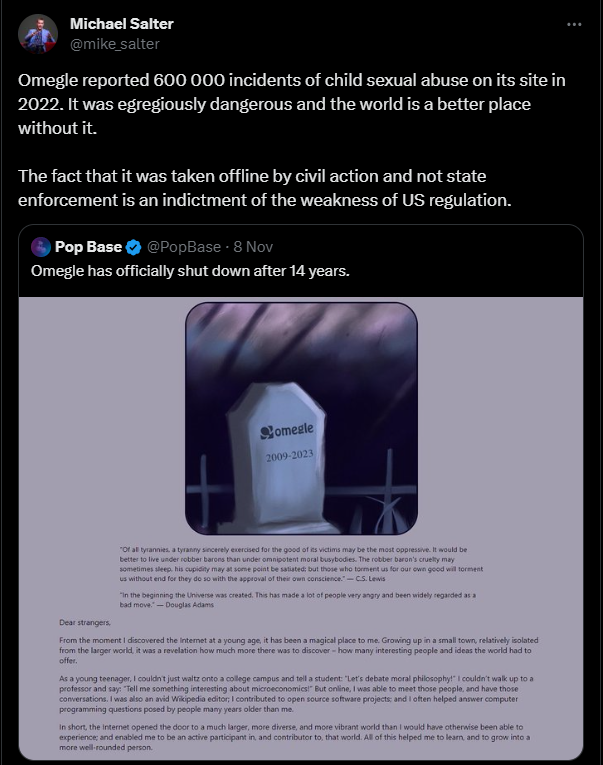
How do we reclaim the internet for the “good people”? How do we forge a global community akin to Medium, where ideas flourish in the fertile soil of encouragement, curiosity, and respectful discourse? The risk, as K-Brooks penned in his parting words, is that the internet could morph into a glorified television — sterile, passive, and devoid of the human touch that once made it magical.
“I worry that, unless the tide turns soon, the Internet I fell in love with may cease to exist, and in its place, we will have something closer to a souped-up version of TV — focused largely on passive consumption, with much less opportunity for active participation and genuine human connection.”
I choose to stand with hope, perhaps naïvely, but steadfastly. The belief that benevolence outweighs malice, that the silent majority can drown out the cacophony of hatred with a symphony of voices championing diversity and unity. It is our task to find our collective voice and support those who carry the torch of hope and human diversity. Let us not mourn the loss of Omegle as the end, but as a clarion call to action — to build a more connected and empathetic digital world, with or without Omegle.