
The Earth Is Not Here to Serve Us
On Edward Abbey, the Yucca and Her Moth, and Our Place in the World
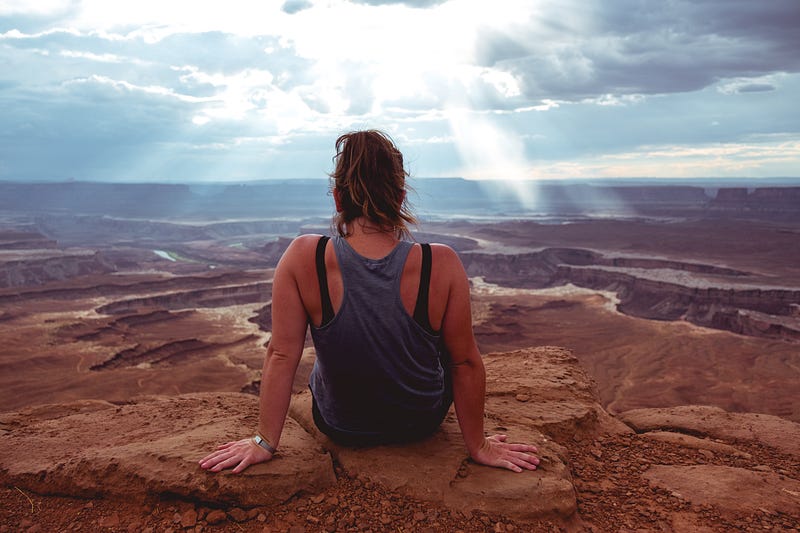
“The Grand Canyon has brought people to their knees, made writers poets, and painters artists. Looking around leaves me in awe, in heartbreak, in joy, in beauty. And yet, I also find myself without words — how to describe this place, our time here. A poet’s fingers are not in my hand and yet I can feel words, dying to spill onto paper, but never quite getting there.”
River Journal, Day 5
A Love Affair
A Paradox
“Paradox preserves mystery, and mystery inspires belief.” — Terry Tempest Williams
We may never know the complete magic of the wilderness, the miracle that is desert and canyon and river. You do not know desert until your lips are so chapped you cannot feel the water being poured over them; until you’ve got seven miles to your nearest water source and both your bottles are empty; until your arms and legs are dripping blood from cactus spines, and still you can look out at the arid and desolate land and see the abundance that lives, grows, and thrives there. Similarly, you do not know a river until you’ve swum it’s rapids; until you’ve run a rapid without letting your oars in the water, trusting that the river will take you to safety; until you’ve let the river wash you clean. Even then you know nothing for certain. Wild and untamed. Possibly, probably life-affirming.
The desert can also induce fear — scorpions, bone-drying heat, cactus spines, and an unknown water source, possibly miles and miles away. A desert then, is not a place to be known, not intimately. It is a place to be tamed and utilized; a place to demonstrate the sheer capacity of human will. Wild, untamed, possibly, probably life taking.
There are those who walk amongst us who believe in the preservation of the desert while still experiencing the fear it induces. In both awe and fear, we dance to the rhythm in our bones, the thumping, humming knowledge running through our very veins that we have been this dust before and we will become it again. The desert and its river are sacred, a temple worthy of veneration.
There are those who walk amongst us who believe in taming the desert and the roaring river it contains. To remove the wild from it in the name of human need and desire. To tame becomes both a method of conquering fear and providing for our kin. They ask how we could revolt against them when it is their work that puts water in our sinks and electricity in our homes. The desert and its river are profane, pure resource.
The desert is a paradox. Sustaining, life-providing, spirit-filled. Deathly, empty, bare. It exists as a stretch of red rock and river and canyon. It holds both to be true at the same time.
The desert is a paradox and so are we. We claim ownership of it without ever asking ourselves the question: Can something so alive, so wild, so magnificent, ever truly be claimed and is it really ours for the taking?
The Yucca and Her Moth
“John told us about the Yucca Polynesian Moth — an emblem of mutualism. They lay their eggs in the flower of the yucca and then pollinate the flowers all over. When the larvae hatch, they eat some but not all the seeds of the yucca plant. Ecologists often ask the question why one doesn’t exploit the other but as John says most of them are men who think human thoughts of competition and exploitation without realizing that or rather refusing to realize that mutualism and cooperation rule the animal kingdom.”
River Journal, Day 11
The glow of the campfire cast shadows dancing on the canyon floor. A harmonica hummed, the river rushed by, and the deep, red walls of the canyon darker than the night sky, rose around us. If we looked straight up in that narrow strip of sky been the walls, we could see more stars than we’d seen in our lives.
Jeff’s glasses reflected the fire back at us. A quiet, balding man who looked every bit the mad scientist as he hunched over his river notes. Connor, Matt, and Frank sat off to the side, staring intently at a board game we’d endearingly come to call ‘Math Teacher Beats You’ because at no point, could any of us beat Frank the Math teacher. The rest of us had curled up in our own seats, reading, writing, basking in the canyon night.
“Jeff?” I broke the silence as gently as possible and waited for his large, bug-like eyes to blink, look up, and re-focus on me. “Can you tell us about the Yucca moth?”
“You’re reading Desert Solitare?” I nodded. “It’s a truly beautiful species.”
We knew the tone in his voice, his storytelling voice. The board game paused, others set down their journals and books, and we gathered around Jeff and the fire like children. Jeff spoke, winding the story of the Yucca moth up to the crescendo of such beauty only a desert, wild and untamed could ever have a hope of understanding.
The Yucca moth looks remarkably similar to the Yucca flowers. Soft white wings greet soft white petals. The moth spends its life pollinating the yucca plant — and only the yucca plant. In other words, she ensures its survival. When it comes time for the moth to lay her eggs, she does so, leaving them in safekeeping with the Yucca plant. The plant, with long hard, sword-like leaves protect the eggs and even the larvae when they hatch. The larvae feed on some, but never all, of the developing seeds of the yucca plant and then continue on on their mother’s line — pollinating and leaving their own eggs in care of the yucca plant.
When Jeff finished with the story, he sighed. “Ecologists often ask why one doesn’t exploit the other but most of them are men who think human thoughts of competition and exploitation without realising that mutualism and cooperation rule the animal kingdom.”
With that, Jeff nodded and hunched his head back down towards his journal. Slowly, one-by-one, we returned to our respective nights of reading and gaming and journaling. The yucca moth haunted my dreams that night.
As humans, we have a lesson to learn from the yucca and her moth. How sweetly they care for one another, only taking as much as they need while giving everything they have. No exploitation. No competition. No, the yucca and her moth serve each other. So it has been for 40 million years.
Does the yucca moth know it is an emblem of the ways of the animal kingdom? Does the yucca know we wish we had a home that loves us the way the yucca loves the moth? Do they know they look alike — the home and her inhabitant? Soft and white. Would they care if they knew? Would they just keep going about their yucca and moth-like ways?
Now, you’ll tell me not to be so anthropomorphic. But maybe in being so, I can give the yucca and her moth a chance. In Desert Solitare, Edward Abbey writes, “Water, water, water...There is no shortage of water in the desert but exactly the right amount a perfect ratio of water to rock, water to sand, insuring that wide free open, generous spacing among plants and animals, homes and towns and cities, which makes the arid West so different from any other part of the nation. There is no lack of water here unless you try to establish a city where no city should be.” Their desert is disappearing in the name of human progress. Rivers dammed, homes built where humans take in excess, the desert is slowly falling to the will of humans.
The yucca and her moth keep on keeping on and I’m guessing that if they could talk, they’d ask us when we’ll leave them and their desert be. The wild and untamed belong to the Yucca and her moth, not to us.
Abbey’s Middleground
“There’s a sweetness to our own little group of wilderness lovers, of wilderness protectors, of ecological preservers. Each of us with our own love and desire to keep this place wild. Desert Solitaire has become a gospel of sorts, passed around the group, whispers of “have you read this yet?” or sometimes around the campfire “What does Ed have to say today?” as someone reads. We sit, listening with bated breath, to the declarations of Abbey.”
River Journal, Day 17
Rebel. Radical. Raucous. Troublemaker. Disturber of the peace. Such words were used to describe Edward Abbey by dam builders, national parks road builders, and really anyone who tried (and often succeeded in) developing the wilderness under the guise of progress. A man of firm ethics, Abbey knew how to stand on principle, to not waver in the face of an uphill battle, to encourage the preservation and conservation of the natural world.
Many have fallen in step behind him, following suit, quoting him like he was some sort of prophet. Even in my own Grand Canyon experience, Edward Abbey held authority. Desert Solitaire was passed around the group like gospel. Not uncommon would you hear someone say “What does Ed have to say today?” to whoever was currently reading it and they would read from wherever they were and we’d listen with bated breath. For a few on our journey, this was the beginning of their relationship with Edward Abbey. Rebel. Radical. Raucous. Disturber of the peace. Or so we had heard.
Or so I had heard but I’m not convinced such statements are so simple. Edward Abbey seemed a reasonable man to me. Prudent even. Surely, he had two feet, standing firm, unwavering, on principle but he also knew the importance of compromise.
I wonder what the Yucca moth thought of Abbey. Maybe she wouldn’t mind so much. A compromise of sorts. A peace agreement between the wild and humans.
In the development of National Parklands, Abbey was unwavering in his opinion. Don’t do it. Not for the sake of growth without cause. Don’t do it because wilderness is a human necessity. Don’t do it because the wilderness is sacred.
Sacred. A place, a space, an object, a being worthy of worship and veneration. Have you ever knelt in a church? Felt the grace of God fall before you? What about a temple? Have you knelt in a temple and felt the sweetness of the Lord? Now let me ask you this: have ever stood before a river, in a desert, on a mountain top and felt the same grace? If you had, would ever dare develop it?
Abbey writes, “We have agreed not to drive our automobiles into cathedrals, concert halls, art museums, legislative assemblies, private bedrooms and the other sanctums of our culture; we should treat our national parks with the same deference, for they, too, are holy places. An increasingly pagan and hedonistic people (thank God!), we are learning finally that the forests and mountains and desert canyons are holier than our churches. Therefore let us behave accordingly.”
He goes on. The lands that have already been developed? We can work with that. The asphalt is already in place, vehicles already dominate roads that used to be dirt and dust. We can work with that.
A middle ground can be met. Three steps.
One: Remove the automobiles and motorcycles. No longer give them access. People can walk, they can bike, they can ride horses, anything they want but no motors.
Two: No more new roads. They won’t be needed if the people aren’t driving.
Three: Get the rangers in the field and out of the office.
Abbey even offers us solutions to accessibility, permitting government vehicles to give the elderly and disabled riders, to even carry in gear for people who wish not to carry their packs. Just give the people the experience of the wilderness outside the confines of their automobiles.
If the conservationist calls him saint then the developers must call him sinner but such linear simplicities lead us to forget about the middle ground Abbey tried to offer us. Let us return to Abbey’s middle ground. Re-evaluate our decisions and options. Let us visit the bedrock and sandstone, come away bloody from cactus spines, let us come back with our water bottles empty and throats begging for water. Let us know paradise as Abbey knew it. Rebel. Radical. Raucous. Disturber of the peace. Let’s gather around a campfire and ask ourselves, what does Ed have to say today?
Where do we go from here?
“It is a paradox rooted in the dream that many of us share of immersing ourselves so deeply, so inextricably, into a pocket of landscape, or a stretch of river — anything that seems to embody the wildness we have lost — that we may somehow take possession of those places and make them ours. Yet the truth, like an eddy, runs in the opposite direction. In the end, it is they that claim us. And we who belong to them.” -Emerald Mile, Kevin Federarko
It is the wilderness that has claimed us, latched itself into our heartstrings, led us to something akin to obsession. Our fight for the wilderness is rooted in our obsession over it, rooted in that gnawing sensation that something holds us so tightly. It is our response to being claimed which is different.
My friend Kati’s words ring through my head. To live in the desert is to have a fierce relationship with desire, she says after morning runs through the desolate and arid lands she has come to call home. Now I wonder if a relationship with the wilderness is only about desire.
Whether it is a desire to conquer that which we fear or to find God or something else entirely, the wilderness opens us up to a world of possibility, hope, and dreams. With desire comes a thirst that can only be quenched when possession over that desired object is met. Our desire leads us to believe we can claim the wilderness as ours to destroy or protect.
In our arrogance, in our determination to be right in our ways, are we all fighting a losing battle? Will developers develop until there are no resources left? Will naturalists grieve their lost wilderness, a necessity to their lives and livelihoods? Are we as a species really so rich in material that we can afford to lose our public lands and yet so poor in mind that we will not know what we have lost until it is gone?
Grief and hope share the same address in my chest. I grieve the lost wildlands. I hope for their preservation. My nights, haunted by the yucca moth, often leave me wondering what violence I myself have committed in the same of goodness.
Whatever route we take, we must understand that this world was not created to serve us. Rather, we were created to serve the world. Each species, each canyon and river, are worthy not only of our reverence but our service and care. My life does not hold more value than that of a desert cat or mole-rat. Our souls are made of the same substance.
Our world spins faster every day into catastrophe. Climate change is no longer a real threat. It is our reality. We must face the consequences of our actions. We will continue to be baptized by the elements-by flood and fire and air and earth. I grieve those we will lose in the process. My heart aches for them. Nonetheless, our planet is one fire. I refuse to see it as our demise but rather an opportunity to rebuild, rising like a phoenix from the ashes of our destruction. No one will be saved from the suffering of change. No one will be saved. No one will be spared.


