
The Dynamic Duo For Your Gut: Probiotic And Prebiotic As Synbiotic To Fight Off Chronic Diseases
Synbiotics for Building a Healthy Gut Microbiome

Dietary strategies like the food and supplements rich in probiotics and prebiotic dietary fibres are a powerful tool to nourish the gut health. They support and feed the 100 trillion microorganisms that reside in our gut, the infamous “gut microbiota” that in turn bestow us with health and immune benefits.
But the combination of probiotics and prebiotics — called synbiotic is a powerful strategy that you can apply to harness the maximum advantages the synergism between probiotics and prebiotics has to offer, especially in the case of chronic health conditions. They can be your own personal dynamic superhero duo — Batman and Robin — fighting off the diseases and infections in your gut as a team.
Chronic diseases encompass a vicious inflammatory cycle
Chronic conditions like diabetes, cardiovascular diseases, arthritis, cancer, obesity, digestive disorders, back pain, COPD, asthma and even mental health conditions have gradually and deeply embedded themselves in our society and are the leading causes of death worldwide.
These chronic conditions, as the name suggests, are long lasting conditions with persistent effects and involve chronic inflammation in the body. Chronic systemic inflammation is also commonly associated with ageing due to wearing-off of the immune system as we age.
Inflammation is the over activity of the innate immune system. The production of overzealous immune cells can damage our tissues and organs.
Chronic inflammation is a three-part circuit, with each component driving the other to propel the continuity of the vicious cycle of inflammation and comorbidity in chronic illnesses.
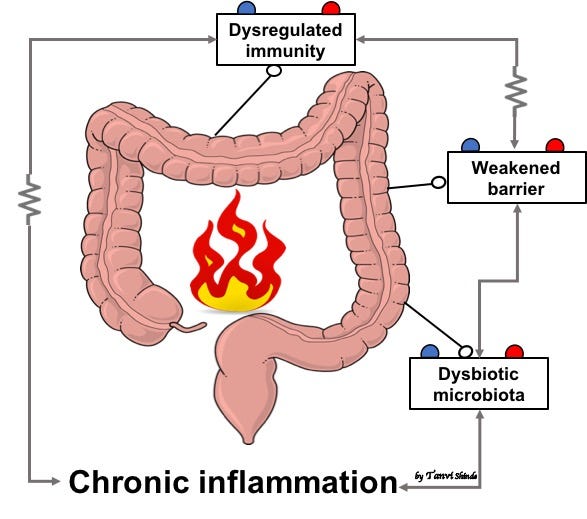
There are three components to this inflammatory circuit of chronic diseases :
- dysregulated immunity (increased circulation of inflammatory immune cells and signaling molecules)
- weakened gut barrier (leaky gut — resulting in leakage of toxins and microbes across the epithelial barrier into blood circulation)
- dysbiotic microbiota (disturbed microbial balance — decline in beneficial microbes and bloom of pathogens)
Such hostile factors render the chronically ill people more susceptible to infections and comorbid diseases that compromise their quality of life while also increasing their risk of mortality.
Among the lost populations of gut bacteria in chronically ill patients are some of the well-known probiotic bacteria like lactobacilli and bifidobacteria residing in our gut. This means losing out on an array of positive functions that all these lost beneficial bacteria usually play in influencing our well-being.
Current medical treatments is a one-point approach and often fails
Standard medical treatments generally involve regulating the immune system functions or immune-suppression therapies— calming the over-activated immune system and preventing the inflammatory immune cells from damaging our tissues and organs.
But in many cases, immune-suppression therapies have proven insufficient in resolving chronic conditions owing to recurrence of disease symptoms in some patients after treatment ends. In worst cases, some patients are known to not even respond to specific immune therapies to start with.
Medical therapies targeted solely at regulating the immune system are a one-point approach — working on the branches of the problem rather than on the roots of the problem.
At times, therapeutic drugs can aggravate more inflammation by damaging the gut barrier and reducing the microbial diversity necessary for homeostasis.
Strategies like the probiotic and prebiotic alongside the standard medical therapies that target the whole inflammatory circuit by attacking the root of the inflammation — the dysbiotic microbiota, gut barrier and immune system could be the game changer in chronic conditions such as cancer and diabetes.
Synbiotics: the marriage of probiotics and prebiotics
Now you might be wondering why we need to team up the probiotics and prebiotics as synbiotics, and why can’t either of these be employed for the job alone?
Before understanding the need for their merger let us examine what probiotic and prebiotic can individually achieve for our health benefits.
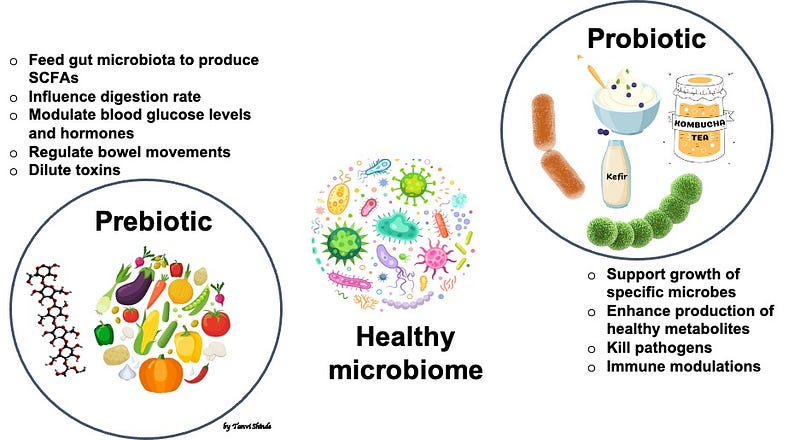
Probiotics as we know are live microorganisms that can provide health benefits when consumed in adequate amounts. They are often the same or similar to the microorganisms that already reside in our gut.
By supporting the microbial diversity in the gut or by helping to replace the loss of the beneficial microbes (due to antibiotic treatments etc), probiotics can help rescue the disturbed microbial balance and help support our gut’s ability to defend against pathogens and diseases.
Prebiotics, on the other hand, are the indigestible plant fibres that escape digestion in the small intestine and reach the colon to feed the microbiota and the probiotic members in our gut.
In addition they help regulate bowel movements, can influence blood glucose levels by slowing down digestion and eliminating toxins from the body.
Specific members of our microbiota can feed directly on the prebiotic fibers to manufacture important metabolites like short-chain fatty acids (SCFAs) and neurotransmitters through fermentation.
Other microbes rely on the left-over fibre portions or intermediate products that are produced by other members of the microbial community (cross-feeding) to provide us with health benefits.
Thus, maintaining the diversity among the gut microbial community is a key to achieving positive health effects.
In healthy individuals, both prebiotic and probiotic can function well individually to provide health benefits for general well-being — probiotics working to replenish or maintain microbial diversity, provide direct immune support and prebiotics to feed the gut microbiota and produce beneficial anti-inflammatory metabolites.
But things are slightly different when we are dealing with the chronic inflammatory conditions and marrying the probiotic with prebiotic for synergy in their functioning is required to promote the remediation of the whole inflammatory cycle by augmenting their positive effects.
Microbial dysbiotic signatures in chronic conditions
In the case of chronic diseases, in addition to dysregulated immunity and weakened barrier integrity, it is important to appreciate that the dysbiotic gut microbiome of individuals with chronic diseases has distinct signatures compared to healthy individuals—
- loss of beneficial and fibre-fermenting microbes like Latobacillus, Bifodobacterium etc.
- bloom of pathogens — E. coli, Clostridium difficile etc.
- reduced levels of anti-inflammatory metabolites like the SCFAs — butyrate, propionate and acetate
- Increased level of toxic metabolites like LPS
In the absence or decline of the right microbial candidates (the fibre-fermenting microbes) to efficiently chew on prebiotic fibres to produce SCFAs or feed the other microbial members dependent on primary fermenters, the employment of prebiotic fibres is not of much use.
Similarly, administration of probiotics alone without the prebiotic fibres to feed them and the resident beneficial members and supporting their colonisation and/or activity in the gut to provide us with health benefits is of limited effectiveness.
Synbiotic — a two-point approach
Synbiotic that combine the power of both prebiotic and probiotic have the potential to overcome the shortcomings that these two strategies possess when applied individually.
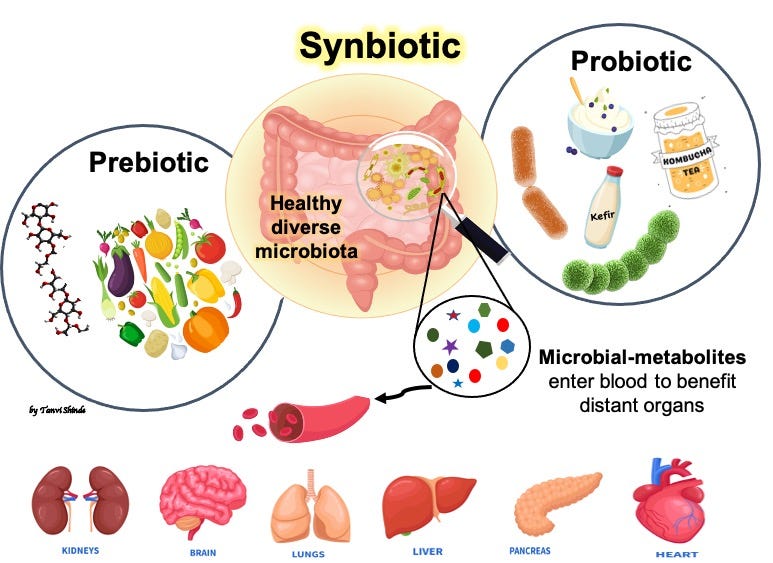
The probiotic supplementation (single member or cocktail) will help replenish the lost gut members and maintain microbial diversity and the simultaneous prebiotic fibre supplementation will feed the microbiota ( including the administered probiotics) to produce SCFAs and other anti-inflammatory metabolites.
Butyrate, for instance, is the major energy source for cells lining our gut thus, improves barrier integrity and prevent the toxins and microbes from entering the circulation.
Propionate and acetate also play significant roles in maintaining gut homeostasis. SCFAs are transported through the circulation to distant organs where they promote numerous immune benefits.
In addition to controlling the activities of the immune system, SCFAs help us respond better to certain treatments, and also play a role in controlling our appetite and mood.
Teamwork between the probiotic and prebiotic in a synbiotic combination promotes augmented health benefits
There are two types of synbiotic:
- Complementary synbiotic — where probiotics and prebiotics work alongside each other to promote health benefits separately. Probiotic is chosen based on it’s specific desired health effects, and the prebiotic is independently chosen to selectively increase the level of the beneficial microbiota. The prebiotic may promote the growth and activity of the probiotic, but only indirectly as a part of its target range.
- Synergistic synbiotic — where the probiotic is chosen based on the specific beneficial health effects but the prebiotic is chosen to support and enhance the growth and activity of the administered probiotic in the gut. The ingested prebiotic may also increase the level of beneficial host gastrointestinal microbiota, but the primary target is the ingested probiotic.
In chronic conditions, the direct and/or indirect synergism between the probiotic and prebiotic treatments can target the resolution of inflammation by attacking all three inflammatory components in the vicious cycle:
- by regulating immunity through direct and indirect effects on immune cells via direct interaction or through production of anti-inflammatory SCFAs and other bioactive metabolites (like neurotransmitters).
- by promoting microbial diversity through replenishing the lost fibre-fermenting bugs, supporting the other beneficial gut microbes and inhibiting pathogens thus reducing dysbiosis.
- by promoting increased gut barrier through production of metabolites like butyrate to strengthen the barrier integrity and prevent cross-over of toxic substances in the blood to keep them at bay.
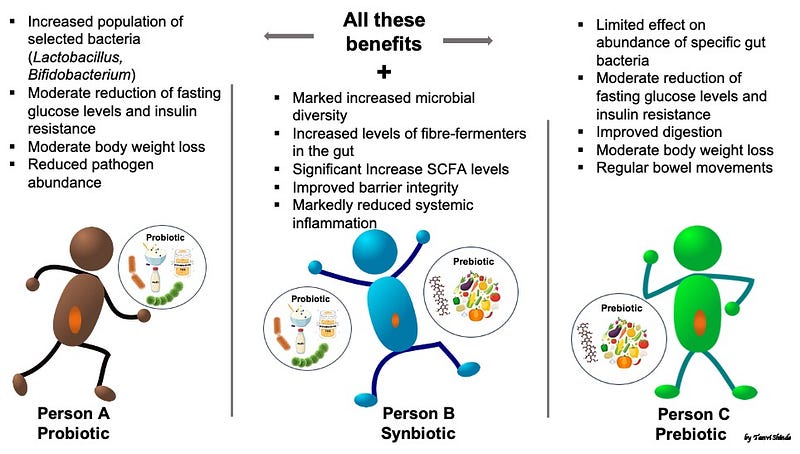
Synbiotic as an adjuvant therapy in chronic conditions
The lower the gut microbial diversity, lower is our ability to respond to particular treatments.
Synbiotic therefore could play a significant role in supporting the individual’s immune system to respond well and benefit from the therapy in cases of chronic health conditions.
In the mild or early stages of chronic conditions, synbiotics could have immense potential in reversing/reducing specific illnesses or even preventing the onset in the first place.
Synbiotic for general well-being and immune fitness
Well, now that you know how probiotics and prebiotics work and how teaming them up as synbiotics can render numerous added positive health effects you can also avail yourself of the immune benefits of this superhero duo.
The prebiotic is the Robin to the probiotic Batman.
The area of synbiotic is still in its infancy with efforts being made to understand the mechanisms of its synergism, but given the wide variety of different strains of probiotic and the array of prebiotic fibres available, making it even more difficult for precise application for different health conditions.
Ultimately the choice of candidate probiotic and prebiotic for conferring health benefits will boil down to “what do you need these bioactives to do?”. The answer to this question will then guide the selection of appropriate probiotic strains with the ability to deliver that health function while the compatible prebiotic supports its growth and activity in the gut allowing it to deliver the benefit most effectively.
You don’t necessarily have to rely only on supplements to take the advantage of this dynamic duo as probiotics and prebiotics can be consumed through a variety of food options that carry them — fermented foods like kimchi, sauerkraut etc. or by pairing the probiotic foods like kombucha, yoghurt etc. with fruits and vegetables rich in prebiotic fibres.

Probiotic + Prebiotic = Synbiotic
“Teamwork makes the dream work” — John C.Maxwell
If you are interested in learning more about the use probiotic and prebiotic to nourish your microbiota for health and well-being you are welcome to read my other article :