The Dutch Age of Observation
The 17th Century was the Dutch Golden Age
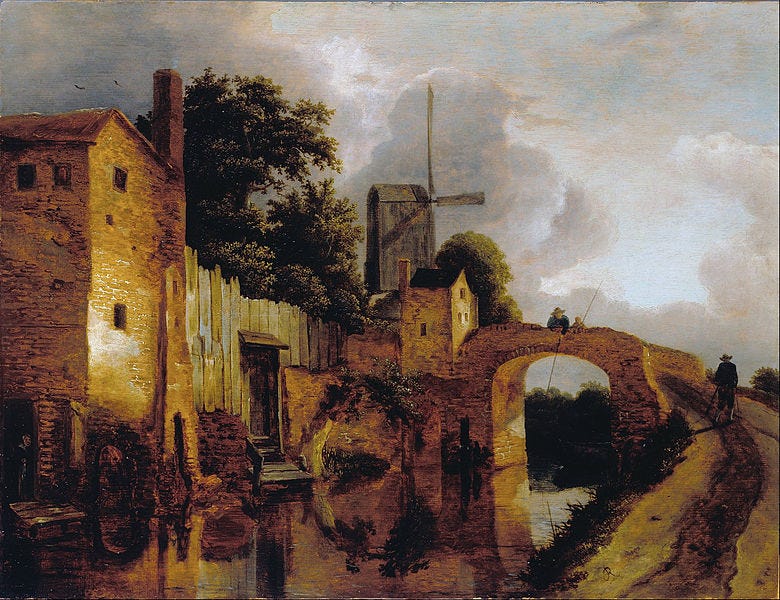
The dawn of the Dutch Republic brought with it a remarkable upsurge of scientific as well as artistic achievement. This was directly related to new needs and new ways of looking at the world.
For the people of Holland and the other six United Provinces, the Truce of 1609 marked the dawn of a golden age. Released from the yoke of Spanish rule, Dutch merchants had before long made Amsterdam the commercial hub of Europe, and the fortunes of the new republic soared.
The exquisite genre paintings of artists like Vermeer and Ruisdael, and the brilliance of Rembrandt reveal one aspect of the remarkable flowering of Dutch culture in the 17th century. But Dutch achievements in the 100 years after independence extended into many different areas, both intellectual and practical.
Dutch scientists were among the most influential of the age and made a number of crucial discoveries. Dutch cartographers set new standards in mapmaking; Dutch engineers were in demand all over Europe for drainage and flood control schemes; Dutch decoration and architecture became the vogue in England; and Dutch sailors were making epic voyages to New Zealand and the far north of Canada. Indeed, there were few corners of the world that did not feel Dutch influence.
Religious Influence
What made the United Provinces unique in the 17th century was the way the Dutch people seemed able to apply a practical, down-to-earth approach to everything from painting to growing turnips. To some extent, this practical bent was characteristic of the Protestant revolution that had precipitated the break with Spain. The old Roman church had laid stress on the mysteriousness of the universe and the assertion that only priests — and ultimately the pope — had access to the truth. It had also emphasized that it was only the next world that mattered.
The Protestant revolution overturned these ideas, by maintaining that this world is as important as the next and that each individual’s experience is as important as any lesson taught in church. This appealed very strongly to the Dutch, and they took the new Protestant ideal to heart. It instilled in them a desire to explore everything in the world around them, and gave them confidence in what they saw with their own eyes. Dutch artists and intellectuals began to examine the real world in detail, closely observing even the most mundane phenomena.
The Importance of Lenses
While Dutch genre painters were painting small details of the world around them with superlative skill — interiors, still-lifes and landscapes, rarely thought worthy of the artist’s attention before — Dutch scientists began to use lenses to help them see the world better.
The lens was the scientist’s most important tool and almost every Dutch scientist could grind and polish his own lenses. Indeed, the great scientist Christiaan Huygens ground lenses professionally. It was the Dutch scientist’s ability to exploit lenses, whether in microscopes or telescopes, that enabled him to make some of the most important discoveries of the century.
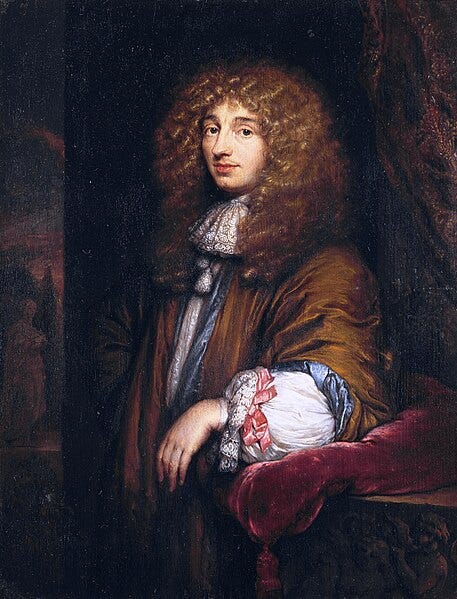
At one end of the scale, telescopes of enormous focal length allowed them to see further and further into space. With his own 12-foot focal-length telescope, Huygens discovered that the planet Saturn not only had a moon (Titan) but was also encircled by concentric rings. And it was his knowledge of lenses that helped him develop the theory that light travels in waves. At the other end of the scale, Anton van Leeuwenhoek’s improved microscope enabled him to confirm, in 1668, Marcello Malphigi’s belief that blood from the arteries flowed into tiny capillaries. Later, he discovered tiny corpuscles within the blood and the existence of micro-organisms (such as bacteria) which he called animalcules.
In keeping with this microscopic examination of the world, “anatomy” became a vogue word among Dutch intellectuals, and they published books on the Anatomy of the Universe, the Anatomy of Melancholy, and so on. The word symbolized the meticulous dissection of a subject which was their aim. Human anatomy became so popular that each year the Guild of Physicians and Surgeons in Leyden would publicly dissect or “anatomize” the corpse of a recently executed criminal. And the anatomist Hermannus Boerhaave became so famous that he was known simply as “The Great Boerhaave” and a letter addressed “Boerhaave, Europe” safely reached him.
The hallmark of Dutch observers of the world, whether artists, astronomers or botanists, was a remarkably methodical approach. They wanted to examine the world in meticulous detail and find out not what purpose, but what process lay behind nature, and mathematics began to assume more and more importance. In keeping with this, the Dutch began to publish instruction books describing the correct method to do anything from painting flowers to grinding lenses.
The Importance of Trade
The methodical approach of the Dutch scientists owed a great deal to Dutch merchants’ care in bookkeeping and accounting. Life in the United Provinces revolved around trade. Besides focusing attention on the real world, the Protestant revolution had helped to foster the idea that trade and the pursuit of worldly goods were compatible with Christianity — or traders fostered the idea that the Roman church strangled human endeavour.
Either way, the Dutch had taken to trade so enthusiastically that the great French philosopher Rene Descartes, who lived in Amsterdam, grumbled: “In this great town, . . . apart from myself, there dwells no-one who is not engaged in trade.” And he may not have been exaggerating much, for even scholars and artists often had to trade to support themselves — the painter Jan van Goyen, for instance, was a tulip merchant.
Trade not only brought the prosperity that allowed the Dutch to achieve so much, it was the spur to many of these achievements as well. It was trade that impelled many Dutch seamen to undertake voyages into unchartered waters. Heemskerck and Jacob Barentsz were searching for a quicker and cheaper way to the Pacific when they perished in the Arctic sea, while Abel Tasman was looking for a more reliable route to the rich Spanish colonies in South America when he discovered Tasmania (which he called Van Diemen’s Land) and New Zealand in the 1640s. It was to provide sea traders with more reliable information that Dutch mapmakers such as Waghenaer and Willem Jansz Blaeu made their superb charts and inspired an era of superlative mapmaking.
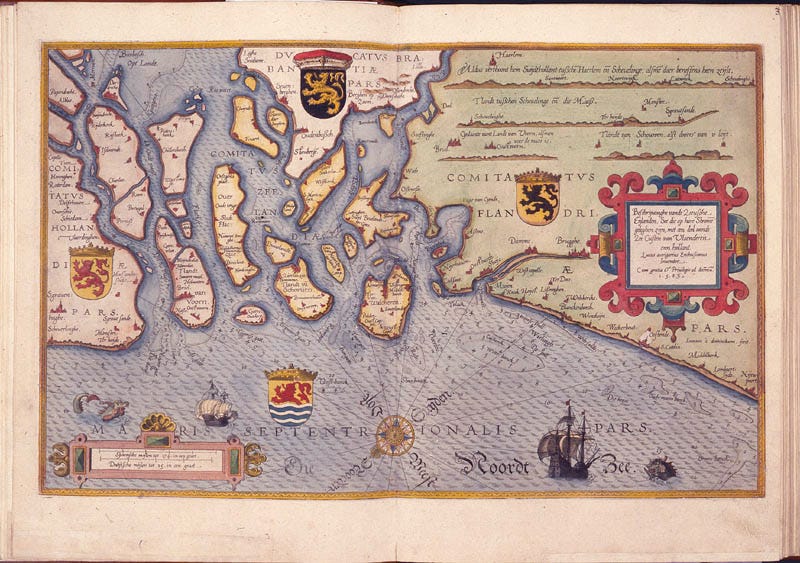
Waghenaer’s charts, printed with engraved copper plates, were so successful that for centuries afterward, British sailors referred to charts as “waggoners”, while the English diarist John Evelyn considered no trip to Amsterdam in the 1640s was complete without a visit to the mapmakers Jodocus Hondius and Blaeu.
The rewards of trade encouraged all kinds of inventions and persuaded scientists to look for practical applications for their ideas. It was the need for better navigational equipment to match the expanding sea trade, for instance, that was behind Huygen’s invention of the pendulum clock. The enormous profits that could be made from reclaiming land from the sea spurred on Dutch engineers to develop the skill in drainage that made them so much in demand — not least with the English, soon to be their trading rivals.
Did you like this? Maybe not! Either way, your comment will be very welcome!
For other similar pieces, see my List:


