The Dunning-Kruger Effect — Unskilled and Unaware
When you don’t know enough to know you don’t know enough

Media, co-workers, friends, “experts” and leaders. They all do this; talk confidently and persuasive about topics, making it sound like they know all there is to know, and that their truth is the only truth that matters. It sounds interesting, truthfully, and you want to believe them. Even though, in reality, they have no clue.
On the other side, there are experts, without quotation marks, that may appear insecure and less confident. She knows everything there is to know about a topic, she also knows all the facets, and the more you know the less absolute it gets.
Nothing is black and white is right for everything not black and white.
The Dunning-Kruger Effect
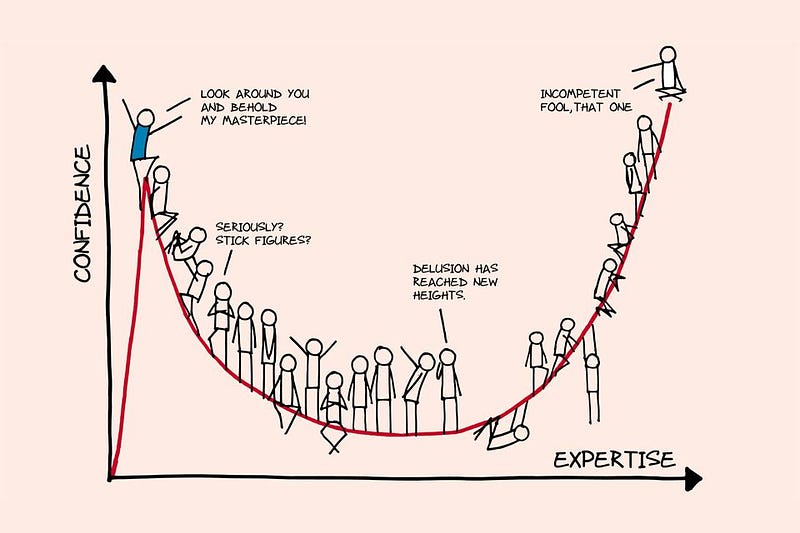
The Dunning-Kruger effect is a cognitive bias in which individuals are prone to assess their cognitive ability as greater than it truly is. — Kruger and Dunning’s 1999 study, “Unskilled and Unaware of It: How Difficulties in Recognizing One’s Own Incompetence Lead to Inflated Self-Assessments”
To simplify: The less competent you are the more confident you are. You think of yourself as an expert, because you don’t have the ability to know better.
Ignorance is bliss (until you are caught)
When researching the Dunning-Kruger effect, this story came up several times:
In 1995, McArthur Wheeler robbed two Pittsburgh banks in broad daylight. He was caught smiling at the camera and the police identified him on the surveillance tapes and drove home to him later that same day. When they showed him the tape he was surprised.
“But I wore the juice.” Mr. Wheeler said. He had rubbed lemon juice in his face because he was convinced it would render him invisible for the cameras.
It’s a funny/strange story. But he really believed and had confidence in the power of the Lemon Juice. I don’t know where he got this information from, but today it should be fairly easy to google the invisibility-probability of Lemon Juice.
I have met many under the influence of Dunning-Kruger. Many generalists that knows a little of many topics but believe they know all there is to know. And they will often appear confident and trustworthy. Pair that with good rhetorical skills, and you have a scary combination.
It’s hard, if not impossible to enter argumentation with a person that’s in denial of his own shortcomings.
Experts seem weak, “experts” strong
The confidence of an “expert” is believable and contagious.
The hesitating of an expert, because she knows the ins and outs of a topic, may seem weak and insecure. This is often called the imposter syndrome, which is the opposite of Dunning-Kruger, where you doubt your own ability and feel like a fraud.
Using Dunning-Kruger to your advantage
When I researched this post, and this is true for all my research, I didn’t go too far into the material. I want to write something easily available and uncomplicated. The more I learn, the more any topic will show its many facets, and be harder to describe. For this post, I read the ingress for some of the articles from David Dunning and Justin Kruger and based the rest on my understanding of it.
This isn’t a scientific article but a nice-to-know article. And I know I might be wrong or imprecisely without knowing it. And that’s OK
Four years of Dunning-Kruger, will it be eight?
I try to steer away from politics, but I can’t not mention the orange elephant in the room; Donald J. Trump, President of the USA.
He should be Dunning-Krugers poster boy.
For good and worse.
Ses!