
The Domestic Slave Trade
The Parts They Don’t Say Out Loud
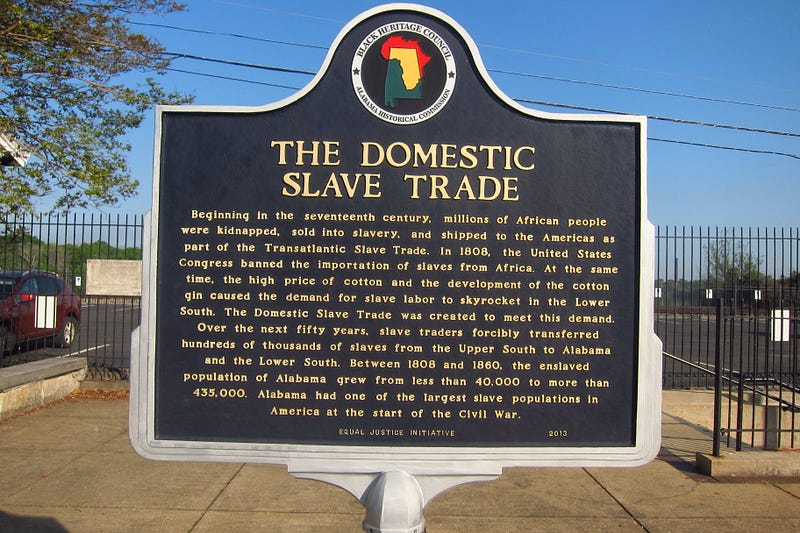
“Beginning in the seventeenth century, millions of African people were kidnapped, sold into slavery, and shipped to the Americas as part of the Transatlantic Slave Trade. In 1808, the United States Congress banned the importation of slaves from Africa. At the same time, the high price of cotton and the development of the cotton gin caused the demand for slave labor to skyrocket in the Lower South. The Domestic Slave Trade was created to meet this demand.
Over the next fifty years, slave traders forcibly transferred hundreds of thousands of slaves from the Upper South to Alabama and the Lower South. Between 1808 and 1860, the enslaved population of Alabama grew from less than 40,000 to more than 435,000. Alabama had one of the largest slave populations in America at the start of the civil war.”
Those two paragraphs sum up the what, without telling you anything about the who and very little about the why. If you only read that Alabama’s enslaved population grew from 40,000 to 435,000 in just over fifty years. You might conclude that most of them just moved from one place to another, like the great migration. The truth is that the increased population was due to forced breeding and rape of enslaved women. They were forced to have babies, optimally, at a rate of at least once every two years. The children were then torn from their mothers to be sold for profit.
“I consider a woman who brings a child every two years as more profitable than the best man of the farm, what she produces is an addition to the capital, while his labors disappear in mere consumption.” — Thomas Jefferson.
Historians have acknowledged the incredible birth rate among the enslaved, without mentioning the means by which it was achieved. They made up their own explanation, calling it, a “natural increase.” Natural increase suggests for some unknown reason, Black women just happened to have babies at a rate higher than normal. People that should know better like Dr. Jenny Bourne, explain away the birth rate without once mentioning the rape and forced breeding that achieved it.
It’s also misleading to mention that America ended the Transatlantic Slave Trade as if it was an attempt to end enslavement, or not part of a grander plan to provide protectionist pricing to those who purposefully bred enslaved people which was planned for in the Constitution. South Carolina didn’t see the okey-doke coming. They thought they were getting a guarantee that no attempt would be made to eliminate the Transatlantic Slave Trade for at least twenty years and hopefully a lifetime. They had no clue that the very first day the Transatlantic Slave Trade could be gotten rid of, it would, all to the benefit of plantation owners in Virginia, Delaware, and Maryland who all had excess slaves due to their mismanagement of land.
The term, “forcibly transferred” gets glossed over a bit. The railways hadn’t been completed in the South at the time. Many of the enslaved were forced to walk hundreds of miles in a coffle. They were chained together in pairs, young women often carrying babies. It wasn’t unusual for the enslaved to walk from Richmond, VA to Atlanta, GA, or Natchez, MS.
I’d like to add that the demand for cotton was even higher after the Civil War ended. The 13th Amendment still allowed for enslavement for the incarcerated. The first thing the former slave states did was incorporate the Black Codes which made many things a crime when Black people did them, like gathering in groups of more than three, owning a gun, or staying out past curfew. These “crimes” led them sent to work on plantations, often the very plantation they’d been freed from.
One last thing about the population increase of Black people, even after the Civil War. Black women still had little protection. The federal troops stationed throughout the South to maintain order were often rapists themselves. Law enforcement also charged with protecting Black women were often members of the Klan and showed little interest. Forgive my mini-rant but the picture at the top of the page inspired this flow of words. Take care!


