The Diversity Problem of Public Space
Apparently the Lake District is too white.
According to Richard Leafe, the Chief Executive of the Lake District National Park Authority, “We are deficient in terms of young people, we are deficient in terms of black and minority ethnic communities and we are not particularly well-visited by those who are less able in terms of their mobility.
‘Our challenge is to see what we can do to reverse that, to encourage people from broader backgrounds and a wider range of personal mobilities into the national park to be able to benefit in the same way as those other groups do.”
It’s not the first time it has been said. In 2014 and again in 2017, ‘acclaimed writer and critic Zainab Akhtar’ (yeah I don’t know who she is either) complained about the Lakes International Comic Arts Festival, in Kendall, saying “ Foremostly, my whole experience was coloured by people’s reaction toward me. Kendal, and the Lake District by large, is a very white, very middle class region. We saw -I think- maybe 6 people of colour in the time we were there (yes, I counted).”
And it is not the first time National Parks have come in this criticism.
Quite what the National Parks are meant to do about the people who live there, to make them less white, isn’t clear. Nor is it ever explained how they are supposed to diversify the people visiting. I suppose they could put up check points on all approach roads, or erect sign-posts only visible to disabled non-whites (the able-bodied whites being directed towards Carlisle or Blackpool — dependent upon which hasn’t reached it quota for able-bodied white visitors that day) but beyond that… well… they could have the park staff knee-cap picnickers I suppose… that would bump up the disabled count….
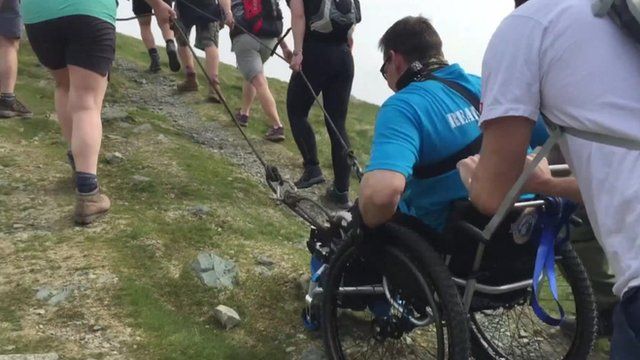
Well actually we already know what they will do. Brochures and leaflets and advertising films for the park will be sprinkled liberally with non-white young faces: with numerous people in wheelchairs added to the mix (leading to complaints that the location of the wheelchair user in the photograph isn’t fully accessible in reality — no doubt).
What they won’t do is to teach people Wordsworth with the verve, passion and love of the nature with which he wrote. Or make Withnail and I compulsory viewing as the end of term Christmas film.
Or just leave people to do their own thing. Sitting in a lay-by drinking tea from a thermos, and worrying the handbrake isn’t fully engaged, is not to every one’s taste… and nor is camping… and nor is paying three or four quid for an ice cream.
Personally I’ve only been to the Lakes once, a thoroughly depressing visit a month after my daughter died to spend Christmas with my in-laws. But it looked nice from the campsite on the other side of Morcambe Bay, when a I went camping with my lads some years later: as the bar-b-que lost heat, and the night pulled slowly down upon the hills.
However, what is being obscured by this debate is something rather different. For it isn’t whether enough black people, or disabled people, or any other sort of person visits the national park: (as those professing this dogma don’t actually care about real people) it is that those managing the land, in this case the Lake District National Park Authority, the National Trust ( Registered Charity 205846), etc, are meeting their diversity and inclusion targets, which in turn justifies their funding.
You can perhaps throw in the Ramblers Association ( Charity England & Wales No: 1093577), the Beatrix Potter House, the Windermere Jetty Museum, and no doubt a whole host of other societies and attractions, who are all required to have diversity and equality policies to receive funding.
For now we’ll skip the aspic nature of the management. This seeking of stasis is somewhat ironic as the landscape is almost entirely man-made. (Not the hills and mountains, obviously).
Ironically the landscape of ‘money-laundering’ and ‘slush-funds’ in the name of diversity and inclusion is almost as picturesque and breathtaking as the scenery they are ostensibly managing. And made as amusing and enchanting as a Beatrix Potter tale by those engaged in it perpetually posturing for fear of the arrival of the Gogol’s Inspector General.
Which would explain why the Lakes International Comic Arts Festival (sponsored by Arts Council England) got so jumpy, for daring to hold a comic book convention in a town where a racist grievance monger could go out of their way to count only 6 non-white faces (how racist do you have to be to even think of doing this?).
Ah yes you say… but diversity and inclusion is important…. and maybe it is but go and have a look at the election results and what you will notice is a split between the towns and the cities. It would be interesting to see research on the level of government, and charity, spending (which remember is in large part dependent upon diversity and inclusion targets) between towns and cities… and particularly between cities and towns with low ‘diversity’.

I know the Centre for Towns think-tank is interested in this question. And the Labour party leadership candidate, Lisa Nandy, is keen on promoting the economy of towns. There is only one problem… if you go to their blog… they working with Arts Council England.
We shall see if the new government will address this knotty problem.