
The Disconnectionality of Intersectionality
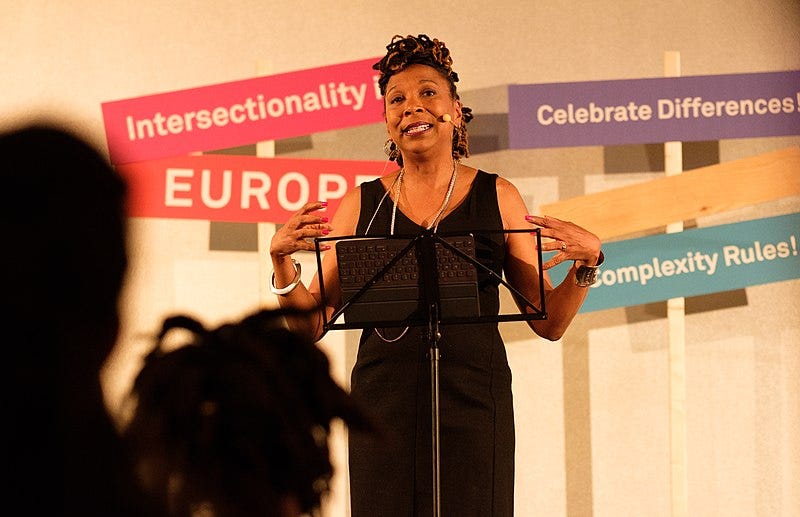
When I first heard about intersectionality, a word adopted and promoted by Critical Race Theorist Kimberlé Crenshaw, I was conflicted. I hated the term because it was a fancy way to talk about the obvious—who doesn’t know that black women and gay Jews and handicapped trans people face more than one form of prejudice? But I also loved the term because I thought it gave a way to talk about class with people who focus on social identities like race and gender.
But I completely misunderstood how identitarians use “intersectionality”.
Crenshaw originally used the word to talk about race and sex—her focus was on legal cases where black men and white women were treated well enough that rules about racism or sexism did not apply, yet black women were being excluded. Intersectionality was quickly adopted by people who wanted to discuss interactions involving all forms of social identity. Crenshaw’s term works well when talking about groups that want acceptance and respect, which explains why the umbrella of intersectionality eventually covered “classism”, aka snobbery, the prejudice of richer people against poorer people.
But intersectionality fails when discussing class because economic class is about what we have and social identity is about who we are. We all want respect for our social identities, but, as Matt Breunig noted, “The fundamental problem with cramming poor people into the identitarian framework is that, unlike every other identity treated in that framework, justice for poor people requires their elimination.”
Intersectionality comes from a worldview in which every form of oppression is independent and therefore they can only meet at intersections. In the intersectional model, prejudices are never intertwined, interconnected, or interrelated. It leads identitarians to say things like this:
“…I do think class is a significant axis of oppression separate from but interacting with race and gender. I just don’t think it’s the root oppression that is the basis of all other oppression, or that eliminating class injustice will magically cause other forms of prejudice and injustice to fade away.” —Coffeeandink on LiveJournal
That statement is a fine example of intersectional thought because its dismissive conclusion shows how intersectionalists acknowledge class in order to ignore it.
Deeper thinkers disagree with the idea that class, race and gender are separate things that only sometimes intersect. Some examples:
“Slavery was not born of racism: rather, racism was the consequence of slavery.” —Eric Williams, Historian and First Prime Minister of Trinidad and Tobago
“…we must not forget that white racism was from the start a vehicle for classism; its primary goal was not to elevate a race but to denigrate a class. White racism was thus a means to an end, and the end was the defense of Virginia’s class structure and the further subjugation of the poor of all “racial” colors.” — Rev. Thandeka, “The Whiting of Euro-Americans: A Divide and Conquer Strategy”
“The first class opposition that appears in history coincides with the development of the antagonism between man and woman in monogamous marriage, and the first class oppression coincides with that of the female sex by the male.” —Frederick Engels, Origin of the Family, Private Property, and the State
Identitarians don’t realize that in most tribal societies, men and women were seen as equals and that before the development of the African slave trade, prejudice was cultural, not racial—perhaps the best example is the Greek prejudice against barbarians, who were not strangers who looked different but strangers whose language sounded like “bar-bar-bar” to Greeks. Identitarians have to believe racism and sexism are natural to humans because the alternative is to question the growing wealth gap that’s increasing the divide between the rich and the rest of us. No ideology born in the Ivy League will ever do that.
Recommended:
RACE — The Power of an Illusion . Go Deeper | PBS
Slavery and the origins of racism by Lance Selfa
Marxist Internet Archive Library of Feminist Writers
PS. Tim Wise left the first comment on this post. You can read my reply to see where I disagree with him, but if you don’t read the comments, I want to acknowledge that he’s right that “no one with any prominence in this work” promotes the idea that humans are naturally racist. Alas, too many of their followers do.
PS #2. I have argued that class is what you do rather than what you have. Here’s an update on something I said in 2011:
Class is not identity. Identitarians describe the world in terms of being: people are male or female, black or white, Californian or Welsh, Coke drinkers or Pepsi drinkers. Class describes the world in terms of doing: the owning class controls the world’s wealth; the working class works to survive.
Identitarians see the world in fixed terms: race and gender cannot be changed. Their concept of class is feudal, so birth is very important to what you are. But universalists see the world in mutable terms, tribal rather than racial.
Most socialists and capitalists recognize that under capitalism, what matters is your relationship to capital. Identitarian leftists see Obama as a traitor to his race, but socialists and capitalists see him as being true to his class.
P.S. #3: From Identity Crisis by Salar Mohandesi:
Although intersectionality theory added some much-needed nuance to identity politics, it, too, ran into its own limits. As Sue Ferguson and David McNally have explained, while “intersectionality accounts have rightly insisted that it is impossible to isolate any particular set of oppressive relations from the other,” they have not developed any coherent explanation of “how and why” different forms of oppression intersect with each in other in some ways and not others. The result is often an enumeration of oppressions without an adequate explanation of their articulation into a structured, though always uneven, whole. This is precisely why, for example, partisans of this kind of intersectional identity politics almost always revert to composing breathless catalogues of injustice when trying to explain what they oppose — the colonial white supremacist heteronormative patriarchy, or something to that effect. Moreover, since the list is the only way to present the object of social struggle, failure to include a particular oppression in the master list will often be mistakenly interpreted as the willful rejection or erasure of a particular struggle against a particular oppression.


