The Discomfort of Evening – A Book Analysis and Review
“Even though it will feel uncomfortable for a while, but according to the pastor, discomfort is good. In discomfort we are real.”
Discomfort is an understatement to the feeling I had when I read this book. Narrated by the mature, yet childish ten-year-old protagonist, Jas, who was raised in a Protestant family that runs a farm. Scared for her pet rabbit being killed for meals by her father, and angry at her older brother for skating without bringing her, she prays to God: “and I asked God if He please couldn’t take my brother Matthies instead of my rabbit. ‘Amen.’”. The same day, her brother is fished out of a frozen lake and is pronounced dead.
This book shows how a devout Christian family handles grief in their own way, and how a child makes sense of the unknown world around her. It is as if after the death of their brother and child, the whole family descends into a realm of madness of their own; each blinded by anguish. Being reverent Christians Jas’ parents were afraid to talk of death – they blamed God and their sins as reasons for this loss.
“If you hadn’t have wanted to get rid of the child…”
“Oh, so now it’s my fault?” Dad says.
“That’s why God took away our oldest son.”
“We weren’t married yet…”
“It’s the tenth plague, I’m sure of it.”
Before the death, they were already incredibly pious; certain acts of nature were forbidden topics, watching the television was a careful business, and words that weren’t in the Bible were called “blush words”. However, as this new-found sorrow found a place inside the home, Jas’ mother’s palate for food grows smaller and smaller, and she refuses to eat in front of her children to guilt-trip them; her dad speaks of the Word less and less; her brother starts torturing animals he deems inferior; her sister is beginning to daydream after a “Saviour”, who will rescue her.
Jas is known by her peers for her imagination; her school teacher often comments on her vivid descriptions and her odd personality. With her imagination and her fear of her parents dying, she gets paranoid about when and how “Death”, as if he’s an actual incarnate, will take them away from her. At one point, she imagines herself as an orphan and starts fantasising about how she’ll tell her teacher about it and how she would cope with her new life. She imagines the causes of her parents’ death and compiles a list of probable deaths – ranging from lung cancer to jumping off a feed silo. She believes her mother keeps Jews in the basement, and that she’s one of the “good guys” because she’s hiding them.
In addition, she is very creative in her self-expression; after witnessing her teacher sticking a pin into a map to show her students where she would want to go, Jas sticks a pin into her navel. The reason being is that she wanted to “go into herself” instead of to God, unlike all her peers. I interpreted this as her dissociating and growing more suicidal, as, from this point on, the book quickly grows darker.
From the start, Jas dissociates – she loses herself in her mind. As she numbs herself, she also loses her belief in God: ‘I’ve discovered that there are two ways of losing your belief: some people lose God when they find themselves; some people lose God when they lose themselves. I think I’ll belong to that second group.’
She tells herself not to cry after her brother’s death. She forces herself to hold back her tears yet she continues imagining how her brother felt as he drowned; how it must have been very cold, and how it must have felt being helpless under the ice. It’s not that she didn’t love her brother; as a child growing up where your opinions don’t matter unless they were about the Old Testament, she was emotionally stumped. She also didn’t believe tha her brother died, but more on that later.
Like how children use their jargon and thought processes to make sense of the vast world around them. She uses her wide knowledge of animals – credited to her growing up on a farm – to describe her feelings and surroundings; to make sense of what she perceives. For instance, she explains her parents’ lack of love for each other as frogs that don’t mate. She keeps two frogs in a bucket under her desk and ardently forces them to “mate” every other day so her mother and father can love each other again. Often, she confides to her frogs and stresses the importance of their sexual needs for the survival of her parents’ well-beings.
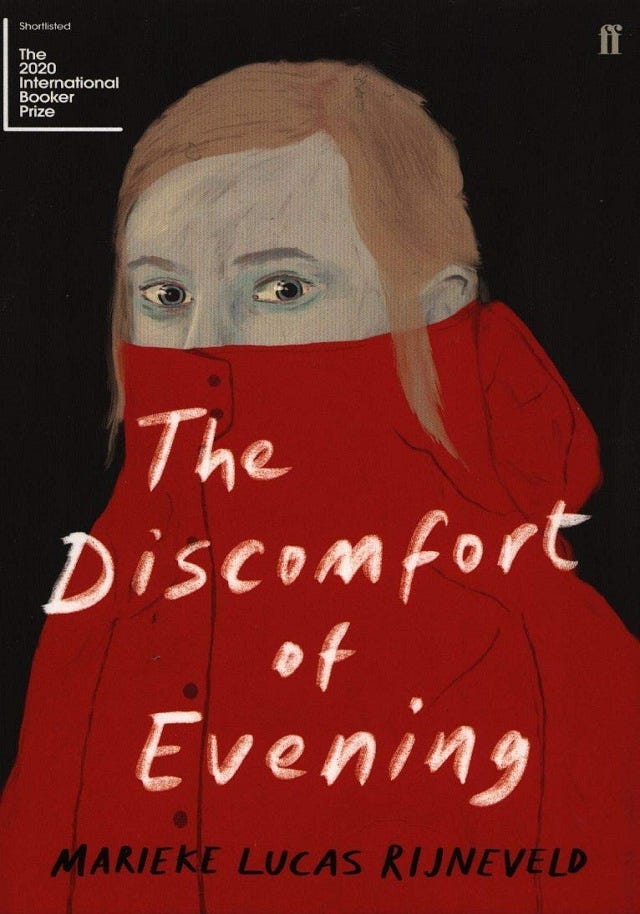
After Matthies’ death, she never took off her signature red coat. She doesn’t tell anyone her friends and family why, and at one point her mother tries to force her to take it off by threatening her that she would jump; Jas didn’t take it off and her mother suffered an injured ankle. Her coat was her facade; she zips it up to her chin and collects fragments as tangible memories, such as a cheese-scoop her mom used, in its pockets. She thinks the coat will protect her secrets, her thoughts from everyone, including God Himself. At one point her friend, Belle, even said to her: “You’re just like Anne Frank. You’re in hiding.”
“Nobody knows my heart. It’s hidden deep beneath my coat, my skin, my ribs.”
Throughout the book, she is chronically constipated. She refuses to excrete, and holds it in for two main reasons – the first one is that she “wouldn’t have to lose anything I wanted to keep from now on”. Her constipation can be interpreted as a metaphor for grief; she is bottling up her “ungodly” emotions and all her memories of Matthies because it is forbidden for her to talk about such topics. Another is for her parents to have something to talk about. Since her parents are also growing apart, she purposely makes herself sick so her parents can discuss it with each other and talk to her; the latter they rarely do after the death of their eldest.
As I mentioned before, Jas doesn’t believe that Matthies is completely dead. During the first night of him encased in a coffin, Jas thinks this as she holds her breath as a way to imagine suffocation: ‘It wouldn’t be long before I could hold my breath for so long that I’d be able to fish Matthies out of his sleep, and just like the frogspawn we got out of the ditch behind the cowshed with a fishing net and kept in a bucket until they were tadpoles and tails and legs slowly began to grow out of them, Matthies would also slowly transform from lifeless to alive and kicking.’ She believes that Matthies is somewhere, waiting to be found, like a childlike game of Hide-and-Seek; she often tapped on the glass of his coffin to see if he would open his eyes.
In this book, there’s a lot of Biblical references and verses, which noticeably influences Jas’ thought process. Everything that happens is related to God, and anything relatively bad that happens is because it’s “God’s Will”. She imagines her and her siblings as the Three Kings of the Bible, and in being able to find the Star of the East, they would find Matthies. She believes that by “meeting death”, she and the other two kings would meet their brother and also obviously, die.
She also tells Hanna, her sister, about how their recent unfortunate events – their cattle getting the Foot-and-Mouth disease – are due to the fact that they’re at the receiving end of the nine out of ten plagues from Exodus. She explained to Hanna about how she had a nosebleed, so water is changed into blood; they had a toad migration, so their farm was teeming with frogs; their peers suffered from head lice; the family’s firstborn died; flies around their farm’s muck-heap; a locust being squashed by Obbe’s, their other brother, boot; ulcers on her tongue, and hailstorms terrorising their farm.
They fight these retributions by doing what they call “sacrifices”. Obbe kills and tortures animals repeatedly – at one instance, his hamster Tiesey – and sexually assaulted his sisters. He helped Hanna masturbate with cans of Coco-Cola, and had prodded his fingers into Jas’ anus. Hanna imagines herself being whisked away by a man; she often tells Jas to do the same so they could escape their home together. Obbe and Hanna were mentioned to “bang their heads on the wall” and were described to have tics; which would explain their oddness.
Towards the end of the book, Jas finally releases her faeces into a hole she dug. She even places a stick on the buried piece of excrement so she could “remember to where I lost a piece of myself”. Her finally stopping being constipated – her metaphor for grief – meant that she let go of everything; her sadness, her secrets, and her life. Like many actual people who ended their lives, they appear happy or relaxed before they committed the act; so for Jas, this was her relaxing. During her final days, she experiences the final plague out of the ten: darkness. She describes her days as getting “blacker and blacker” and how she can’t see her own hands anymore in the evenings; in the end, she succumbs to the blackness of her own depression. The book started with death, a young boy drowning in a cold lake; and ended with a younger girl suffocating in a freezer.
Jas could have been easily been turned into a cute, innocent farm girl with braided pigtails; she could have been given a voice that wasn’t as grotesque or dark. The picture that the author painted for her was mature; she was ten-years-old and can be easily seen to be depressed. She compares her sadness to Belle, in which she describes Belle’s misery to be “as big as an aquarium”, while hers is “as big as the Giant Goliath from the Bible”.
The author, Marieke Lucas Rijneve, prodded around forbidden topics of incest, paedophilia, and underage pornography. I, someone with a decent moral compass, did not enjoy reading about Jas and Hanna kissing, and the kiss being described as “a leftover steak that Mum’s warmed up in the microwave”. The innocence of childhood farm life is contrasted starkly in this book; at one end of the story, there’s a young girl describing her life in all its vivacity and the other the immorality. The unnecessary violence, talks of different excrement and eating it, animal cruelty, was all in all very discomforting. A semen gun for inseminating cows was placed in the anal cavity of Belle, Jas’ friend, at one point by Obbe with Jas’ assistance as an act of sacrifice. Gore and horror are my favourite topics to read about, but some scenes could have been replaced by less nefarious acts; they were downright unnecessary for whatever effect they were going for.
The non-binary author has an undeniable writing prowess; they write impeccably and the imagery they project out is truly worthy of a Booker prize. I just don’t know what was the point of all the scatological, paedophiliac, and incestual talk.
I would recommend this book. “The Discomfort of Evening” will become controversial if it reaches mainstream social media such as “Bookstagram” – a subgroup in Instagram for readers and writers alike. This is a grotesque, morbid book that is not for the light-hearted, but I believe it’s worth reading. I don’t believe that the author is a scatophiliac or sick in the head for literally writing about every taboo known to the world; it’s important to separate the art and the artist.
If you like my book-related content, follow and subscribe!