
The Dilemna’s Prisoner
“You were right, comrade. Turns out I am a traitor.”
Under the stark, naked bulb, two men faced each other across a worn wooden table. Branko’s face was a map of hard-won endurance, the laborer’s legacy imprinted in the gruff features carved by years of factory work.
Constantin, by contrast, showed a different type of strain. His countenance held the heavy wear of countless decisions made in dimly lit rooms, the invisible chains of Soviet bureaucracy leaving their trace in his pensive gaze.
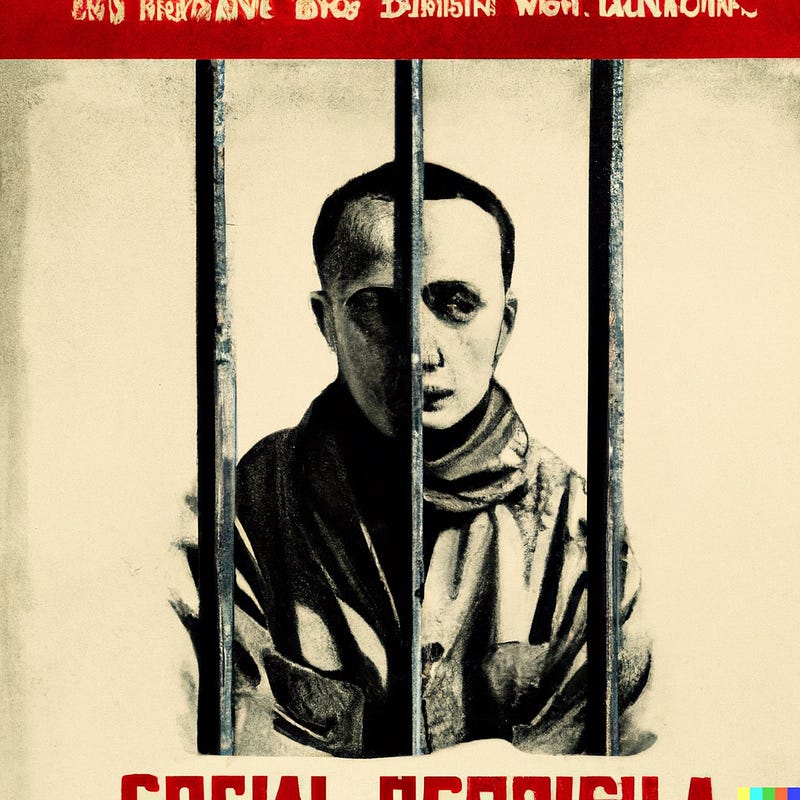
“You’re charged with treason, Comrade Branko,” Constantin declared, his voice echoing off the barren walls.
The accusation hung heavy in the frigid room.
The embers in the fireplace were dying.
Branko’s features, hardened by the relentless cold of many winters and the ceaseless glow of the foundry’s molten iron, were momentarily suffused with incredulity.
He was as steadfast as the comrades he worked with. “For possessing a foreign newspaper? It’s not even mine, comrade.”
Constantin, the embodiment of Soviet authority in his crisp uniform, offered a tight smile.
A seasoned interrogator, he’d seen many men like Branko, brought in for transgressions ranging from significant to trivial.
He knew the burden of the choice Branko faced. “It was found in your locker, a locker you share with Andrej.”
Branko’s eyes hardened, the simple laborer’s pride flaring within him. “That doesn’t make me guilty,” he countered. “I wouldn’t accuse Andrej either.”
There was a melancholy air to Constantin’s expression as he leaned forward, his fingers steepled.
He was no stranger to the dance of blame and survival. “Listen carefully, comrade,” he intoned, his eyes fixed on Branko’s.
“The State gives you an option. You and Comrade Andrej are implicated in the same offense.
Now, if both of you deny the accusation, and no concrete evidence is found beyond these circumstantial signs, the State would not convict you solely on this.
After all, what would justice be without a solid accusation?”
Branko, still sure of his comrade, responded, “I know Andrej, we’ve toiled together at the factory. He wouldn’t accuse me.”
Constantin, acknowledging this sentiment, continued, “That’s admirable, comrade. But allow me to extend a courtesy to you by posing a hypothetical situation.
What if Andrej were to cooperate with the People and offered evidence against you?”
Branko’s expression tightened, “He wouldn’t… But if he did?”
“The State is lenient in such cases. If Andrej provides evidence against you while you stay silent, he would be pardoned. However, you would face hard labor in the mines of the North.”
“So, you’re asking me to accuse my comrade, Andrej?” Branko asked, his voice wavering with disbelief.
Constantin, composed, responded, “No, Branko, I am merely laying out the choices before you. The People’s justice provides options.
If you were to provide evidence against Andrej, and he remains silent, you would walk free while he goes to the mines.
But, if Andrej also decides to cooperate with the People and accuses you, both of you would be spared the mines. Instead, you’ll serve your time helping to construct the new railways.
It’s not freedom, but it’s a far cry from the mines.”
An icy understanding froze over Branko’s features, his face fading to the pallor of frost as the grave implications took root.
Yet, he shook his head defiantly.
“I refuse to accuse Andrej. He’s a comrade.”
Constantin sighed, the heavy weight of his duty pressing on his shoulders.
He pushed a signed statement across the table. “Andrej didn’t have the same hesitation.”
Branko picked up the paper, his heart sinking as he scanned the accusing words. “Andrej…accused me?”
“Seems your comrade valued his survival,” Constantin stated, his tone stripped of judgment, merely stating a fact of their grim reality.
It was as if the chill of betrayal had crystallized around Branko, as cold and hard as the winter ice on the Volga.
He put down the paper, stared at Constantin, and then with a bitter resolve, picked up a pen and signed an accusation against Andrej.
“Two can play at that game,” he muttered bitterly.
As Branko was led away, he paused at the door. “You were right, comrade. Turns out I am a traitor.”
Constantin was left alone in the room, the cold seeping into his bones. His eyes moved from the confessions to the innocuous newspaper and finally to the dying embers in the hearth.
The room was growing colder, and with it, his resolve. Survival was at the forefront of his mind, warmth a necessity.
He threw the newspaper and the signed accusations into the fire, their ends curling up in the growing flames.
The flickering light cast long, undulating shadows across the room.