
The dilemma of AI in the music industry
The advent of AI (or AGI) and ChatGPT over the past few months has been one of the biggest shake ups to the business and tech worlds in a long time. The ramifications, ethical dilemmas and uptake in usage has been confronting. Exciting at times whilst deeply existential. The arguments for and against are straight forward. The outcomes are blurry and uncertain.
AI at its best will help those buried in spreadsheets, reports and writing mind numbing social media copy and marketing plans to palm off the workload. It will allow for more creative thinking and strategy, while a virtual assistant does the monotonous work for you.
Inversely, it could limit the barrier to entry for interns and emerging talent to get a foot in the door. It will eliminate people’s jobs as their bosses realise the work can be done much faster, for much cheaper. Without healthcare and annual leave built in.
We live in a capitalist society. One that doesn’t do a great job of empathising and looking after human beings. AI will heighten this attitude and wedge a gap between the very rich and the people underneath. In the name of higher profits, we risk a complete disregard for the passion and humanity of those who work tirelessly to better the world and the industries they work in.
No doubt there are new and emerging startups, concocting ways to implement AI into their business models. An opportunity to exploit the excitement and demand for AI products and sell the dream to a network of keen investors ready to make a tidy profit. The gold rush and subsequent deflation of Web3 and NFT hype is a recent case study in how profits over functionality can bastardise an objectively incredible technology.
The music industry as always is ripe for disruption. AI is yet to show its full impact but we have seen examples, from the fake Drake/The Weeknd song ‘Heart On Your Sleeve’, to the Kanye and Taylor Swift covers on YouTube. On one hand, this is an innocent and lighthearted way for fans around the world to hear their favourite songs by their favourite artists. On the other hand, where’s the consent? It doesn’t quite sit right.
It’s inevitable that the initial pushback by major labels and artists will soon be seen as a major opportunity. The torrent and piracy era of Napster and Limewire in the early 2000s saw the music industry panic, overnight losing their ability to make money on selling music. Eventually, streaming platforms offered a life raft and the labels figured out how to monetise once again.
With thousands of search results appearing on YouTube already for ‘Ed Sheeran ai cover’ this appears as an existential threat. Reframing the problem, this is a huge new marketing opportunity for artists and labels. For example, a hardcore Pinkpantheress fan, who isn’t fond of Ed Sheeran might hear his AI cover of ‘Boys a Liar’ and think “actually I don’t mind this”. Then off they go to discover Ed Sheeran, streaming his music and watching his videos. Could there be a major label certified release of ‘Official Ed Sheeran AI Covers’ in the next 12 months? I could see it.
Grimes has kicked things off, having opened up the free usage of her AI voice for official releases. In exchange she gets a portion of the revenue. On May 19th 2023, popping up on Spotify’s New Music Friday was Kito’s new single ‘Cold Touch’ feat. GrimesAI (an official Mad Decent release). Clicking through to GrimesAI page, the official bio reads:
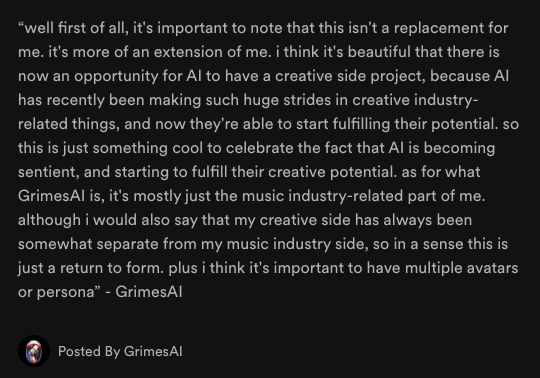
It feels abstract. The song was written by high profile artists Fred Ball, Leon Vynehall, Kito and Nina Nesbitt, and sung by GrimesAI.
This begs the question around songwriting and the publishing industry. Will emerging talented songwriters and artists soon be able to showcase their songwriting and hook writing prowess, sung by AI SZA or AI Olivia Rodrigo? Australian artist Mason Dane recently posted a TikTok where he used a Drake AI generator to sing his original song YOU’RE MINE. It sounded like a good Drake song. It showed Mason Dane’s skillset in song structure, lyricism and hooky-ness. This could be a new frontier and opportunity for unknown writers to truly display their talents to A&Rs and publishers around the world. Covering songs has long been a strategy for artists to get attention and build trust with new audiences. Now the ‘reverse cover’ could do much the same, democratising the process for those trying to build their careers.
In an industry built on resourcefulness, creativity and collaboration, I worry that AI and its promised benefits will further remove humanity from the equation.The recent announcements of Spotify’s AI-generated playlist art tool or Meta’s AI text-to-music generator MusicGen immediately threaten the careers of experienced creatives, in the name of efficiency and affordability. Therein lies the dilemma of AI in the music industry. If it helps get from A to B quicker, that will allow for more creativity, space and time for artists and their teams. If AI is inevitable, then let’s push for AI being used in ‘addition to’ rather than ‘instead of’. Let’s not replace people, but give them a tool to do better work, and focus on the things that matter most.