
The Difference It Made When Two White People Made the Ultimate Sacrifice For Civil Rights
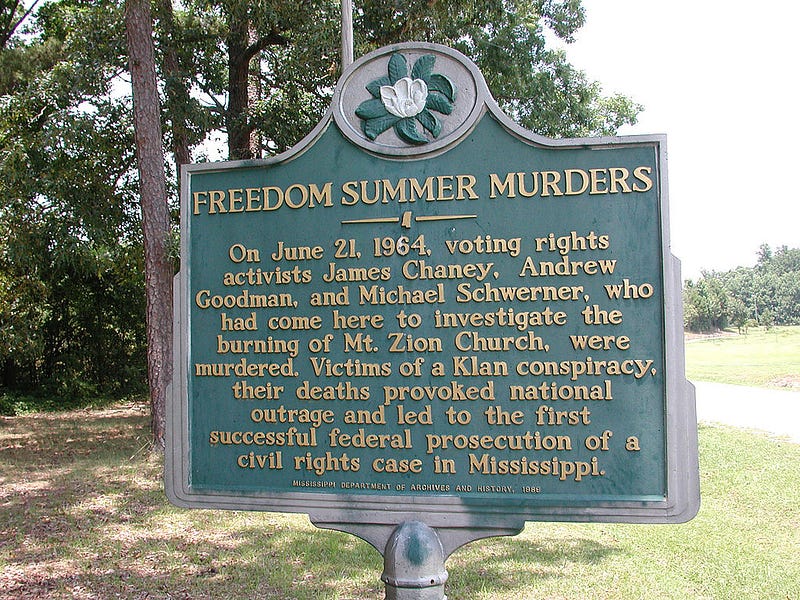
The argument is often made that Black History is just history. While it may have been distorted, minimalized, and omitted in various tellings, little Black History in America isn't part of a more extensive history needed to provide perspective. When writing about Black History, the contributions and sacrifices of white people cannot be ignored, much as the heinous and racist stories must be told.
I want to dedicate this story to two white people who lost their lives in support of the rights of others. They were labeled traitors to their race. I'll soon be writing about other individuals who knew the risk and still placed themselves in danger on behalf of Black Americans.
James Chaney was a 21-year-old Black man from Meridian, MS. He was returning close to his home turf when he drove to Philadelphia, MS, with 20-year-old Andrew Goodman and 24-year-old Michael Schwerner. Schwerner was a CORE organizer and former social worker from New York. Both Goodman and Schwermer were white and Jewish. I don't mean to diminish Chaney's contribution; he, too, gave his all, and I will tell his story another day.
Andrew Goodman
Andrew Goodman was an anthropology student at Queens College in New York. He came from a family steeped in activism, his mother being a lifelong labor activist. He attended the progressive, private Walden School from age three until high school graduation. When he was 14, he went to Washington, DC, to participate in the 1958 Youth March for Integrated Schools. At 15, he spent his summer in West Virginia in a poor coal mining town. He and a friend lobbied the governor to improve conditions. At 17, he joined a sit-in at a New York Woolworth's in opposition to segregation. He also helped invite Brooklyn Dodger Jackie Robinson to speak to his high school about breaking the color barrier in Major League Baseball.
The senators could not persist in this polite debate over the future dignity of a human race if the white Northerners were not so shockingly apathetic.— Andrew Goodman- 1964 High School Paper
During his junior year in college in 1964, Civil Rights Activists Fannie Lou Hamer and Aaron Henry with the NAACP recruited students to participate in the Freedom Summer project to help register African-Americans to vote in Mississippi and to set up Freedom Schools. That June, he met with James Chaney and Michael Schwerner at the Western College for Women (now part of Miami University) in Oxford, OH, where they taught hundreds of volunteers about the racism they could expect when they went to Mississippi. One of the Freedom Schools they established was at the MT. Zion Methodist Church in Philadelphia, MS, which the Ku Klux Klan burned down. Chaney, Goodman, and Schwerner drove from Ohio to Mississippi to investigate. It was there the trio was killed.
Michael Schwerner
Michael Schwerner was the oldest of the group. He grew up in Westchester County in New York; some people consider that "upstate New York." No one would argue that wealth abounds there. Michael left home to attend Michigan State, later transferring to Cornell, where he graduated with a major in sociology. He later entered graduate school at the School of Social Work at Columbia University.
Michael found a cause he supported, working for the Civil Rights of African Americans. He led a local Congress of Racial Equality (CORE) group on the Lower East Side of Manhattan called Downtown CORE. Schwerner joined a 1963 effort to desegregate Gwynn Oak Amusement Park in Maryland. John Lewis recruited Schwerner. He and his wife, Rita Schwerner Bender, volunteered to work for National CORE in Mississippi. The Schwerners were assigned to organize the community center and activities in Meridian. James Chaney was a local youth who started working with them there. Michael and Rita were the first whites to be assigned by CORE permanently outside the state capital of Jackson.
The Mississippi State Sovereignty Commission, a state agency, paid spies to keep track of northerners and suspected activists. The spies passed information like housing arrangements and license plate numbers to the state, who gave that information to the local sheriff. The Ku Klux Klan targeted Michael after he organized a boycott of a local white-owned store that sold goods to Black people but wouldn't hire them.
The Murders
“Deputy Sheriff Cecil Price arrested Chaney, Goodman, and Schwerner for an alleged traffic violation and took them to the jail in Neshoba County. The trio was released but not allowed to make a phone call to alert anyone. On the way back to Meridian, they were stopped by patrol lights and two carloads with members of the White Knights of the Ku Klux Klan on Highway 19, then taken in Price’s car to another remote rural road. Alton Wayne Roberts reportedly pulled Schwerner out of the car, pointed a gun at his chest, and asked, “Are you that nigger lover?”. Schwerner replied, “Sir, I know just how you feel,” before Roberts shot him in the heart. Goodman was killed by Roberts in the same manner, while Chaney was killed by either Roberts or James Jordan after beating, chain-whipping, and castrating him.” — Wikipedia
Their dead bodies weren't found for 44 days. The national media latched onto the story, likely because two of the Civil Rights workers were white. Rita Schwerner said if only Chaney, who was Black, had been missing, the media would have paid far less attention. Black civil rights workers had disappeared previously with little attention paid. The FBI was called in along with US NAvy sailors to help in the search.
Ten men were ultimately charged under provisions of the Enforcement Act of 1870. Seven were convicted, and in three cases, the jury was deadlocked. The only man charged with murder was Edgar Ray Killen, an outspoken white supremacist nicknamed "Preacher." Killen was convicted of manslaughter on June 21, 2005—forty-one years to the day from when the murders took place.
Why Highlight the Two White People
James Chapman is just as dead as Goodman and Schwerner and as much a hero. They are singled out because their deaths caused the media to pay attention to white supremacy when their default was to look away. The two young white men left their privileged lives to join the fight against racism. For them, freedom wasn't just a word; they believed in and fought for.
Had it not been for Goodman, Schwerner, and others like William Lewis Moore, Viola Gregg Liuzzo, and Rev. James Reeb. The progress made may have come slower. In telling Black History, the sacrifices of white people aren't always remembered. Without the combined efforts of Black and white people, success will always be a goal and not a result.


