
Grammar Tip
The Difference Between Your and You’re
When you use these words incorrectly, it completely changes the meaning of the sentence, drives readers crazy and reflects poorly on you.

Do you prefer to watch a video rather than read? Scroll down to see the video.
You learned in elementary school that homonyms are words that sound alike but have different meanings. Homophones are a type of homonym. They’re words that sound alike but have different meanings and different spellings.
Let’s talk about one of the most commonly misspelled and consequently misused set of homophones:
YOUR and YOU’RE
When you use these words incorrectly, it completely changes the meaning of the sentence, drives readers crazy and reflects poorly on you. I’m going to give you some tips so you’ll never mix these words up again.
YOUR is a possessive adjective. It usually comes before a noun or pronoun, showing that the noun or pronoun either belongs to you or is related to you.
For example:
Your home is lovely. Your mother’s cupcakes were delicious.
YOU’RE is a contraction of you are. If you can’t replace it with you are and have your sentence make sense, it’s wrong. Unlike so many other grammar rules, there are absolutely no exceptions to this one.
For example:
I hope you’re having a great day. You’re a smart person.
Your and you’re have inspired some great memes illustrating why it’s important to get them right. Such as:
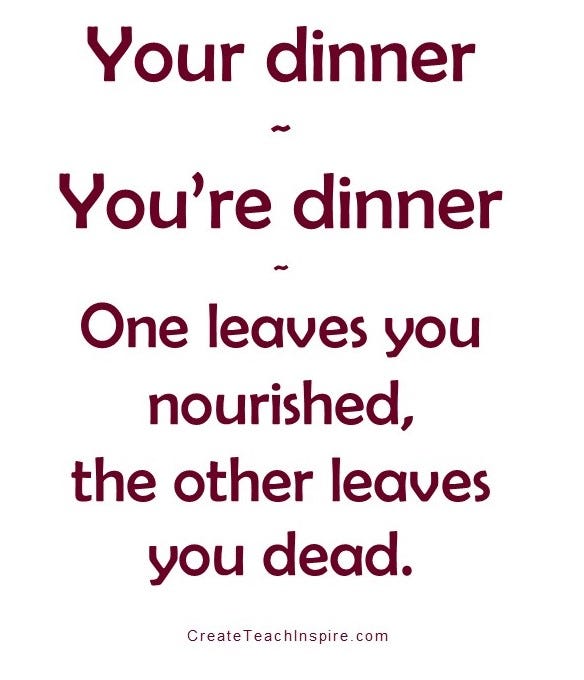
Your dinner You’re dinner One leaves you nourished, the other leaves you dead.
I’m sure you’ve seen others and I invite you to share them. The point is, it’s easy to get this one right.
Watch the video:
This article was originally published on my site at https://createteachinspire.com/the-difference-between-your-and-youre
You can reach me there or email me at [email protected]
Want more grammar tips? Check these out:
I’d love to connect with you! May I send a brief inspirational message every Saturday morning? Visit CreateTeachInspire.com/saturday to receive messages like these:


