
The Difference Between Using Logic Versus Emotion
How to know when to use logic and emotion to better your life
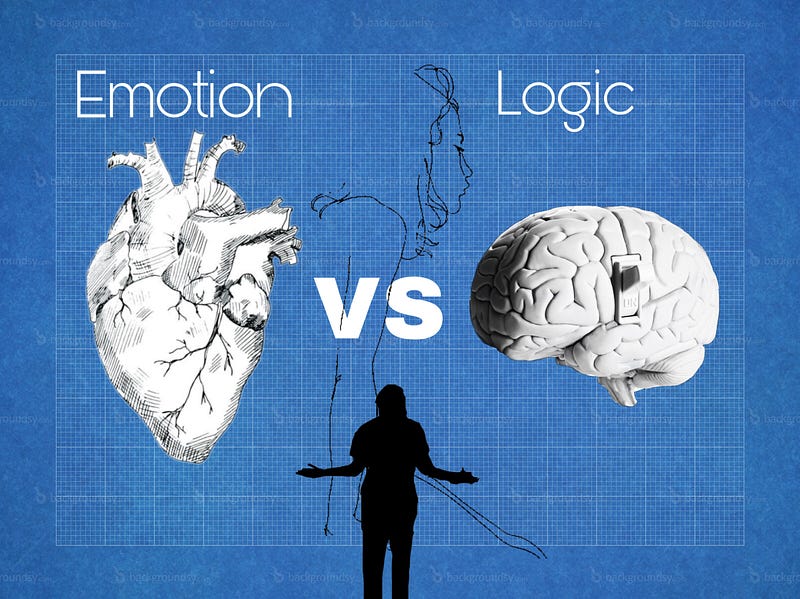
Have you ever reacted to your situation, which would later cause you to admit defeat and apologize?
It was 2015, and I was facing jail time for vandalism. I was upset from a previous altercation with a friend of mine. Instead of looking at the situation logically, which would’ve been to cease all communication and press charges, I decided to take matters into my own hands and vandalize her vehicle. That’s a perfect example of using emotion instead of logic.
Often, we tend to be more emotional than logical. Some examples would be debating on social media, arguing with family and friends, communicating with our partners, and even disciplining our children.
What happens when you learn to approach situations from a logical standpoint instead of an emotional one?
What is logic?
Logic is a tool to develop reasonable conclusions based on a given set of data. Logic is free of emotion and deals very specifically with information in its purest form. There are many subsets in the study of logic, including informal logic, formal logic, symbolic logic, and mathematical logic.
Long story short, being logical means approaching a situation with an understanding of the outcome. And addressing an issue with proof and comprehension of something without involving emotions.
When I see those sad animal commercials, it’s easy for me to get wrapped up in an emotion, and get angry at people who abuse animals, but what does that do? It does absolutely nothing but damages my psyche. Instead, I should approach the situation logically. For example, what can I do reasonably to change the outcome?
When you refuse to let your emotions dictate your actions, you can get so much done productively. However, that does not mean that emotion is not essential; they both have their place. It is learning when to use them. That’s a process that takes practice.
What is emotion?
Emotions are physiological states associated with the nervous system brought on by neurophysiological changes variously related to thoughts, feelings, behavioral responses, and a degree of pleasure or displeasure.
Being emotional can correlate to various elements. If you are approaching a situation from an emotional state, it can hinder your understanding of the opposing side, or even deflate your intelligence due to lack of logic. Emotions are caused by a signal coming from your heart to your brain; reacting on emotion is hardly ever a good thing.
Here’s a good example.
Much like my example above, if you watch that sad animal commercial, and approach it from an emotional standpoint instead of a logical one, what do you think is going to happen?
Using emotions, especially negative ones, for a situation that would require logic won’t do anything to solve an issue within the problem itself, or your well-being.
If, after watching that sad animal commercial, you decide to get upset, cry, and post your angry feelings about animal abusers online, what is that doing? It’s doing absolutely nothing but getting you emotionally exhausted. You aren’t solving any problems; if anything, you’re creating more problems because now you are upset. Not only you, but everyone else who sees that anger will reflect emotionally from it.
Examples of when to use logic or emotion
There’s a time and place for everything. There is a time to be emotional, and the time to be logical. However, deciding which time is right for which mental perspective, is a process that takes some getting used to.
Let’s look at a few examples of when it is good to use emotion:
- Personal experiences. Using emotion revolving around your own experiences allows you to be truthful to your story, whether you were telling somebody an account, or reliving your past.
- Loving somebody. Logic has a play as well; however, emotions are what give us connections – using a passion for expressing your feelings or concerns to one another.
- Meditation. When you’re trying to center yourself, or practice mindfulness, you’re allowing yourself to be raw in your emotions.
- Teaching your children. While not all learning should be emotion-based, they need to learn emotions from you. How to love, and how to handle stressful situations.
- Relationships. Whether it be your spouse, children, family, or friends, you show them how you care by using emotions.
Emotions are what separate us from robots. However, we can learn to avoid certain negative emotions, such as anger, sadness, lust, Etc. They are what makes us vulnerable. Think of the times you have made emotion-based decisions in your life, which had an adverse reaction.
Approaching situations with logic, not only corrects the outcome of whatever issue you’re approaching, but it also allows you to listen and understand opposite sides of the coin.
The best way to find yourself in a place where emotional action doesn’t lead to an adverse reaction, is by giving yourself more time between the problems you are facing. Resisting to act on that triggered emotion will enable you to analyze the implications of your actions and choose to logically, stray from being emotional.
Let’s look at some examples of using logic in place of emotions:
- Arguing online. Debating online has become the staple of getting the point across, but using emotions in a debate is not a promising impression. If you become emotional and upset, it’s hard to look at both sides. Let alone be taken seriously.
- Problem solving. To solve a problem, whether it be with a friend, spouse, etc. it’s best to look at the facts and approach the problem with logic. Being emotional just causes conflict.
- Spending. When spending money, using logic is essential. If you can’t afford it, don’t get it. Think of the outcome from future purchases.
- Judging. Can you imagine if a judge and jury made their ruling based on emotion?
- Goals. You are setting goals and standards for your future.
Methods to use for learning how to think logically
Comprehending how to think logically may seem like common sense. But it isn’t. It’s pretty tricky when our environment is filled with emotional triggers. Here are some of the ways I used to incorporate logical thinking into my life:
Mindfulness is an excellent method of understanding your thoughts when deciding to use logic or emotion. When practicing mindfulness, you allow yourself to recognize your feelings or emotions for what they are — fleeting moments that you can choose to dwell in, or dismiss. I often get emotional when I hear about child abuse, but then I sit and think about how my negativeness and emotions do nothing but upset me. So I dismiss them and approach from a logical angle.
Test your recall. An excellent way to practice thinking logically by testing your mental recall. It could be anything from thinking about what you’re going to add to your grocery list, what chores you have to do, or remembering activities you did last week. Pay attention to the slight details; over time, this will motivate your brain to utilize critical thinking and the ability to use logic.
Learn a new skill. I started doing crossword puzzles, and picked up water coloring, as side hobbies. It drastically boosts your brain when compartmentalizing tasks that need to be accomplished, or things that have to be memorized.
Watch for logical leaps. Logical leaps are leaps in judgment, when you assume something about a person or an action. Thinking that somebody doesn’t like you because of the way they’re looking at you is a prime example of using emotion. Try and remember that you can bypass any form of judgment by being aware of your emotional thinking.
Learn to take several steps back. If you feel like you’re about to get emotional, or something has triggered you, pay attention to those mornings. Take a step back and evaluate the situation; if you’re irritated, sad, do you think it’s the fairest time to respond?
These aren’t the only methods, but these, in particular, have helped me drastically. Straightforward mental devices.
Takeaway
It’s impossible to eliminate all emotional thinking. Nor should we try. Emotions play a significant role in assembling the fundamentals of relationships, family, and are the core of what makes us who we are. They allow us to express concerns and give credit to our stories and vitalities. But we shouldn’t let them be the staple of the way we interact.
Thinking logically is essential to growing as individuals. We can recognize a lot more in people and predicaments if we are capable of listening and understanding versus being emotional.
We can help how we feel, we can help how we act, and we can help what we say. It just takes patience and practice.