
The Difference Between Megan Thee Stallion & Taylor Swift
Yes, one is Black; the other is White. But, what does that mean?
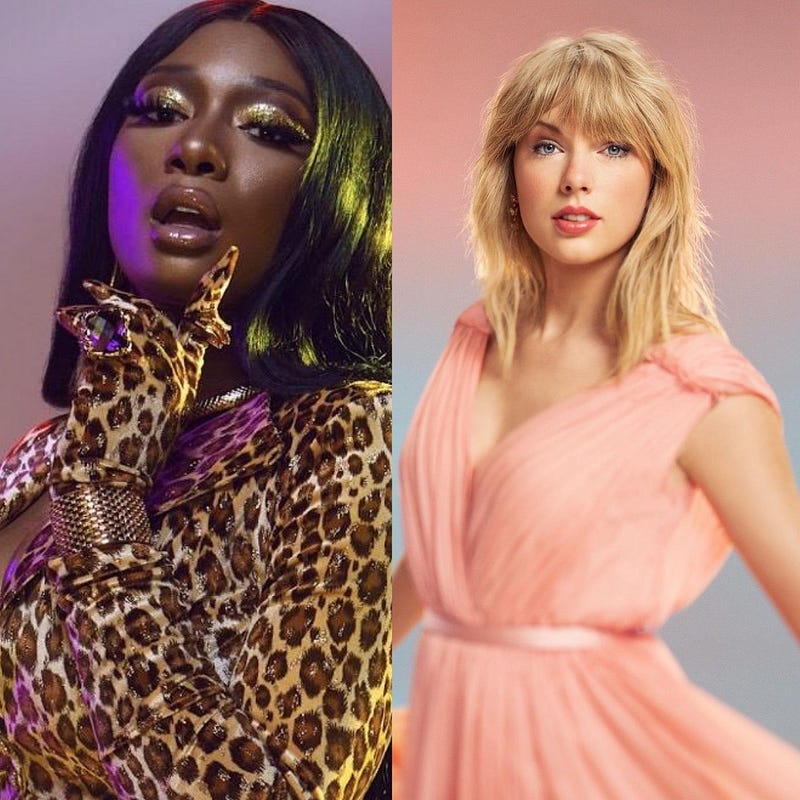
Megan Thee Stallion is a 25-year-old rapper from Houston whose song “Savage,” featuring Beyoncé Giselle Knowles-Carter, snatched the number 1 spot on the Billboard Hot 100 in May. The song was a Tiktok sensation, with Gen Zs and millennials alike chanting they were Savage, Classy, Bougie, Ratchet, with the moves to match. Actually, everyone and their mama was a savage. But, on July 12th, when news broke that Megan had been shot, the so-called kinship so many had with her was gone with the wind. Ridicule and memes ensued.
Why is that?
The world hates Black women.
Sure, people emulate our fashion and vernacular, dance to our music, and are entertained by us, but our pain is constantly trivialized.
Remember when Snapchat poked fun at the domestic abuse Rihanna endured?
Black women are the antithesis of the White damsel in distress trope. The White woman, she can garner sympathy in a way women of color — especially Black women — cannot.
Ever wonder why missing persons who make the news are disproportionately White women?
White women are the perfect victim — as odd and problematic as that sounds.
As for Black women, we are deemed obnoxiously loud, hypersexual, angry, masculine, strong, and, therefore, unworthy of protection.
Where did those stereotypes come from?
When Europeans invaded Africa, they took the barely-there attire of the natives as a sign of lewdness. Indeed, the colonizers pegged Africans as hypersexual due to their clothing. Sound familiar?
Saartjie Baartman, also known as Sarah, was a South African woman who was exhibited in London in a cage as the Hottentot Venus between 1810 and 1814. Her derriere was an object of fascination. In 1814, she was sold to a surgeon in France, and, once again, she was exhibited; this time, completely naked. French zoologists (yes, you read that right), anatomists, and physiologists conducted research on her “that formed the bedrock of European sick ideas about Black female sexuality.” After her death, her brain, skeleton, and sexual organs were displayed in a Paris museum up until 1974. Her remains were only sent back to South Africa in 2002.
The Black woman was Jezebel, and literature played a part in disseminating that message. African women were described as “hot constitution’d Ladies” who “are continually contriving stratagems how to gain a lover.”
Enslavers used that stereotype to justify raping enslaved women. In 1859, James Redpath, an abolitionist, wrote that enslaved women were “gratified by the criminal advances of Saxons.”
The Zora Neale Hurston quote comes to mind:
“If you are silent about your pain, they’ll kill you and say you enjoyed it.”
This othering of Black women formed the basis of our abuse and exploitation. The hypersexual woman deserved to be assaulted — actually, it’s not assault, because she wanted it. The angry woman must have thrown the first punch — and therefore deserved any ensuing violence. The strong woman can withstand the abuse, so, why make a big deal of it anyway?
During slavery, Black women were physically, verbally, and sexually abused, and forced to do manual labour — while also breastfeeding the children of their oppressors.
When thinking of all this, I recognize their trauma far ahead of their strength.
Black mothers lose their children at the hands of the police (similar to how plantation owners would rip their babies out of their hands to be sold) — and then must clock in, because their job is deemed essential.
Let’s not forget about the Angela Davises, the Claudette Colvins, the Ruby Bridges, the Sojourner Truths, the Assata Shakurs, and the Sarraounia Mangous of the world. When thinking of all of them, I feel gratitude, but I also lament the fact that so many of us sacrifice rest for the collective. That’s what I thought while watching the movie Harriet, too.
I’ve seen people of all races use the stereotypes mentioned throughout this article to justify our abuse. In Megan’s case, rumors surfaced painting her as the Angry Black Woman. It was said that she attacked her assailant first, which she later said was false. As for R.Kelly’s underage victims? Well, they dressed and acted too grown — which is in line with the Jezebel trope.
It is easy to poke fun at Black women’s pain, because our abuse is normalized, and we are somehow always to blame. We can take it, after all, since we’re so strong. As I’ve said many times: White supremacy has impacted the way the world — including other Black people — thinks about Black women.
Black women are not protected.
You’re a feminist, why do you need protection anyway?
We’re part of society, and everyone deserves to be advocated for. It took months for Breonna Taylor’s story to reach mainstream media, and her killers Brett Hankison, Jonathan Mattingly, and Myles Cosgrove are still free.
I am happy so many people are speaking up for her now that her story has seen the light. Many NBA players are answering post-game interview questions with #JusticeforBreonnaTaylor.
But, still, as pertains to the fair treatment of Black women, we still have a ways to go.
Black women are not protected.
As for White women, they are extolled as the image of purity. Sure, there is the Karen meme. But, when a White woman gets hurt, the world stops — except if we’re talking sexual assault and the perpetrator is a White man. In that case, that purity is called into question.
Remember when Kanye West stole the mic from Taylor Swift? Remember how she was painted as the helpless victim, and Kanye, the monster? Now, of course, what Kanye did was wrong and merited a call-out. But, where is that same energy when it comes to the mistreatment of Black women?
I am 100% sure that had a high-profile white woman been shot in both feet, the world would have stopped.
White women like Taylor Swift are not, however, always treated with respect by the media. Taylor was ragged on, as Megan was, for dating too many men. After all, a hypersexual woman (or a woman believed to be hypersexual) is a bad woman. But, her whiteness remains a shield.
So, yes, Taylor’s seemingly active dating life was frowned upon. But, no one can physically harm her without the world rallying around her to offer support— and that’s how it should be. Black women deserve that support too.
I’d be remiss, though, if I didn’t mention how society treats people with mental illnesses. Britney Spears and Amanda Bynes, both White women who’ve experienced public meltdowns, have been and continue to be the butt of jokes. That speaks to the fact that people with mental illnesses too are othered. Granted #FreeBritney is now picking up steam, but that came after years of memes and ridicule. Would the public turn her physical abuse into a joke if — heaven forbid — something were to happen to her? For some reason, I don’t think that would be the case. The line is drawn far sooner for White women.
Part of anti-racist work is addressing the myths surrounding Black women. Yes, Black women have endured a lot. But, how about we dismantle the systems that have made us have to be so strong instead of applauding the fact that we’ve adapted to a hostile environment? When you see abuse turned into memes, before hitting that retweet button, think about what exactly you’re sharing and the impact it’ll have on generations to come.