
What Is Happening to My City?
How coronavirus, corporations, and racism will restructure society
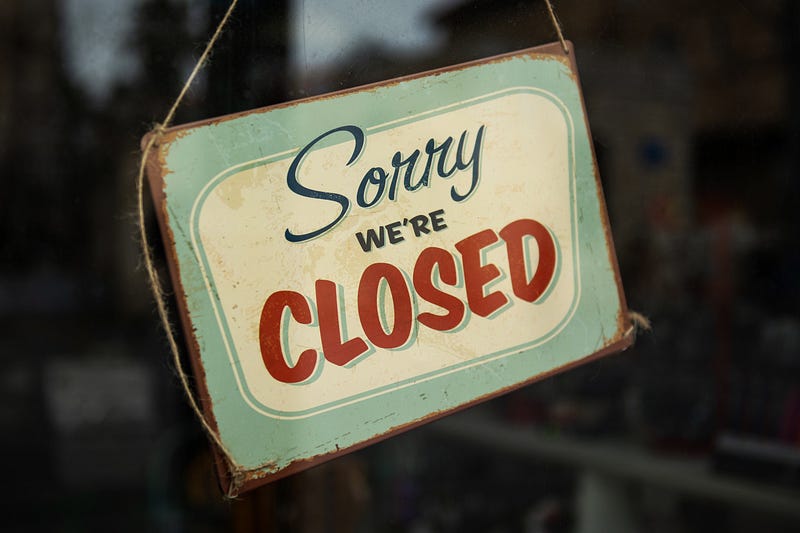
I have to say — I’m really stressed right now. I just received another email, this time from a local Black-owned bakery, that said they were closing their doors permanently due to the coronavirus pandemic. A few months ago, when the government began ordering certain industries to close, I was certain that financial help would be made easily available to small businesses.
Whether it took the form of freezing mortgage payments or giving out loans with no approval required, it didn’t actually occur to me that some businesses would be left to fend for themselves completely. It seemed this entire situation was unique in that the government was telling businesses to close, with no alternatives.
Overnight, independently-owned businesses, many with no substantial online marketing experience or the means of selling services and products online, let alone having a team of people to rely on for support, would be left to completely restructure the ways in which their businesses operated.
Some independent businesses have flourished online. Those selling goods like clothing, crafts, artwork and others of the like, have actually been able to keep their businesses afloat due to enormous amounts of people being home and on their computers.
It seemed this entire situation was unique in that the government was telling businesses to close, with no alternatives.
But for lots of brick-and-mortar small businesses in industries such as health and wellness, food service, beauty, and countless others that are unable to offer the same services or the volume of business required to stay afloat, things have been looking grim for awhile now.
I live in a major Northeast city, where corporations absolutely have a presence but it’s by no means overwhelming. It’s one of the things I love about my city — on any given block, there’s a restaurant or shop to wander into where you’ll be greeted by the owner herself.
It seems monstrous, and in some ways, disturbingly strategic, that many corporations were allowed to stay open when so many independent businesses in similar industries were forced to close. Not to mention, corporations have the financial means to quickly restructure their business models and strategies to adapt to changing societal conditions, with entire departments of people at their disposal.
It’s well-documented that companies such as Amazon aren’t hurting for money right now. With the recent announcement that Jeff Bezos might become the world’s first trillionaire, it’s hard not to feel disgusted by Amazon’s inability to simply pay workers the wages they deserve for working during a multifaceted international crisis, in both warehouse and similar on-the-ground positions for companies like Whole Foods.
The power of convenience will destroy this world. Corporations get away with this kind of behavior because many people rely on the ease of their services, the means by which they operate only being attainable by insurmountable wealth.
What does the future look like?
Small businesses closing means much more than people realize. Independently-owned businesses are essential to the cultural perservation of communities. A neighborhood is shaped by the businesses that reside there. It’s been proven countless times by processes such as gentrification: cities change when neighborhoods change. When cities change, how do states change?
These are seriously the only options?
There seem to be two sentiments that are the loudest above all the noise of this calamity. If you think businesses should reopen, you’re deemed an immoral capitalist who condones the death of thousands of people. If you want society to continue to wait for more advancements before reopening, you’re overreacting and completely dismissive of the thousands upon thousands of people who will be permanently affected by business closure.
As a result, we’re left with this: it’s either businesses permanently close — some of which are long-standing gems of communities, and closure would put employees out of work, owners in potential bankruptcy, and cause morale to plummet — or open everything back up and kill who knows how many people.
These are seriously the only options?
Being forced to choose between these two outcomes only exacerbates already opposing attitudes. It’s not fair to brush off independent companies closing as simply what has to happen for society to stay safe, but it’s also immoral to trade lives for business. How did we even find ourselves at this ridiculous crossroads?
My brain is splitting open trying to understand how the “richest” nation in the world refuses to do the legwork to ensure everyone succeeds, not just companies massive enough to gorge on profits made from an international crisis. Choosing a lesser of two evils is not the problem, it’s a symptom of the problem. The problem is that those who have the most power in this country will hand-pick the businesses that succeed in the long run, and completely ignore all others. Often, the chosen ones do much, much more damage than good.
Racism and inequality at every turn
There are, of course, loans available to help small businesses through this crisis. But just because a business applies for one does not mean it will be approved for one. Many states and the federal government aren’t even releasing the names of businesses that are being denied funds for the Paycheck Protection Program and similar “life-sustaining” economic relief programs. Which leads me to believe that, of course, the process of obtaining this particular kind of loan (or any loan, long before this crisis) is plagued by racism and inequality.
Almost half of the 1 million Black-owned businesses in the United States had failed by April, due to being denied loans, lack of bank credit, and countless cancellations in their respective industries.
CBS News recently came out with an article stating that a staggering 41% plunge occurred in the number of Black-owned businesses in the United States since February. Yes, you read that right. Almost half of the 1 million Black-owned businesses in the United States had failed by April due to denial of loans, lack of bank credit, and countless cancellations in their respective industries. Blatant and historical racism are destroying the ability for Black-owned businesses to survive this crisis.
With this information in mind, it’s impossible to conclude that what’s happening to small businesses is a necessary evil. Communities will simply not recover from losing the bread and butter of their neighbourhoods. How will this crisis further abolish generational wealth in communities of color, when it was already largely denied to them to begin with? With each passing week, more and more businesses will permanently shut their doors.
This has been proven countless times in history: corporations do not care about their employees or the well-being of society. Their owners will never know the names of the people who are most affected by their negligence and greed, and have proven time and time again that bad publicity will amount to nothing. Which leads me to the scariest question of all — when all the independently-owned businesses in my city fail, who will replace them?
I think we have our answer.
Read the CBS News article about Black-owned business closure here.


