
The Delight of DIY Mechanical Models in Unschooling
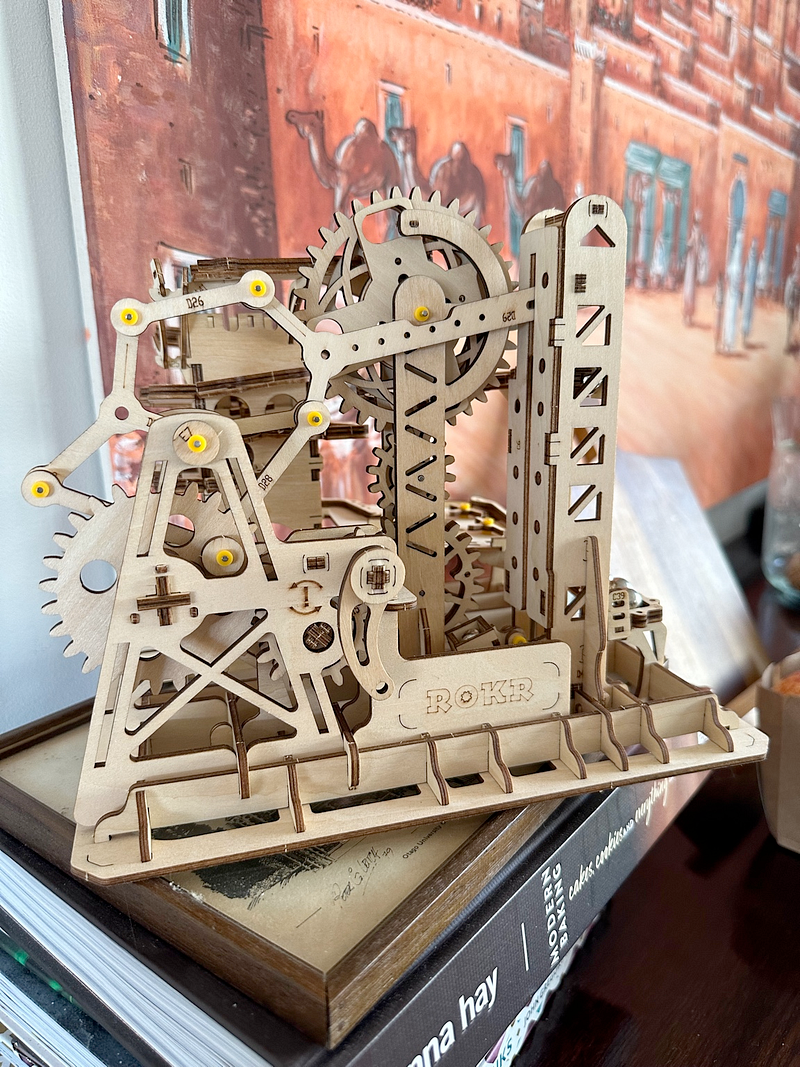
In recent months, a new passion has taken hold in our household — one that has not only brought a wealth of focus and joy to our 8-year-old but has also carved out precious bonding time with dad.
It all began when we introduced him to his first DIY mechanical models.
At first glance, these wooden puzzles seemed like a challenging endeavour for a child his age, but what unfolded was nothing short of marvelous.
With each piece my son fitted together, I watched my son’s eyes light up, his little hands working with a determination and precision I hadn’t seen before.
The living room floor became a workshop, scattered with gears and wooden panels, each waiting to find its place in the grand puzzle.
What surprised me most was the silence that accompanied this activity — the kind of deep focus that is rare and precious in the bustling life of an energetic 8-year-old.
With every model, I also got to watch my son’s confidence soar. The joy on his face when the gears turned for the first time was a picture of pure accomplishment.
This wasn’t just playtime for him — it was a triumph of persistence and learning through experience.
And by his side, his dad, sharing in every moment of frustration and success, their bond strengthening with each turn of the gear.
Imagine a wooden mechanical model: gears interlock in perfect harmony, each piece meticulously designed to contribute to the whole. There’s something almost magical about watching a mechanical model come to life through the power of one’s own hands.
The process of assembling these models teaches the importance of following directions, understanding mechanics, and the satisfaction of creating something functional from a seemingly random assortment of parts.
Unschoolers thrive on direct engagement with their interests. Building a mechanical model provides a tactile experience that textbooks simply cannot match.
It’s about seeing the physics of motion unfold in real time, feeling the tension of a spring, or hearing the click of gears meshing together.
This hands-on work cultivates a deep understanding of mechanical principles that govern everyday objects.
Patience is also a virtue, as they say, and nowhere is this more applicable than in the construction of a mechanical model.
Each piece must be placed with precision and care — a lesson in perseverance, too, as sometimes it takes multiple attempts to get it just right.
Unschoolers learn that the most worthwhile things in life often require the most effort and that setbacks are not failures but opportunities to learn and improve.
The benefits of such activities are also backed by research — engaging with mechanical models can enhance spatial reasoning, problem-solving skills, and even improve concentration.
For unschoolers, these skills are learned within a meaningful context, making the learning more likely to stick.
We’re also talking about inter-discplinary learning too — not just engineering and physics at play, but artistry in the design, history in the type of mechanism being constructed, and language arts that can all be integrated as students document their process or write about their learning experience.
It’s a holistic learning experience that ties multiple subjects together seamlessly.
And once unschoolers become comfortable with the basics of mechanical models, they can move on to customisation. This is where creativity really takes flight.
They can paint their models, modify them, or even try to build their own from scratch. It’s a fantastic way to bring art into STEM (Science, Technology, Engineering, Art, and Mathematics), turning it into STEAM.
In an unschooling setting, there should also be no fear of failure, because mistakes are not seen as setbacks but as part of the learning process.
When a gear doesn’t turn as it should or a piece doesn’t fit quite right, it’s a chance to troubleshoot and problem-solve.
This fosters a growth mindset — an essential life skill that teaches learners to embrace challenges, persist through obstacles, learn from criticism, and find lessons and inspiration in the success of others.
Building a mechanical model therefore isn’t just academic; it imparts real-world skills.
From reading instructions and understanding diagrams to managing small parts and tools, unschoolers gain practical knowledge that is directly transferable to real-world scenarios.
Unschooling often also involves community learning, and mechanical models provide a perfect opportunity for this. Learners can collaborate on projects, share techniques, and even teach others how to build their own models.
This fosters a sense of community and reinforces social skills.
In the unschooling approach, every activity has the potential to be a rich learning experience.
Constructing mechanical models is an example of a compelling and multi-dimensional way to learn, blending practical skills with academic concepts.
It encourages a lifelong love for learning, creativity, and curiosity. Whether it’s a wooden puzzle or a metal model, the learning that comes from such an endeavour can be as intricate and interconnected as the gears within it.
For any parent or educator considering incorporating mechanical models into their unschooling curriculum, the benefits are clear — it offers a hands-on learning experience that not only builds knowledge but also character.
In the end, it’s not just about the model that’s built, but about the lessons learned and the person who emerges from the process.


