
The Deconstruction of Faith is NOT the Destruction of Faith
How Do You Question A Belief?
To put it simply, the work of a philosopher is to explore an idea when coming across it, no matter how trivial or profound, because the truth must be shown as it is.
So what happens when I read an article that asserts something definitively?
Yep! I question it.
Yesterday, I was at the dog park, scrolling through my phone, and I came across an article I knew I had to talk about. The article was The First People to Deconstruct Their Faith by Samuel Sey. I won’t go into detail about the entire piece, but the sentiment was clear. The overall idea was: the act of deconstructing one’s faith is the same as destroying their faith. On top of that, it is also an act of destroying one’s soul.
The thought stuck with me the rest of the day, and I had to explore it.
Now, I’m not particularly religious in the conventional sense, but I am accustomed to questioning ideas. So I broke the argument down.
To deconstruct is to tear down, or to disassemble, but it isn’t to obliterate. Deconstruction is a process of bringing something down, breaking a thing into parts, in order to see the parts individually that make up the whole.
When you deconstruct a building, we assume it’s in order to renovate it, to make it better, or perhaps the building is torn down so something else can be brought in. This is, of course, the superficial sense of deconstruction.
Imagine now you deconstruct an idea, or a belief. You start with the first statements, the blank assertion of what the belief says, and you follow up with the assumptions within. Why do you believe what you believe?
This can also be seen in mathematics. We’re given an equation, a blank assertion, and are asked to solve or prove what it is or what it means.
In the case of an idea, we deconstruct the thought, sift through the assumptions, so we can better understand why the idea remains.
Now, revert to the notion that the deconstruction of faith is to destroy it. How so?
To deconstruct one’s faith would mean to break it apart for a reason. The purpose of deconstructing any belief isn’t simply to break it down bare and deny or dismiss it. We break down our beliefs so that we better understand them, so we know what we fundamentally assume when we actively believe something.
What would it mean to destroy one’s faith? This would mean to demolish it, ruin it, or completely tear it down so that it’s no more. Destruction doesn’t always have a reason; a purpose for the ruination. To destroy faith would be to rid oneself of it.
I imagine this would be alarming to any religious fellow, especially if one connects the act of deconstruction as equal to doubt. But I offer an idea; a kind of saving grace.
Doubt is easy, but it takes discipline to question.
And so, Friedrich Nietzsche’s most popular quote comes to mind!
“That which does not kill us makes us stronger.”
Nietzsche’s notion is a statement that we can overcome odds, and when we do we are all the better prepared for future harms. But this isn’t meant to be applied in merely superficial matters. Nietzsche was also referring to matters of the mind and belief.
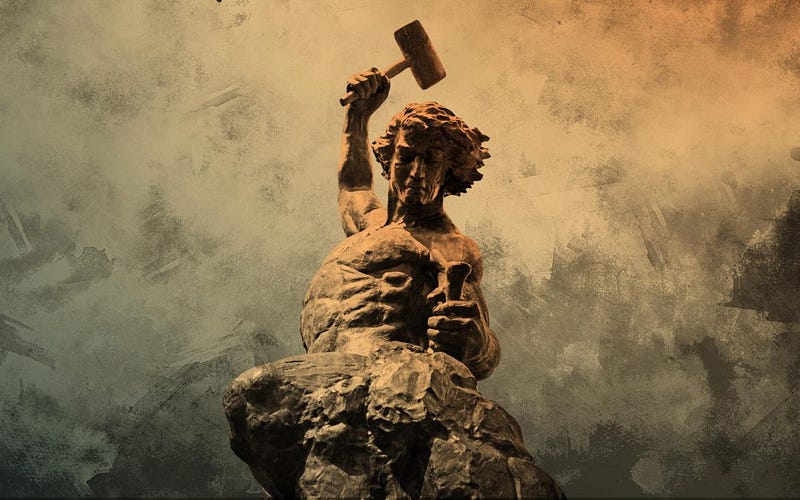
Nietzsche demonstrates this in Twilight of the Idols, or, How to Philosophize with a Hammer. There is a story of a sculptor and his son. The sculptor asks his son to watch over his work, sculptures of his idols, and he comes back to the sight of all his work destroyed while his son stands there with a hammer. In short, the son breaks the idols in order to raise the question to his father: With your idols broken, do you still believe?
Crude? Yes. Important? Absolutely.
I question what I believe because I firstly want to know precisely what my beliefs mean, and secondly to decide what must be done with my belief should I find something that could lead me to unbefitting conduct.
Question by doubt, but doubt with the aim of deconstruction. Deconstruct the belief and see if the belief survives. If the belief survives, then the belief is stronger, not because it was broken, but because it was understood.
The same principle can be applied to faith. Who said questioning or doubting faith meant it was also destroyed in the process? Perhaps the fear of doubting at all was for the concern of the soul. But how does one make the soul stronger? Simple! Put it through the ringer. Make the soul face its trials. Deconstruct it, because it is through the deconstruction that a thing can be understood. Knowing a belief, a faith, or a soul comes down to looking at its parts and seeing what remains — to see what makes it survive.
There is much more to be said about the concepts of faith/belief and how one ought to face its trials, but I ought to break it down for another day. After all, often times our beliefs make us who we are, and I hope for a goodness we can all share. But we have to understand ourselves, and it takes a great amount of patience and time to break things down sufficiently for all to see.
What are your thoughts on the matter?


