
The Debate on School Shootings in the United States
A summary of some of the key ideas and arguments made in recency on gun control and school shootings.
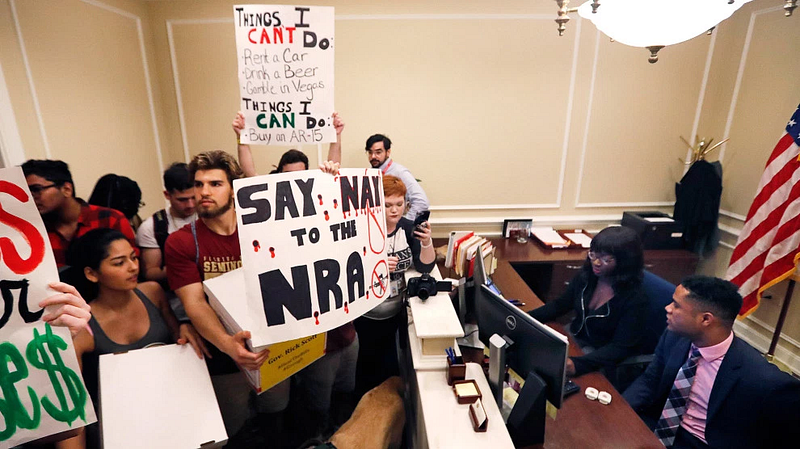
On February 14, 2018, the United States was hit by yet another school shooting, in Florida this time.
The horrific scene of students running from their school in Parkland was seen in news outlets. The Parkland shooting resulted in the killing of 17 people, and is regarded as the deadliest since the Sandy Hook shooting back in 2013, which had resulted in the death of 26 people. The Parkland shooting is also the 18th school shooting in 2018 alone. Since 2013, there have been about 300 of them, making the United States the country with the most school shootings in the world.
The images of stand-offs and barricaded schools and people getting killed and injured in schools is, thus, an all too familiar scene in the United States. Americans disagree on how to address school shootings because the subject of gun control, which is usually ignited by school shootings, is a controversial subject.
Conservatives and pro-gun groups argue that guns are not the real cause of school shootings. Anti-gun groups and politicians, on the other hand, argue that guns should be controlled to address school shootings. Here, we take a look at the liberal and conservative views on the causes and effects of school shootings and analyze the validity of these arguments.
Causes of School Shootings in the U.S.
Guns
The most controversial of the possible causes of school shootings is guns. Some Americans, especially liberal ones, argue that school shootings are happening because people can easily get access to guns and weapons. The U.S. has the biggest stock of personal firearms in the world. At the same time, it has the weakest and most lenient set of gun regulations.
Critics of guns call for stricter gun restriction laws that would minimize the incidences of shootings, as this would keep guns away from people who might want to use them. Senator Cory Booker, a Democrat, stated after Parkland; “Our nation must act on gun violence” (McCowan 1). This side of the debate argues that whatever the other contributing issues, shootings are perpetrated by the use of firearms. If kids did not have access to guns, they would act out on and kill people at schools regardless.
On the flipside, pro-gun Americans contend that guns are not responsible for killing people but people are. In fact, they contend that guns keep schools safe. The National Rifle Association (NRA) has stated that “more guns will make schools safer and prevent massacres” since teachers and staff would be armed to protect themselves (Baker and Shear 1). They state that putting in place stricter gun laws would not necessarily reduce the risk of shootings because people who are willing to break the law and kill people will not abide by gun restriction laws. Further, they argue that the right to own firearms is a Constitutional right provided by the Second Amendment.
Mental Illness
Pro-gun Americans often cite mental illness, not guns, as the cause of school shootings. They argue that perpetrators of shootings are almost always mentally ill. In the aftermath of the Parkland shooting, for example, the Trump administration stated that mental illness is the primary cause of shootings (Gilligan and Lee 1). There is a wide range of mental disorders such as mood and anxiety and mania disorders that compound the problems that shooters face. They feel the need to act out to show the world how they feel and how painful their problems are.
Effects of School Shootings
School shootings can have an impact on the students’ learning and on schools. The extreme violence that is associated with shootings can make students and parents decide to change their school enrolment patterns (Beland et. al. 123). Students may also drop out as a result of a violent shooting. The trauma that results can have a negative impact on the students’ likelihood of attending school, their performance in tests, the likelihood of graduation, and the possibility of suspension.
School shootings also have a political effect. They have prompted both state and federal governments to debate gun-control laws. We have seen Congress, courts, rights groups, and national institutions proposing their ideas on addressing school shootings.
In some schools, bullet-proof supplies have been created such as bullet-proof bags, desks, doors, and boards among others, creating a boom in the security industry (Hsu 1). Response and countermeasures for schools are being considered as part of the policy debates sparked by school shootings. Schools and colleges have been asked to be keen on the student behavior. Numerous behavioral intervention systems have been put in place to respond to behavioral concerns. The idea of arming teachers has also been discussed as a possible countermeasure though it has received some concerns from some teachers.
Analysis of Arguments
The argument that guns are contributing to the problem of school shootings in the U.S may be sound. Evidence shows that the frequency of death through guns in any community is directly proportional to the number of firearms that are owned by that community (Gilligan and Lee 1).
States with substantially more gun ownership than others have more cases of suicides, murders, and unintentional gun deaths. In the same vein, countries that have higher figures of firearm ownership also report higher gun death figures. Gunshots are seven times deadlier than a knife. Gun are also more prone to be used for mass killings such as school shootings than other weapons such as knives.
The argument by conservative politicians that mental illness causes mass murder is, however, not factual. Not all murders are attributable to mental illness.
Only one percent of homicides have been attributed to insanity by the courts. In the same vein research has found that only a few portion of mass murderers to be mentally ill.
Only 22 percent of mass murderers have mental illnesses; the other 78 percent do not (Metzl et al. 245). This shows that a significant majority of mentally ill people are not violent. Thus, the argument that links school shootings to mental illness probably has less credence despite its popular associations and portrayals in the media as the reasons behind mass shootings.
Conclusions
The recent Florida shooting is one of the numerous cases of school shootings in the U.S. Schools in this country experience significantly higher rates of mass shootings than any other country in the world. Due to this, the issue has sparked policy and political debates, especially around gun control and gun violence as well as other possible causes such as mental illness. The argument that mental illness is responsible for the problem possesses less definitive and causal factual support in the context of psychological studies.
Guns, however, have been shown to be a major factor in school shootings. Thinking ahead, there are potential hurdles to possible solutions. There will be serious opposition by bodies such as the NRA who are there to protect the interests of gun owners who rely on the Second Amendment. Another possible hurdle might involve moving liberal viewpoints and language from “gun control” (a phrase that puts off gun owners and encourages more gun sales) to “gun safety.”
PS: If you’ve enjoyed my work and want to support me, you can become a Medium member using my link for a relatively low cost of $5 or so per month!
Further Readings
Baker, Peter, & Shear, Michael. “Another Shooting, Another Gun Debate. Will the Outcome Be the
Same?” New York Times, 22 Feb. 2018, https://www.nytimes.com/2018/02/22/us/politics/school-shooting-gun-debate.html. Accessed 6 Mar. 2018.
Beland, Louis-Philippe, and Dongwoo Kim. “The effect of high school shootings on schools and
student performance.” Educational Evaluation and Policy Analysis 38.1 (2016): 113–126.
Gilligan, James, & Lee, Bandy. “Look at the Root Causes of Gun Violence.” USA News, 21 Feb.
2018, https://www.usnews.com/opinion/policy-dose/articles/2018-02-21/after-florida-school- shooting-look-to-the-root-causes-of-gun-violence. Accessed 6 Mar. 2018.
Hsu, Tiffany. “Threat of Shootings Turns School Security Into a Growth Industry.” New York Times,
4 Mar. 2018, https://www.nytimes.com/2018/03/04/business/school-security-industry- surges-after-shootings.html. Accessed 6 Mar. 2018.
McCowan, Candace. “School shooting in Florida reignites gun control debate among politicians.”
ABC News, 15 Feb. 2018, http://abc7ny.com/school-shooting-in-florida-reignites-gun- control-debate/3087650/. Accessed 6 Mar. 2018.
Metzl, Jonathan M., and Kenneth T. MacLeish. “Mental illness, mass shootings, and the politics of
American firearms.” American Journal of Public Health 105.2 (2015): 240–249.


