
The Death of the Cover Letter: Myth or Misunderstanding?
Plus a formula that will help you write a great cover letter in minutes.

There is a myth that hiring managers don’t read cover letters anymore, and it’s not entirely true. The truth is, if your resume does not support your candidacy for the role, your cover letter may never get read. However, if you are in fact qualified and your resume shows it, a great cover letter could set you apart from other qualified applicants. I certainly read cover letters, and sometimes they make or break my opinion of an applicant.
A great cover letter plays multiple roles: it’s a pitch for your candidacy, it’s a writing sample, and it’s evidence that you’re an effective communicator. The cover letter is also a great place to get creative. Show your personality, show your passion, show what you’re best at and what you care about.
The case for customization:
A great cover letter is one that’s clear and concise and keyword rich. Ideally, it should also be customized to respond to each specific job posting that you target.
It can be exhausting to write a brand new cover letter for every role, especially if you can’t be sure any human will ever read it. Most people don’t bother. Instead they use a generic cover letter for all applications. This is a mistake — especially since you can follow a simple formula to make your cover letter writing process both efficient and effective.
The cover letter is your chance to show the recruiter and hiring manager that you are eager and uniquely suited to the role. You cannot do that if you don’t customize the cover letter based on the job posting and your research on the company.
Start with a generic cover letter as a base. Customize it for each role. If you’ve done your research and you have a rolodex of stories (check out my article on interview prep for more on the rolodex) this will take you mere minutes.
Make sure it’s addressed to the hiring manager by name, and includes the title of the role and the name of the company. From there, the best way to customize is to prove that your strengths match the requirements of that specific job.
Not a writer? Here’s a formula:
If creative writing is not your strong suit, you might struggle to write a Cover Letter. To make the process easier, you can follow a basic format.
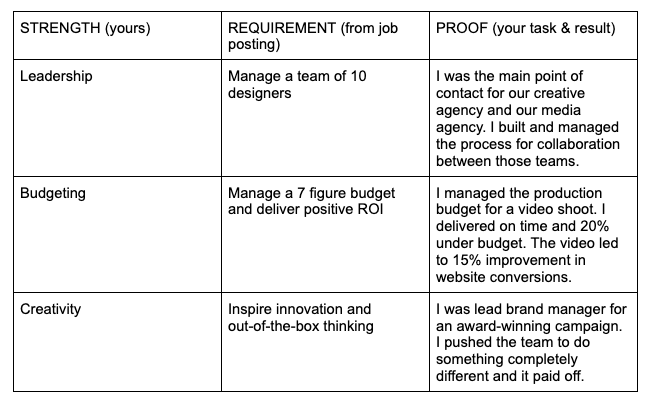
Start by listing three of your strengths that you believe are most relevant to the role. These become the themes of your body paragraphs.
Your goal within each body paragraph is to connect that strength to a requirement for the job, and provide an example that proves your point. Make sure you describe both the challenge or task, and the result or success.
It might be helpful to create a table to organize your thoughts before you write them into letter form. Here’s an example:
You can string these ideas together using another basic formula:
This role requires ____(strength)___. I possess this quality. I was once challenged with _(task)___. The result was ____(result)____. This experience taught me the skills needed to ____(requirement)____.
This formula is intended to help with paragraph structure, not exact wording. Apply the formula in your own words, and aim for writing that is eloquent, concise, and displays your authentic voice.
While writing this body content in prose is advantageous for roles that require excellent written communication skills, it may not be necessary for all roles. In the case of a highly technical role with little emphasis on writing, you could even paste your body content into the letter in table or bullet form.
Once you’ve written your body paragraphs, go back and add your intro and conclusion. The goal of the intro and conclusion is to show eagerness for the role or company. Show them that you want it, and that you’re a culture fit.
An easy way to write an intro would be to simply say something along these lines:
Please consider my application for ____(role title)___ at ___(company name)___. The job posting caught my eye because _________. I believe you’ll find me to be a great fit for the role.
A basic conclusion formula could look like this:
Given my skills and experience, I believe I will thrive and excel in the role of __(title)___. I’m eager to contribute to ___(company name)__’s growth through __(department)___ and to learn from members of your team. I look forward to hearing from you to further discuss my candidacy for this position.
Finishing touches:
Do not underestimate the importance of proofreading. Read it out loud to make sure it flows nicely. Check your grammar and spelling — the free version of Grammarly is great for this. I have disqualified applicants due to typos in a cover letter — specifically for roles where attention to detail is an important requirement.
Once you’re done proofing it yourself, consider asking someone else proofread your cover letter. They might notice things you didn’t, or interpret certain parts differently than you intended.
If you’re submitting your cover letter by PDF, match the font and design to that of your resume for polish.
If the company didn’t specifically ask for a cover letter but they’ve provided a field for “other comments”, paste your cover letter there.
If there is no specific request for a cover letter and no “other comments” field, either include your cover letter as page 1 of your resume file, or use the cover letter as the text for an email to the recruiter or hiring manager.
A well-crafted cover letter is a great tool for obtaining an interview, so try to view it as an asset instead of a chore. If nothing else, crafting a story about why you should get the job is great prep for when you finally land an interview.


