
The Days of the Hermit Writer Are Long Gone
Is writing still the perfect endeavor for introverts?
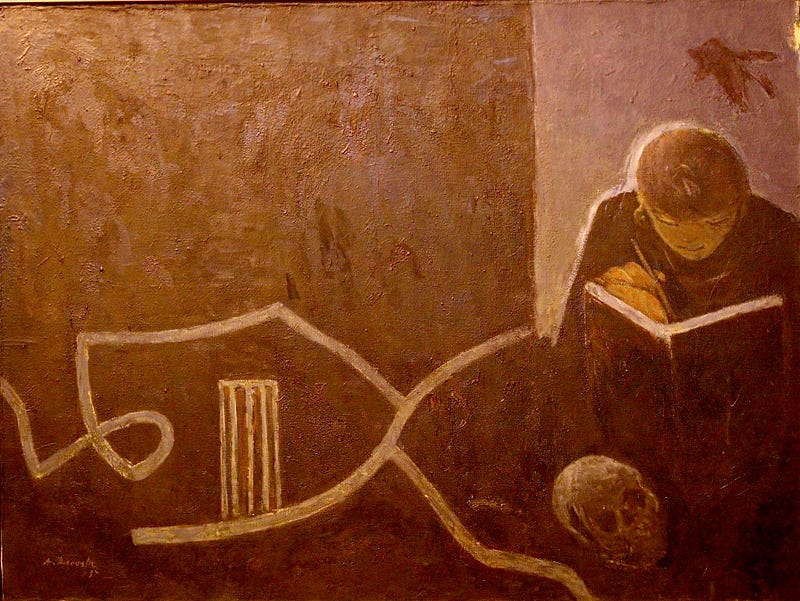
If only we could travel back in time and ask Emily Dickinson how she wrote all of her poems secluded in her room, rarely setting foot outside. She watched her father’s funeral from her bedroom window. While she didn’t become well known until long after her death, at 55, her 1,000+ poems were found in her desk after she died. Truth is, her art might have died with her had she belonged to this era.
“In her later teens, Dickinson assembled a book of pressed flowers numbering over seventy specimens, each meticulously labeled with their Latin nomenclature. Perhaps this was a prelude to how, at the age of about thirty, Dickinson began the practice of transcribing her poems to sheets to be stitched together into manuscript books or fascicles, carefully hidden away throughout her lifetime, found in her desk after her death.” — Hermitary.com
Emily Brontë wasn’t Miss Congeniality either. Had she lived in our times, “Wuthering Heights” might have never seen the light of day. She rarely spoke to people, her sister Charlotte said.
How about Marcel Proust? Enough to say writer Leon-Paul Fargue recalled him as “the man who no longer lives outdoors or by day, a hermit who hasn’t emerged from his oak tree for a long time.” He slept during the day, he wrote during the night. He withdrew to live in utter solitude.
There was a time when writing used to be the perfect endeavor for introverts. They just had to put words on paper. That was it. Could they have pulled it off today?
Many literary works took ages to surface. But they’ve been eventually found. It couldn’t have been any other way. The manuscripts were nothing short of stellar, that’s all that mattered. All it took was one person to find them.
A writer could leave home only to take their work to the publishing house. But Dickinson, for instance, never intended to publish her poems during her lifetime. She even kept them hidden from close relatives.
Past times may have been great for the isolated writer. Present times, not so much. The writer can hardly be just a writer. It’s no longer good enough to be good. Not even to be great. This is “The Networking Era”. Yes, and for us, the introverts, this can be a hard pill to swallow, I must admit it. I’m a mediocre writer and a terrible networker. I’m an Aspie — Asperger’s Syndrome — and English isn’t my mother tongue. What are my odds? Guess I better get to work on my interpersonal skills. My English and writing skills will — or should — get better as I hone my craft.
Different personalities call for different writing approaches
There's a famous saying, “The world belongs to the brave ones.” But it’s much more complex than that. There’s a diverse array of personalities. Each one has its strengths and weaknesses. Some have a strong aversion to public attention. I don’t want to think I’m not entitled to the world because I’m not one of the brave ones.
Judge me by my ability to interact with people and I’ll live my entire life believing that I’m stupid (my own version of a very famous quote attributed to Einstein, which he probably didn’t say).
Internet and Media compensate the extrovert and self-confident ones. Those who don’t fear the spotlight. Those who even crave it. But the introvert ones who just crave solitude may have a hard time trying to adapt to the new paradigm.
These days, the very process of writing is but a social process. Writers’ groups, workshops, events, co-writing, collective brainstorming, cross-pollination. And then, all the previous and subsequent networking with other writers, readers, and editors. You can’t just do all your writing disconnected from everything. It doesn’t work like that anymore.
These are tough days for the quieter ones. You might still lock yourself up at home (especially during the pandemic), but online, you can’t just be an anonymous pen name. You need to show up and do your best to interact. I know it’s challenging. But maybe this is the lesson of our lives. When something triggers anxiety, it usually means we’re growing. Interacting makes me anxious, but I focus on the growth opportunities that lie underneath it.
As contradictory as it may sound, the pandemic is a very auspicious occasion to improve our social skills, albeit online. If not now, when then?
The vast network of shared insights and life experiences
Times have never been better to hone both our technical and social craft. The quiet ones usually have a lot to say. It’s better not to let our own seclusion or self-worth bias censor us. Our insights could be useful to someone else. Everyone’s insights are useful for everyone else, either if we agree with them or not. We build our knowledge and life experience upon others’. If we had to figure everything out from scratch, the learning curve would be quite steep, don’t you think? We’re a conglomerate of shared experiences, knowledge, and anecdotes.
We might trick ourselves into thinking we mainly write for ourselves. But we would have stagnated long ago as a species if all the great minds had kept their art and science to themselves. We’re part of a collective network of shared minds and insights. That’s exactly how we grow. Besides, I suspect there’s always a hidden desire for our words to be found.
Here’s the thing: people do care. They’re willing to listen. I’m willing to listen. And so are you. It’s just that we can’t seem to reach each other. Our words get lost on the web’s vast vacuum, and just by chance, get read by some random reader. We need to put in the work to increase those chances. That’s on us too.
The problem is, if you think no one will care, you'll believe it. And the world will never know who you are and what you have to say.
You might lack social ability, just like I do. You might have a hard time to understand common social cues. Me too. You might feel petrified when in the spotlight. It’s a reality. It doesn’t come as naturally to us as it comes to others. But it’s a skill we can develop. And this is the perfect time to do so. We need not quit being ourselves. Yet, we could use some work on our availability and openness to new experiences and interactions. There’s only so much we can accomplish by ourselves.
In time, we learn to feel less and less uneasy when needing to interact with others.
Opportunities lie beyond our safe cocoon
They have diagnosed me with Asperger’s Syndrome at 34 years old. For an entire lifetime, I’ve been trying to avoid attention like the plague. It’s tiresome. Exhausting, I would say. Lately, I’ve been developing strategies to neutralize my isolation addiction. That’s not to say I will ever stop craving solitude and tranquility. But I’ve been able to integrate and interact more naturally.
The feedback I’ve received during the last years confirms my slow, but noticeable evolution. People who know me since my childhood now tell me things like:
“But you used to be so withdrawn, so shy. Thank God you changed.”
I still have a hard time speaking in public, dealing with multitudinous audiences, interacting with strangers in an event. But I’m getting there. Anyway, it’s a relief when I get back home and I can hear nothing but my own breath (and my dog’s).
For years, I let fear stop me. I would tell myself: “Who’re you trying to trick? You’re not like them. You were not born for notoriety. Just remain hidden, it’s what you do best.” Turns out, you can teach an old dog new tricks. I have a long way to go. Yet, I glimpsed the chance ahead of me.
I’m no longer censoring myself. I now write frantically. It’s a passion. My strongest motivation when I wake up every day. I’ll follow where my writing takes me, even if that means feeling uncomfortable for a while.
A new hermit writer profile emerges
It might take a bit longer and harder work when you’re an introvert. But that doesn’t mean that if we consistently put in the work, we won’t get there.
There’s no need to be a PR Specialist to be noticed. When we love what we do, and we’re willing to work hard, it will shine through, even if from afar. Eventually, we learn to grow closer. But our success will greatly depend on the strength of our passion, which will determine the intensity of our energy.
Remember, many of the brightest stars we can see today shine from afar, from several hundred thousand and even millions of light-years away. Not all of them belong to close galaxies. Yet, we can still see them (some with the naked eye, some are too far away). They radiate a vast amount of energy every second. That’s what makes them so luminous.
The hermit writer’s days as we knew them might be well over. But our essence has remained the same. The hermit writer is still one whose light can be seen from a certain distance. One who can see others’ light. Only the circumstances changed. Putting words on paper and reading other authors’ masterpieces is no longer enough. The outreach of the writing process and the pool of tools at our disposal have drastically expanded, and I don’t see any boundaries nearby. Conversing with other writers is not only limited to reading their lines under a shade tree. So it would be fair to say a new hermit writer profile will emerge (or might have already emerged) as an adaptive response. This is a necessary evolutionary step for our survival.
Engaging with readers and networking with other writers is something we can’t lose sight of, while staying true to our hermit essence, which is to radiate a vast amount of passion from a distance, far enough to allow us to feel comfortable, close enough to be seen with the unaided eye. That’s how others will find our words. That’s how the writing community’s synergy will empower us. It’s the only way we can truly contribute to it. We can’t remain alien to that.
Just put your thoughts out there. Then follow your writing. It’ll take you to places you never imagined if you grant yourself permission to go.


