
The Day Ukrainian Christmas Died….
How the War in Ukraine Continues to Change Everything
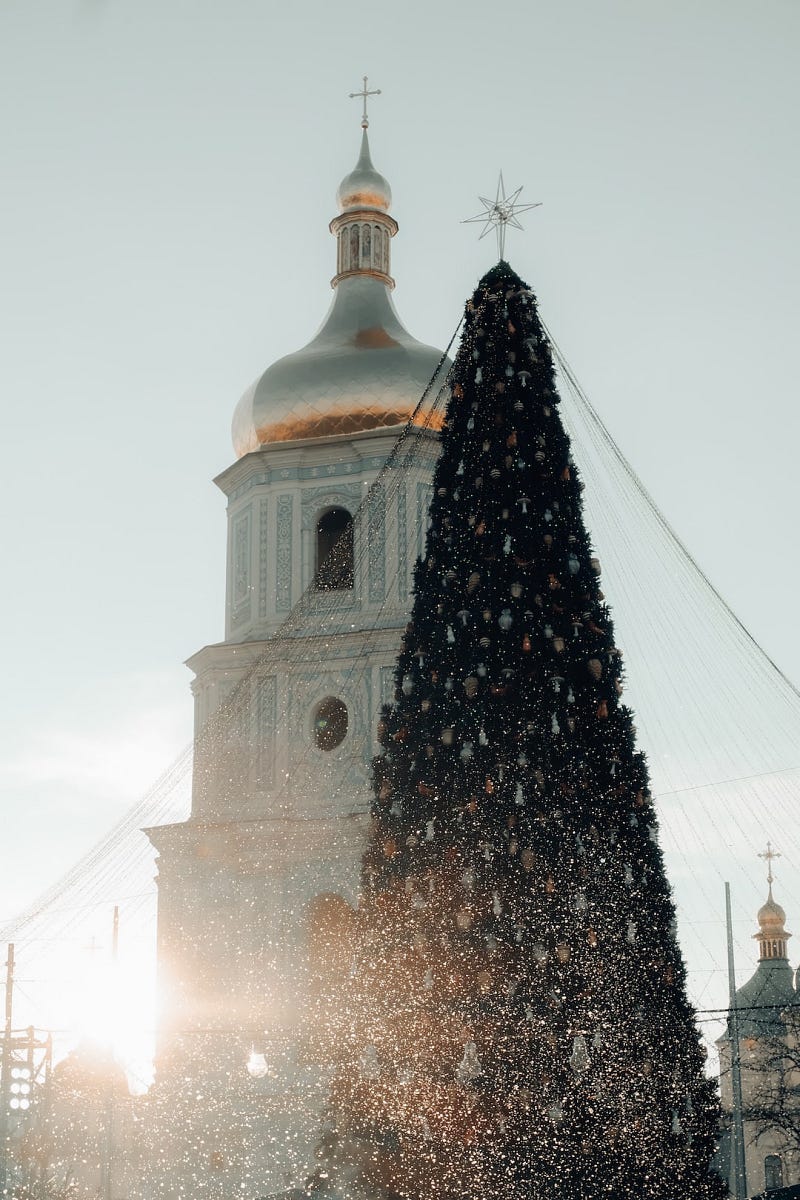
As an American-born ethnic Ukrainian, I grew up with my feet in two worlds — the United States and Ukraine. One of the benefits of my upbringing was the fortune. I was able to celebrate holidays like Christmas and Easter twice. Since Roman Catholics and Protestants observe the Gregorian calendar and Ukrainian Orthodox and Ukrainian Greek Catholics observe the Julian calendar, Christmas and Easter are celebrated on different dates.
We always celebrated American Christmas on December 25th while on January 7th, we celebrated Ukrainian Christmas. Easter was a little more complex since both calendars align approximately every four years but at least for three out of every four years, I had two Easters to celebrate!
Imagine what advantages this would entail for a child like me to enjoy presents and Easter chocolates twice every year. So how many Roman Catholics and Protestants are jealous right now? Even for adults, there were advantages. For family members who married into Roman Catholic or Protestant faiths, there were no arguments about whose family to visit for the holidays since the holidays fell on different dates. Imagine how many marriages could be saved by celebrating the same holiday on different dates!
I was looking forward to passing on this same fortune to my daughter who just turned three years old in October, but now the War in Ukraine has changed everything!
Another faith adheres to the Julian Calendar and that is the Russian Orthodox Church. The Patriarch of the Russian Orthodox Church, Patriarch Kirill, has been boastful in his unapologetic support of Vladimir Putin’s invasion and subjugation of Ukraine. There has also been evidence of priests and monks in the Russian Orthodox Church within Ukraine spying and acting as agents of Putin’s regime. This shouldn’t surprise anyone since there is evidence members of the Russian Orthodox Church collaborated broadly with the Soviets and KGB during the Cold War. Why would this practice have suddenly changed?
Since the invasion, Ukrainians have been pressuring their Orthodox Churches to break away from the Russian Orthodox Church and the oversight from a Patriarch in Moscow who doesn’t value their lives. There is even evidence Patriarch Kirill worked for the KGB himself back in the 1970s. In addition, Ukraine has been purging their churches of priests and monks found to be collaborating with the enemy. This seems like a reasonable response for people to no longer follow Church leaders who want them dead.
What I find a little more controversial is the decision by the Ukrainian Orthodox and Ukrainian Greek Catholic Churches to adopt a revised Julian calendar that more closely aligns with the Western Gregorian calendar. This is all being done as a protest against Russia’s war of aggression and the Russian Orthodox Church’s complicity. The change in the calendar was officially adopted as of September 2023, so this will be the first official year without Ukrainian Christmas as a separate holiday on January 7th.
I respect Ukraine’s decision. Ukrainians are the ones dying and living with death and destruction to their land every day. As a Ukrainian diaspora, I must abide by their decision in solidarity with them. However, it makes me sad that by this decision, we are conceding January 7th to Russia. Hasn’t Russia taken enough already? Ukrainians have been celebrating Christmas on January 7th since Grand Prince Volodymyr the Great of Kyivan-Rus baptized the Rus people in 988 in the Dnipro River. Why should Ukraine acquiesce it to Russia?
Then I think about the anger and animosity every Ukrainian must feel for their dead loved ones on the frontline, the dead civilians, Mariupol, Bucha, and the blackouts, and understand their need to completely break away from anything associated or aligned with Russia. For Ukrainians, it must also feel like they are further integrating with Europe to celebrate the same holidays on the same dates as Europeans do.
I was the one who broke the news to my extended family that we were no longer special. We too only have one Christmas to celebrate this year. Some agreed with me that we must follow Ukraine’s lead and stay in solidarity with them. Others asked why we can’t continue to celebrate January 7th as we always have. However, the ones who make the Ukrainian varenyky, poppy seed barley soup, almond filled kuchen, poppy seed filled kuchen, mushroom soup, and stuffed cabbage rolls eaten by my family to celebrate January 7th agreed to stay in solidarity with Ukraine, so it didn’t matter what the small minority thought.
Instead, we will be bringing Ukrainian foods and traditions to American Christmas on December 25th this year and creating a fusion affair in the future. I guess I should be glad that at least my daughter is too young even to realize there were once two Christmas holidays in her life and will enjoy the one Ukrainian-American Christmas we create together.
Ukrainian Christmas is reborn!
References:
OCU approves switch to Revised Julian calendar — Ukraine news / The New Voice of Ukraine (nv.ua)
Ukrainian Catholic Church Switches Calendars (kyivpost.com)
Slavic Cataloging Manual — Eastern Slavic and Russian Calendar Systems
Russian Patriarch ‘was KGB spy’ | World news | The Guardian (google.com)
Why Do the Russians Trust the Church Set Up By the KGB? (newsweek.com)
Russian Patriarch Kirill Spied in Switzerland for KGB in 70s — Media — The Moscow Times


