
The Day Trees Came to my Street
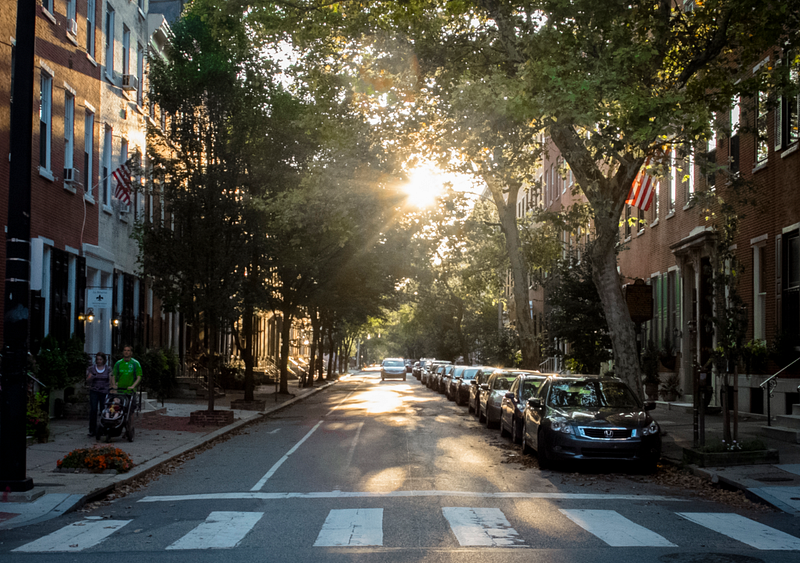
Overnight I was suddenly living on a tree-lined street
.jpg)
Yes, it’s true. I voted for Michael Bloomberg. Twice.
I did not vote for him when he pulled that rotten stunt of ignoring term limits. And I certainly laughed at his inane bid to buy his way into being the Democratic nominee for President (yeah, Mr.-changed-affiliation-to-Republican to avoid the primaries and run for mayor). Pathetic, desiccated little money-hoarder.
But he did give our street in Harlem trees.
In fact, all the streets along St. Nicholas Avenue got trees. All within a week. Without any advanced warning. First crews came out to remove one wide block of sidewalk in front of each building. That was strange to come home to one night, but the very next night I turned the corner and saw that I now lived on a tree-lined street. Surreal.
MillionTreesNYC launched in 2011 with Mayor Moneybags and Bette Midler planting the first tree in the Morrisania section of the Bronx. The last tree of the million was planted in 2019 by the DiBlasio administration.
Here’s a shocker, not all million are still standing.
They came out and plopped trees into the open spots of ground in front of each building and that was it. No further help was offered in this neighborhood, one which (let’s be honest) doesn’t prioritize the health of its trees. If each building’s tree was going to get fertilizer or protection, it was on the people in that building to provide it. Many Monday mornings found limbs torn off some of the trees after another wild weekend.
Local Law 11
They’re calling it FISP now (Facade Inspection Safety Program), but we all know it as Local Law 11 which stipulates that all buildings taller than six stories must have their facades inspected and repaired every five years. And what this means is that the city is forever shrouded in scaffolding. Because this is a city that pays lip service to such laws, building owners often decide that it’s actually cheaper to keep the scaffolding up indefinitely rather than making the necessary repairs.
One of the most egregious abuses of this law is less than five blocks from where I live.
The scaffolding on this building has been in place for nearly 18 years now. Occasionally crews come out to pull it down but then they replace it immediately.
Our building’s fight with this blight went on for nearly three years and only ended when the building was sold to new owners about a year ago. Prior to that, the front of our building was shadowed by scaffolding so deep that the company had to string up lighting under it. For several months there was also an industrial size dumpster in front of the building as well which turned our stoop into Drug Central. Repeated calls to our councilperson and the police were completely useless. Within a month of the new owners taking over, that dilapidated scaffolding came down.
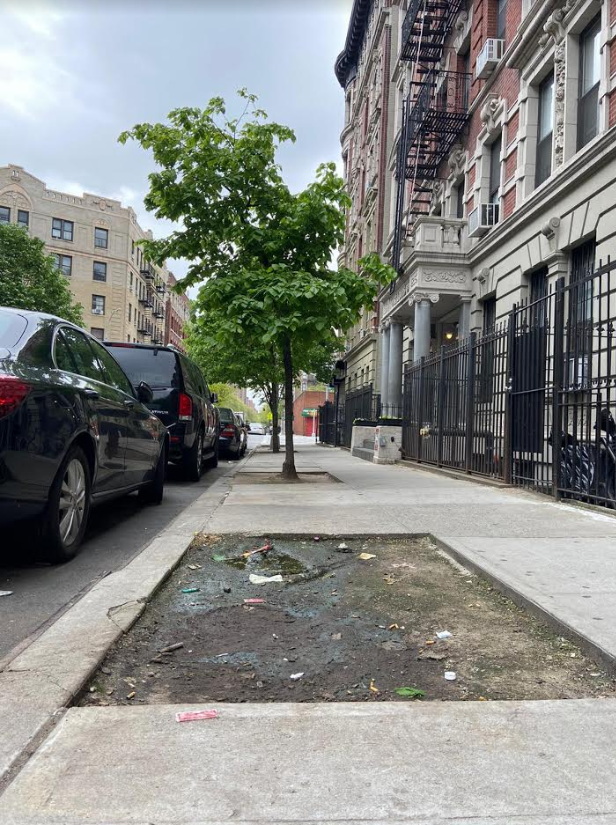
But over the years the scaffolding had bent our poor tree so badly that once the scaffolding came down all it took was one big storm to take that tree out. We came out one morning and it had broken off at the base with part of the root ball unearthed. Crews came out and cut away most of the tree leaving that half-exposed root ball in the dirt.
About two weeks after that I was delighted to see shoots and leaves sprouting from that still viable root ball. Go, Life!
They lasted maybe a week before withering and dying. Dog piss, I’m guessing. It’s a brutal city for the unprotected tree. Or person for that matter.
We’ve reached out to the city to get our tree replaced. A crew did come out to dig out that sad little root ball. They also tilled the soil giving us the impression we’d get a new tree. But no tree. Since the previous owners didn’t bother making the necessary repairs to the facade, the new owners will have to and that will mean more scaffolding. But suddenly trees and facade repairs have been moved indefinitely to the back burner.
So no tree for us but most of the ones planted back in 2012 are thriving in spite of the neglect and abuse.
I guess it’s quite a feat that 1,000,000 trees did get planted across two city administrations and nine years. Not everyone is thrilled about having trees winding root systems around underground pipes and other infrastructure and then there are the female Gingko trees that some neighborhoods got. For those who don’t know this, the fruit of the Gingko tree smells like vomit. Male Gingko trees, obviously, don’t bear fruit but no one seems to bother making sure which gender tree gets slammed into the ground. There are about five female Gingkos along our stretch of Central Park that make August and September stomach-churning.
Even with all of that, I’m glad of the trees.
The two unidentified trees that are just outside our living room and bedroom windows may gift us with loads of pollen each spring, but as they have grown and risen to our fifth floor they fill our apartment with birdsong. They are Life. Life is messy and unpredictable. It refuses to confine itself to convenient boundaries. As I sneeze my way through spring, reminding myself daily that this isn’t COVID-19, I remain grateful for the graceful swaying of green treetops right outside the window.
Now, about the broken dryers in the basement…
© Remington Write 2020. All Rights Reserved.