avatarNikos Skordilis

Free AI web copilot to create summaries, insights and extended knowledge, download it at here

2052

Abstract

required a <i>much</i> higher magnification to show that.</p><p id="3a71"><i>The Moon was below Earth right now. </i>So it was <i>not</i> an eclipse. There was only one other thing it could be. And that light was <i>not</i> a corona. It was…*</p><p id="a76f">Andrews lost consciousness and collapsed. The shock was too great for him. Paul and his aide managed to recover him after a few minutes. His brain kind of shut down from the horror.</p><p id="12d7">When he recovered he said,</p><p id="3ca5"><b><i>“All hope is lost Mr Turner.</i></b> It appears the calculations of the late Stephen Hawking and others about the Hawking radiation rate per unit of mass were wrong by at least an order of magnitude.</p><p id="822c">We never had access to the <i>real thing</i> you see. We modeled, predicted, mathed the crap out of them, but we could never <i>test</i> one to verify the theory experimentally.”</p><p id="2805">“I don’t understand Professor. <i>What</i> real thing?”</p><p id="9632">“The Sun is gone Mr Turner, and is not coming back. Gravitationally we’re still bound to it but its nuclear fusion just… <i>stopped</i>. No fusion = <i>no light.</i></p><p id="48a1">“But <i>why</i> Professor?”</p><p id="eaf1"><b>“Because a mini black hole consumed it</b> Mr Turner, turning it into <b>one solar mass black hole. </b>One probably <b>the size of a pea</b> but multiple Earths worth of mass.</p><p id="581c">Those <i>should </i>evaporate rapidly via Hawking radiation. Our models and math were wrong. A pea-sized black hole hit the Sun, sunk in its core faster than molten metal in butter, remained there for God knows how long and started devouring it from the inside out.</p><p id="abaa"><i>It just completed its feeding.”</i></p><p id="f53f"><i>So?</i></p><p id="f4b5">“Temperatures will collapse to liquid nitrogen levels within a month. <i>By then we’ll all be dead.</i> There is nothing we can do…”</p><p id="334c"><i>*What do you think that light could be?</i></p><p id="39fe"><b><i>Science note, largely for fellow astrophysics geeks: </

Options

i></b><i> I employed some “creative astrophysics” in this part. Assuming a tiny black hole could survive long enough to hit the Sun it would not have switched off like a light bulb.</i></p><p id="13f5"><i>It would have<b> gradually dimmed</b>, since its core would have been consumed first. That’s where all the nuclear mojo happens. But that would have been far less exciting, right? </i>😊</p><p id="84b0"><a href="https://skordilis.medium.com/subscribe">Subscribe 📬</a> | <a href="https://twitter.com/Sharpedon">Twitter 💙</a> | <a href="https://ko-fi.com/sharpedon">Ko-fi ☕️</a> | <a href="https://www.facebook.com/Sahstar/">Facebook 🤝</a></p><p id="1934"><i>Did not have your fill of dystopian sci-fi? This tale might satiate you:</i></p><div id="6702" class="link-block"> <a href="https://skordilis.medium.com/time-capsule-vol-1-f2958222951e"> <div> <div> <h2>Time Capsule Chapter 1</h2> <div><h3>Gathering Part A | Vol 1</h3></div> <div><p>skordilis.medium.com</p></div> </div> <div> <div style="background-image: url(https://miro.readmedium.com/v2/resize:fit:320/0*lDQ1lYbPK31iBVI8)"></div> </div> </div> </a> </div><p id="f42a"><i>And a sci-fi series by <a href="undefined">Author, D. Denise Dianaty</a> I enjoyed. Don’t worry, she does <b>not </b>kill everyone:</i></p><div id="e0aa" class="link-block"> <a href="https://readmedium.com/the-time-it-takes-to-die-1a426a784a8"> <div> <div> <h2>The Time It Takes To Die</h2> <div><h3>Chapter One-Part One from a current work-in-progress</h3></div> <div><p>medium.com</p></div> </div> <div> <div style="background-image: url(https://miro.readmedium.com/v2/resize:fit:320/1*RodUMf5NHmfbXui-d7dU_w.jpeg)"></div> </div> </div> </a> </div></article></body>

SCIENCE FICTION | DYSTOPIAN | STORY SERIES | PART 2

The Day the Sun Went Dark

No one thought that was possible — until the impossible happened | Part 2
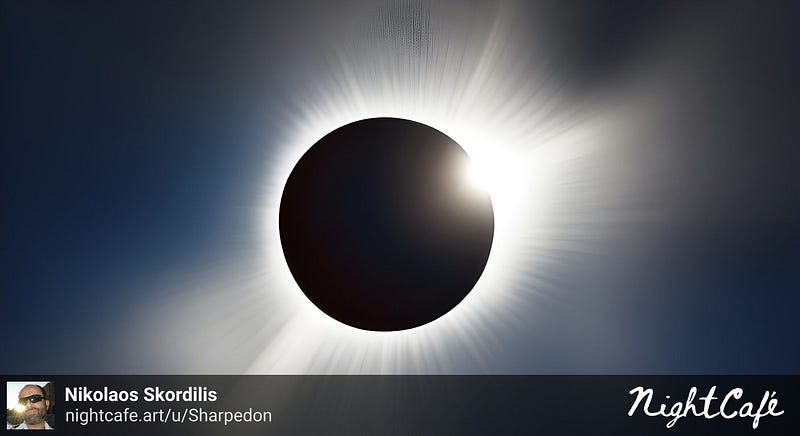
Image by NightCafé Creator and Nikolaos Skordilis

Part 1

Professor Andrews rushed frantically to Harvard’s observatory, ignoring all calls, messages and notifications on his mobile. They were incoming from all over the world, faster than AR-15 rounds.

He wanted to see the Sun with his own eyes. Paul Turner and his camera guy tagged along. Andrews, knowing of only one way the Sun could switch off, muttered:

‘No… it can’t be. All calculations about Hawking radiation rate suggest that would be impossible. But since the Sun did not magically vanish into thin space what else could it be?’

“Come again Professor? You said the Sun did not vanish?”

“If the Sun had vanished we’d all be dead Mr Turner. Earth and the other planets would have been slung into deep space. The acceleration would have generated an Earth-wide mega-quake of 10 magnitude or more.

The Sun is still there. It’s just… gone dark. I’ll soon know why.”

They reached the observatory. Andrews started moving as if walking on eggshells, drenched in sweat, despite a temp of 80 °F. He turned on the scope at the control room, and directed it toward the Sun’s coordinates of the current time.

The monitors depicted what looked like a solar eclipse corona around a black Sun, though the scope required a much higher magnification to show that.

The Moon was below Earth right now. So it was not an eclipse. There was only one other thing it could be. And that light was not a corona. It was…*

Andrews lost consciousness and collapsed. The shock was too great for him. Paul and his aide managed to recover him after a few minutes. His brain kind of shut down from the horror.

When he recovered he said,

“All hope is lost Mr Turner. It appears the calculations of the late Stephen Hawking and others about the Hawking radiation rate per unit of mass were wrong by at least an order of magnitude.

We never had access to the real thing you see. We modeled, predicted, mathed the crap out of them, but we could never test one to verify the theory experimentally.”

“I don’t understand Professor. What real thing?”

“The Sun is gone Mr Turner, and is not coming back. Gravitationally we’re still bound to it but its nuclear fusion just… stopped. No fusion = no light.

“But why Professor?”

“Because a mini black hole consumed it Mr Turner, turning it into one solar mass black hole. One probably the size of a pea but multiple Earths worth of mass.

Those should evaporate rapidly via Hawking radiation. Our models and math were wrong. A pea-sized black hole hit the Sun, sunk in its core faster than molten metal in butter, remained there for God knows how long and started devouring it from the inside out.

It just completed its feeding.”

So?

“Temperatures will collapse to liquid nitrogen levels within a month. By then we’ll all be dead. There is nothing we can do…”

*What do you think that light could be?

Science note, largely for fellow astrophysics geeks: I employed some “creative astrophysics” in this part. Assuming a tiny black hole could survive long enough to hit the Sun it would not have switched off like a light bulb.

It would have gradually dimmed, since its core would have been consumed first. That’s where all the nuclear mojo happens. But that would have been far less exciting, right? 😊

Subscribe 📬 | Twitter 💙 | Ko-fi ☕️ | Facebook 🤝

Did not have your fill of dystopian sci-fi? This tale might satiate you:

And a sci-fi series by Author, D. Denise Dianaty I enjoyed. Don’t worry, she does not kill everyone:

Science Fiction
Flash Fiction
What If
Dystopian Fiction
Pure Fiction
Recommended from ReadMedium