
The Day I Witnessed My Friend Become a U.S. Citizen
It was the same day countless foreign immigrants would find a welcome home away from home
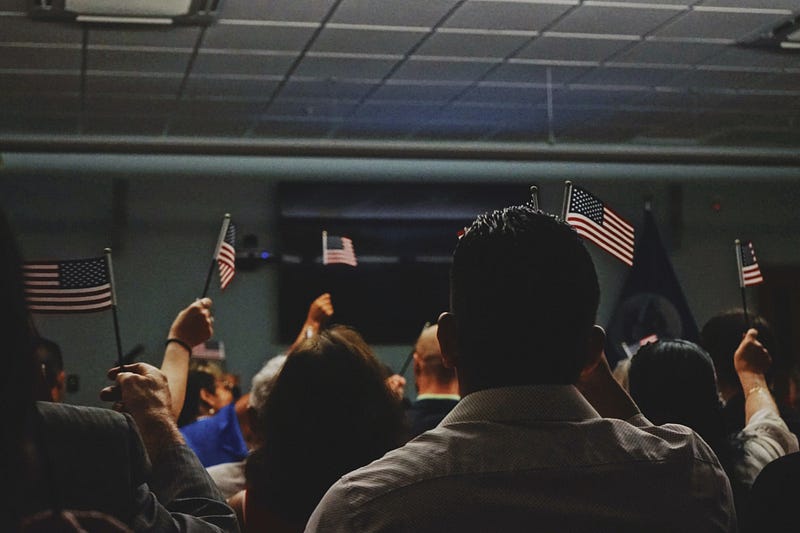
A few weeks before the shelter-in-place was ordered, I accepted the invitation to witness my friend, Patti, a Colombian-born national, take the oath to be sworn in as a United States Citizen officially. What an honor for both of us. It was mid-February, and the global pandemic was not yet a blip on our radar.
I found myself jammed side-by-side in a super-sized courtroom with people whose origins and ancestry hail from all points on our globe. Who knew that gatherings like this would be all but illegal within days.
It was around lunchtime and a brisk six-block walk from my Michigan Avenue office, through a canyoned grid of skyscrapers, partially protects me from the wintery elements. A light dusting of snow swirls in paisley patterns across the concrete walkways. I arrived at the Dirksen Federal Building on South Dearborn Street.
The simple, well-proportioned steel and glass design of the building is signature and epitomizes the minimalist style of Ludwig Mies van der Rohe. This famous Chicago architect immigrated from Germany himself in the late 1930s.
New Americans come from every corner of the globe. Immigrants from Mexico, India, the Philippines, China, Cuba, the Dominican Republic, and Vietnam make up an outsized share of the over 720,000 people who typically become U.S. citizens each year.*
I'm right on time, which to me always feels late. Navigating the security hurdles and metal detector gauntlet stresses me out. After multiple passes, I satisfy the temperamental scanning device.
I figure Gina, Patti's other witness, co-worker, and friend, is already somewhere in the courtroom. She's pregnant and expecting at any time. I assume she would find herself a seat.
As I step off the elevator and turn the corner, there's a long line of people — family and friends of those awaiting official naturalization. They stretch from the courtroom entryway down the length of the deep corridor.
Ignoring the line of people, I walk into the courtroom with confidence, as though I own it; nobody will question me. And they don't. I sit down in the back of the room on a long wooden bench. It reminds me of a church pew.
The would-be citizens are all seated front-and-center, across from the massive bench. It is flanked by American, State, city flags, and emblems. It's where the honorary justice will soon preside.
My restless mind begins calculating the estimated number of people waiting in the hallway along with the open space in the courtroom. There's no way they can fit. It would be standing room only.
I scan the group seated up front, waiting in anticipation for their swearing-in. It's a more significant number than I expected. I can't locate Patti. She's really short, so I'm not hopeful.
I pick up my envelope. It contains a gift Gina and I will present to her after the ceremony. It's a portfolio designed to hold and protect the certificate of citizenship. There's also a small silver keychain. It has the American flag and the year 2020 embossed on its face.
I step out into the crowded but orderly hallway. I see the line grew even longer in that short time I sat down. Somebody was waving — it's Gina trying to get my attention. I join her in the queue, and we wait. It wasn't too long, and once they admitted entry into the room, we were seated quickly.
Why is it that I already had a pre-conceived image of the judge in my mind? He would be old and chalky-skinned, mostly bald, and he'd be looking down at all of us from his elevated vantage point, over half-moon reading glasses.
Maybe it had something to do with the bailiff, who gave us a quick run-down on the proceedings and protocols we were to observe. He said he didn't know who the assigned judge would be this day. He warned us there were no photos allowed unless his honor gave special permission. He was already setting us up for some bureaucratic old grouch. I had it all wrong.
The youngish judge emerged from his chambers, entered the courtroom, smiled, and greeted the crowd warmly. He is Asian-American and relays his own story of how his parents emigrated to the U.S. to build a life. And if that isn't enough to disarm and demonstrate empathy to those in the room, he invites us to take photos. He even offers individual and family photo-ops with himself following the ceremony. He exudes warmth and generosity.
Mobile devices and digital cameras appear from coat pockets and purses. Gina maneuvers her way to the front to capture a moment with Patti. I look around the room. Tiny American flags are clutched preciously in hand—what a priceless thing to see the expressions on people's faces.
It's a combination of Pride. Relief. Joy. Beginnings. Ends. It's an emotional moment. I find myself choked up as the oaths are taken. I can only imagine the flood of emotion that must be coursing through those becoming naturalized.
And just under the wire. To some, I imagine it feels like the last chopper out—the last lifeboat on a sinking ship. The year 2020 brings so much uncertainty with a global pandemic, a government administration working on revamping current immigration policies, and an election year that will prove too close to call.
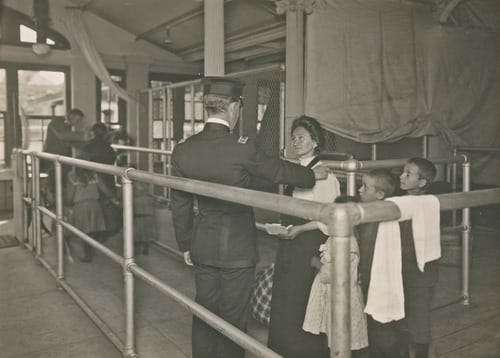
Taking an emotional and physical gasp, I consider the twelve-million immigrants who came through New York's Ellis Island to be processed between 1892 and 1954. I step back even further. I think of the early Spanish explorers who first set eyes on America's shores. A new opportunity. A new life.
They called it "The New World." In many ways, the term is still relevant. Particularly after the events and challenges we faced in 2020 and 2021, It really is a new world for all of us.
- Statistics source: Boundless.com
Thanks for reading! If you find value and entertainment in my work, consider a Medium membership for $5 a month for full access. Your subscription fee will help support me directly and thousands of talented writers on our creative journey.