
Transcendence, Near-Death Experience
The Day I Died…
“The sun shines not on us, but in us. The rivers flow not past, but through us, thrilling, tingling, vibrating every fiber and cell of the substance of our bodies.”— John Muir
One of my early memories is of watching my colorfully-bound set of childhood stories from the Bible spark into flames in the fireplace of my father’s office in the basement of our home in East Aurora, NY. My mother, a devout Lutheran Protestant wed to an atheistic Philosophy Professor, had bought them for me, probably with money she had secreted away, for I am sure that she knew he would not approve.
I still remember the gold vining on the binding of the small hard-cover books, and also my sadness at watching that first one burn, knowing they would all soon follow. I don’t even think I could read yet, but I loved the aesthetic of them — the matching, small, almost-square shape of each of the books in the collection. Every one of those books contained worlds of pictures and stories which lived and breathed in the land of my imagination.
My father ventured through life with a Mensa level IQ, but not a lot of social intelligence. He really had meant to demonstrate that he wanted his daughter to be a free-thinker, unhindered by the religion his parents had imposed on him. But, this incident turned out to be more traumatic and memorable than he may have anticipated.
My mother, for her part, just wanted to expose me to the tradition and community which had given her comfort.
So, my parents struck a deal that day — that I would go to church with my mother until I was eleven, at which point I would decide for myself what I wanted to do on Sunday mornings.
I do remember a tender old minister who gave me an olive-green bound copy of the Bible, embossed with coppery filigree. And I also remember sitting on the floor of my bedroom in the stream of summer sunlight pouring in between white cotton curtains, fringed with tiny white balls of thread, and reading those stories.
Some where terrifying. Some were inspiringly beautiful.
But none of them could ever invoke in me the feeling that I experienced when I was deep in the woods behind our house, lost in the flickering light dancing through the trees and shifting through the moldering leaves on the forest floor.
Watching the glints and the shadows on the smooth surface of the little stream which trickled down from the reservoir, past the giant oak tree, and back into the darkness beyond the blackberry brambles evoked the same sensation. I would watch the dark patches, where the water dipped down low behind a flat lichen-covered rock or a rough-barked tree root, where frogs and minnows danced amongst the mossy tendrils trailing their tears into the dampness.
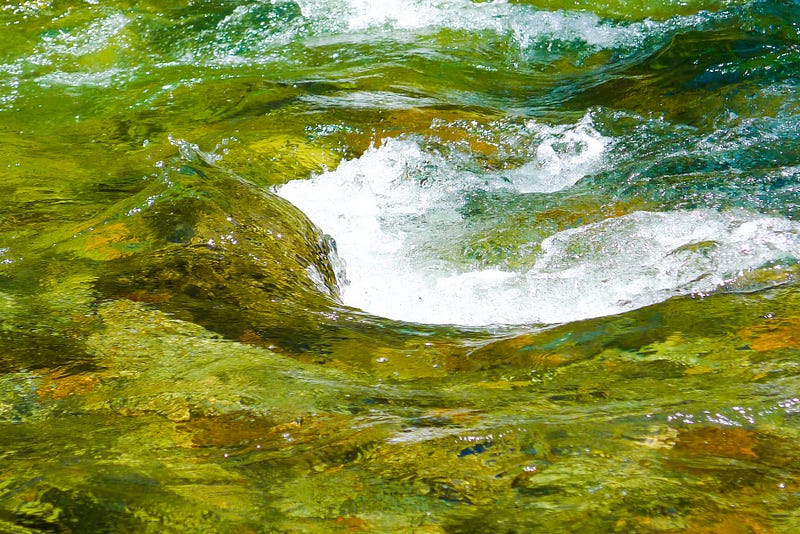
Or, sometimes, the slick silvery vastness of the sky’s reflection on the surface of the water would entrance me.
In those moments, enraptured, I could almost feel myself expanding into the Universe.
The first time I ever experienced that spark of connection to the vastness of creation, I was very young, sitting on the hardwood floor, leaning up against the wall in Mrs. Antonetti’s house. My parents had rented the apartment on the top floor. I vividly recall the glowing orbs of dust motes, sparkling on their edges, drifting in the late-afternoon, slanting sun. I am not sure how to really ever describe that moment, other than exuberance.
I know I am not alone in having these childhood experiences. My husband still talks of a moment, when he was a boy, when he placed his cheek on his dog’s side, and breathed with him. He was overcome with a sense of connection and awe.
I just could not ever get my head around the idea of an anthropomorphized deity. It didn’t seem to have anything to do with the sense of mysticism that I felt for the intricacies, connections, and magical moments that I was seeing and feeling in the natural world, which just had to be a part, expression, or means of expansion of something so big that you couldn’t ever really put words to it.
So, when I was eleven, to my mother’s dismay, I declared myself an atheist too, like my father. But, what I don’t think she understood, was that I was not rejecting spirituality, just religion.
I think my father was actually of like mind, although we did not speak directly of this. What we did speak of was the wash of the milky way over our heads as we walked down the gravely slope of Arizpe Drive in Tucson, Arizona (we had moved by then), breathing in the thick scent of sage after the summer monsoon. I used to share my dreams of story-telling with him. And he would share his science fiction and mystery books with me. I grew to love Robert A. Heinlein and Agatha Christy and Hercule Poirot.
I also remember a book he gave me once, after he had read it. It was about the Druids. And it sparked something elemental in me.
As teen-agers do, I shared this solidarity, this expression of my individuality, the label of “atheist,” with him for most of my teen years.
But, when I was twenty years old, a junior in college, as I was pedaling my bike to school to take one of my last finals in my dreaded Physical Chemistry class (the nemesis of many Chemistry majors), I had a little life-changing experience.
I died.
It didn’t actually feel like death. It felt so beautiful.
But, nonetheless, I was run over by a pick-up truck full of sand, pulling a trailer full of construction equipment.
My grandma used to say that angels must have come along and lifted the wheels just a little bit up off of my chest.
I don’t remember the impact. I don’t remember that the witnesses put a sheet over my face because they were sure I was dead. I don’t remember being put into a pressure suit by the paramedics, who tried to bring me back to life after I had lost too much blood.
What I do remember is birdsong, glorious golden birdsong, washing over me almost like waves…. It was like being in a vacuum, but, weirdly, there was still air for sound waves to travel though. The trees breathed with me, their delicate dance with the wind echoing the non-beat of my heart.
And the sun was warm and beckoning.
I did not see relatives. I did not see a tunnel.
But, I did see light.
And that light was a powerful source.
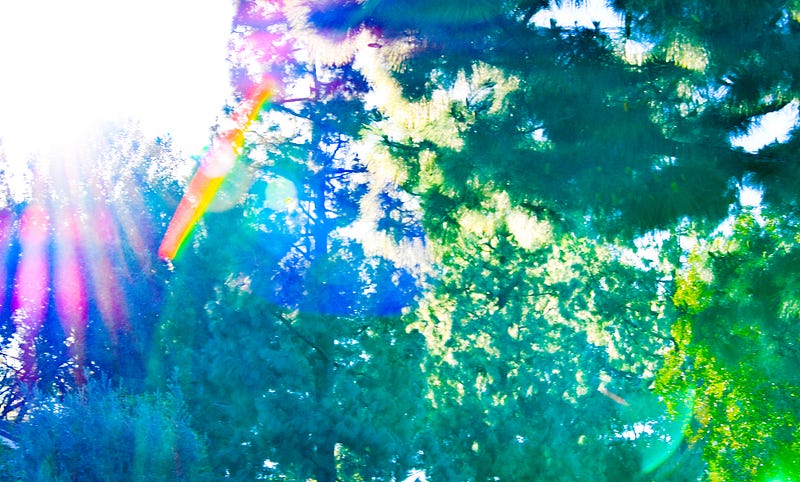
I understand why one of the Hindu’s most sacred prayers (The Gāyatrā Mantra) is directed to the Sun God…
…although I would rather think of her as a Goddess, if she has to have a gender…
I floated for what seemed like an eternity, being rocked in the waves of infinity, amongst those tree tops. But, eventually, almost like a magnet had tugged at my soul, I felt like I had been lifted higher than the trees, and almost was “not of the trees” any longer. I felt bathed in the sun, one with the sun, one with “the light.”
And then, I thudded back down to earth — back down to unimaginable pain.
“Is my back broken?” I asked the paramedic, because I could not move my legs. If that was the situation, I was not going to stay here, on this earthly plane. I was going to go back “up.”
They didn’t know, though. And, so, I skidded back and forth for many hours between that place of peace and this place of pain. They put a board underneath me to transport me to the hospital. They called my parents to tell them that I was not expected to live through the night.
But, I did live.
One of strangest “side-effects” of this experience, to this day, is the change in my “flying dreams.”
When I was young, I flew most nights. But, I had a weird “get-up,” to be able to lift off. I had to do a “gymnastic-like” hop, skip and jump first, and then I could only fly in this high-backed chair.
But, after the accident, I could fly all over the place, no chair required. I flew over water parks and freeways, and across golden fields. I peered in on people I did not know. And, I might have helped escort a few newly-departed souls venture on.
I don’t have as many flying dreams these days. But, when they do come, I still do not need to ride in that chair to fly anymore.
Who really knows where I went that day?
As a former neuropsychologist, there is a part of me that says that this could all be explained by a wash of neurotransmitters flooding my brain at the moment of death.
But, I think that it was more than that.
I still cannot get my head around an anthropomorphized God (a God with a face). But, I “get” what it is supposed to stand for.
Many years after that childhood experience with the Bibles, I returned to graduate school in Yoga Studies — which was essentially the immersion into the ancient texts of India, such as the Vedas, the Upaniṣads, the Bhagavad Gīta, the Yoga Vāsiṣtha, the Spanda Kārikās of Kashmiri Shaivism (which speaks of the throb of the Universe), the ancient Haṭha (or physical) tradition of yoga (originally intended to move energy through the body), the Yoga Sūtra, and many others.
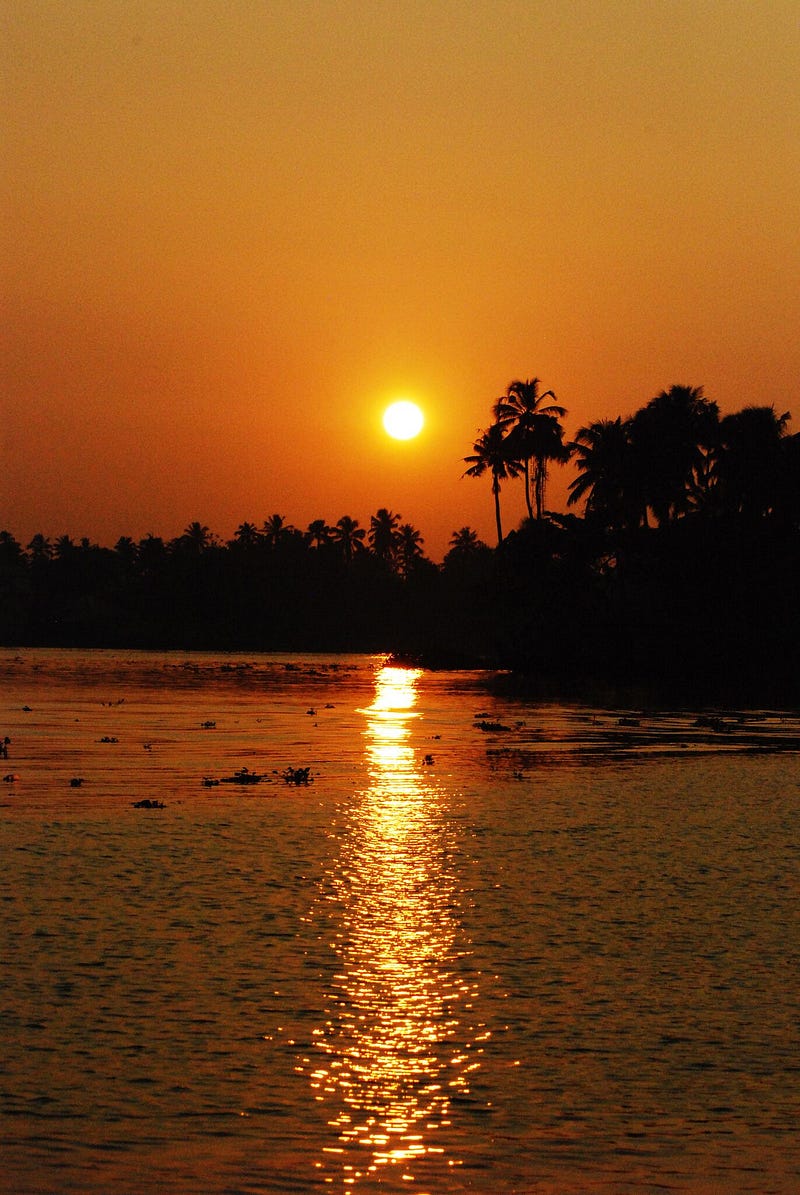
“The Bhagavad Gīta tells the story of Krishna, an avatar come to earth, and Arjuna, a warrior who is reluctantly facing the battle of his lifetime. This text, composed over many centuries, by many different hands, contains references to the divine in such ways as, “I am the taste in water…the radiance of the sun and the moon…the sacred syllable Om…the sound in ether.”
But there are also passages where Krishna, as the divine, is personified. He explains at one point that it is easier for some people to commune with him when they visualize him as such.
But the time period which captured me the most, because of the way those mystical rishis, or seers, related to the interconnection of all things, was the age of the Vedas and the Upaniṣads.
Sometime around 2000–1500 B.C.E., the lyrical, life-affirming hymns of the Vedas began to be composed. These writing held a reverence for nature and her rhythms and cycles that contain an inherent, soul-catching beauty which taps into something raw within us. They speak of natural forces and elemental powers, and the beauty of the rain and the sun and fire and the wind, and the dark of night, as well as the brightness of the day.
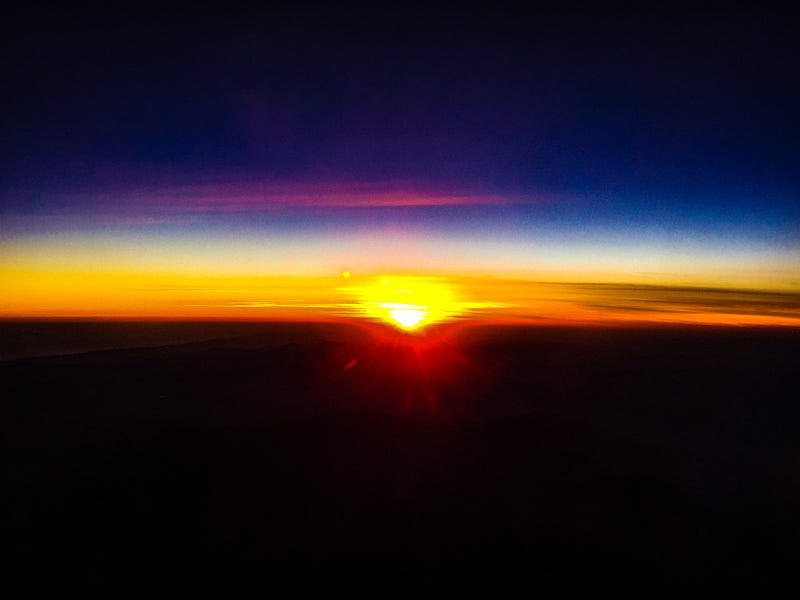
Surely, the dawn was a welcome thing each morning in the ancient world, for it meant that the dwellers of the forest settlements had survived another night without attack by predators. The poignantly beautiful Ṛg Veda 7.77 speaks of Uṣas,the Dawn’s, loveliness: “Like a beautiful woman, Dawn shined brightly, stirring to motion every living creature. Agni (sacrificial fire) was kindled for the use of man; Dawn made the light, driving away the dark.” As the verse continues, we see that she also held the sacred power to hold back the creatures of the night: “Come to us, banish the enemy with your light! Prepare us wide pastures free from danger! Remove hatred, bring us your priceless gifts! Generous woman, shower us with blessings.”
And dawn’s glowing robes, draped across the sky, also heralded the rise of Surya, the sun god, who shines “over the world of men, like flames of fire. He warms and burns.” Surya “makes the days” with his rays and “witnesses the birth of all things.” (Ṛg Veda 1.5).
There were also hymns to Araṇyānī,Goddess of the Forest, who fills with joy “every time the grasshopper sings, or the cicada’s voice shrills, as if tinkling bells would sound.” (Ṛg Veda 10.146). And a song is offered to Vāyu, the God of Wind, who “touches heaven and turns its faces red” and who “is the breath of the gods, the seed of the world,” but whose “roar is never heard” and whose “form is never seen.” Offerings were also made to the waters of the earth and to the healing plants.
The Vedas looked outwards towards nature and spoke of a sense of awe at the ṛtm (rhythm) of life.
But, the Upaniṣads,which followed, began to look within (probing human consciousness) and beheld nature as an expression of an underlying unitary source within everything. This conception of an “Absolute” beyond form and shape is what the Upaniṣadic sages had come to believe was what connected everything in the universe.
They called this “one-ness” Brahman, and knowing Brahman, the sage was immersed in the nectar of divinity pulsing within his own beating heart.
My favorite myth, the best human expression of what this means, is told by the story of Svetaketu, a young Brahmin (not the same as Brahman) boy recently returned from the ashram, a little puffed up by pride (Chañdogya Upaniṣad (8.16)). His father, Uddālaka, begins to question him, asking him puzzling questions about the nature of reality, which his son cannot answer. So, the father begins to explain:
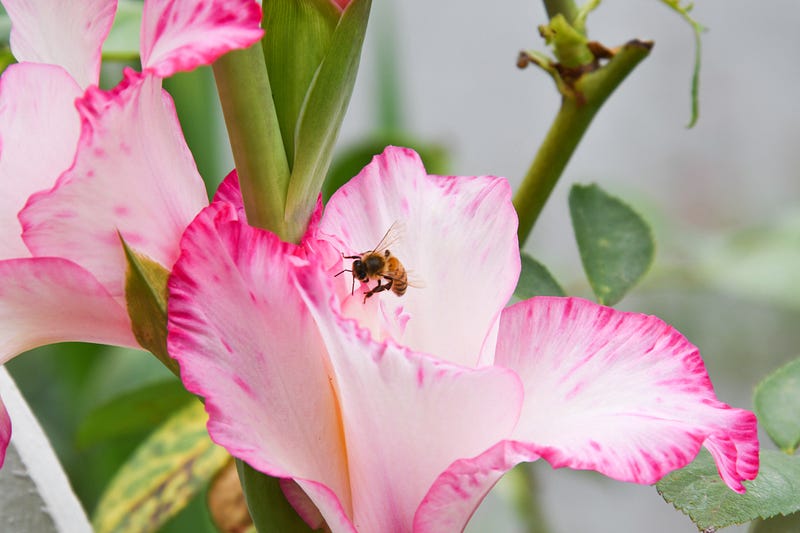
Uddālaka told his son, “Bees prepare honey by collecting the essence of many flowers and trees, but then distill them into one essence. The juices themselves might think they are the essence of this or that tree, although they become one. And tigers, lions, wolves and worms, flies, gnats and mosquitos all become these forms, without knowing from whence they came. But this subtle essence pervades the whole world. That is the truth. That is the Self.”
Śvetaketu, still not understanding, asked his father to tell him more.
“Bring me a fruit from that nyagrodha tree.”
So, Śvetaketu brought his father a fig that had fallen onto the ground.
“Break it open, my son.”
Śvetaketu broke open the fig.
“What do you see?”
“Very small seeds, father.”
“Break open a seed, Śvetaketu and tell me what you see.”
“Nothing, father. Nothing at all.”
Uddālaka, looked up at the towering fig tree. “My son, that subtle essence which you cannot see gave existence to this great and ancient tree.”
Śvetaketu nodded, beginning to understand. “Tell me more, Father.”
“Tonight, I want you to place a handful of salt into a pot of water.”
So, Śvetaketu did so. And in the morning, his father said, “That salt you placed in the water, please bring it to me.”
But Śvetaketu knew he could not.
Uddālaka told him to take a sip of the water and tell him how it was.
“Salty,” Śvetaketu said, although he could not see the salt.
And Uddālaka told him, “It is the same with pure being. You do not perceive it, and yet it pervades everything. Tat tvam asi, Śvetaketu. You are that!”
Ralph Waldo Emerson was greatly influenced by the Upaniṣads. But, his ultimate guru was nature itself, and he drew his inspiration from his time immersed in it. It was these moments that led him further into his musings on One-ness and the interconnectedness of all things. In a break from mainstream religion, he called for individuals to form “an original relationship to the universe.” He had an ecstatic vision of a divine essence which was the “cause behind every stump and clod.”
Standing on the bare ground — my head bathed by the blithe air, and uplifted into infinite space — all mean egotism vanishes. I become a transparent eye-ball; I am nothing. I see nothing. I see all. The currents of the Universal Being circulate through me. I am part or particle of God.” [i]
In nature’s depths, he felt the throb of connection with all other living beings. He experienced that spark of divine essence within every leaf and grasshopper. He understood the rhythm of the sunrise and sunset, and the cycle of the waters.
My modern guru, Mary Oliver, in the lineage of Transcendentalists such as Emerson, Thoreau and Walt Whitman, expressed this same connection to the natural world, and to her conception of “God.”
Her words have held me transfixed in awe as I “slept all night on the forest floor with her, with nothing between us and the white fire of the stars.” I “floated with her, light as moths, rising and falling before vanishing into something better.”
I think of her when I watch my cats slumber in the sun, and I wonder if they are praying, like the sunflower, or the old black oak, or the wren in the privet. She said she was looking for God in the dust, in the flowerbeds and oceans. And I wonder…what does the Goddess look like to her now?

My church is, and always will be, nature.
She throbs in me. I pulse in her.
I taste her essence in the warm night air.
I sing with the frogs doing their concerto down by the riverbank.
I explode into the sparks of sunlight on the water.
And, my biggest hope is that, through my poems and stories, other people will sample even just a taste of the essence of the expansiveness of the Universe.
And, I thank all of the explorers who have gone before, treading this mystical path into the Universe.
[i]Emerson, Ralph Waldo, Nature(Mineola, NY: Dover Thrift Editions, 2009), p. 3.
If you enjoyed this essay, you might also enjoy this poem, which I wrote about my “time between worlds.”
And, this is is about another moment, in which I was struck by the immensity of the Universe.
Erika Burkhalter, MA Yoga Studies, MS Neuropsychology, E-RYT 500, teaches for Loyola Marymount University’s Yoga Philosophy Certificate Program as well as for Yoga Works, where she teaches and trains teachers. She is also a writer, photographer, and a lover of cats, gardening and traveling.
Story and photos ©Erika Burkhalter. All rights reserved.