NaNoWriMo 2022
The Day I Died
American Kingdom: Day 4.2
Previous scene:
My last memory of her and my last memory of anything before I woke up in a hospital in Germany. The green of the fields, a schloss on a ridge, small forests, and an autobahn running past the base were like a fantasy land. Where were the rocky mountains, the bleak desert, the brick mosques?
And what had happened? I was in one piece, nothing missing except dignity. A goddamned unbearable itch all down my front to fill that gap, and amazement when I finally took a shower and saw what they had done to me.
Whatever memories I had hadn’t made it to long-term storage. It was still a dusty cold day in Afghanistan, the coffee mug warm in my hand and then this.
Nobody could tell me what had happened, nobody knew anything. Especially me. The most bizarre and unsettling week of my life. When I could get to a telephone, family and friends would ask what had happened and I couldn’t say except it obviously hadn’t been good.
They shipped me home, confused and empty, and finally a report caught up with me. There had been an attack on the base, I’d been knocked out by the blast, not a mark on me, and they had begun a post-mortem at the field hospital to find out what had killed me, stopping when I sneezed. They’d hastily stitched me up, flown me to Bagram and on to Ramstein.
I’d been dead and come back to life, the Stateside doctor told me as I stripped for yet another display of my wound. An evil-looking thing from crotch to shoulders, purple and scabbed and swollen to begin with. I felt sick just looking at it until I considered the alternative.
Eventually, I pieced the story together as unit members got in touch.
Mojdah’s pack had been full of C-4. Maybe I had looked at her face and seen something wrong, maybe Lance had noticed something hinky. He’d told her to stop, raised his rifle, and when she began to run he’d placed himself in front of me.
Mojdah’s pack had gone off like a crack of thunder. The shockwave had shredded her immediately, Lance and a couple of other Rangers had been killed or seriously wounded by the blast and the pieces of scrap — rocks, junk metal, broken glass — that had been packed around the bomb, and I was knocked into another dimension.
Lance had shielded me from the direct blast but I’d been covered with body parts, body fluids, torn pieces of webbing and camo. There were three of us obviously dead, two needing urgent care, and the medics had worked on the wounded while we corpses were stacked in the back of the chopper on the way to the morgue.
There were some photographs taken. For the investigation. These were not your happy snaps and selfies. I can see why they thought I was dead; I was just a mass of blood and intestines, though none of it was mine.
Someone had been given the nightmare job of washing the bodies and when they hadn’t found any obvious wound on mine, the same doctors who had patched up the two surviving Rangers set to work on me to find an official cause of death.
They had cut me open — no anaesthetic, obviously — and just as they were about to start removing my sternum, I had sneezed. “Bless you!” they both said at the same time and then looked at each other, puzzled.
Somehow, the heart that a moment before had been still was now leaping about and the chest that had been sliced open was heaving as I gasped for breath.
They had slammed in something to take me under again, hastily stitched up the skin flaps and thrown me onto a chopper for Bagram where I had been put back together with neater needlework, kept in an induced coma and flown off to Landstuhl in Germany.
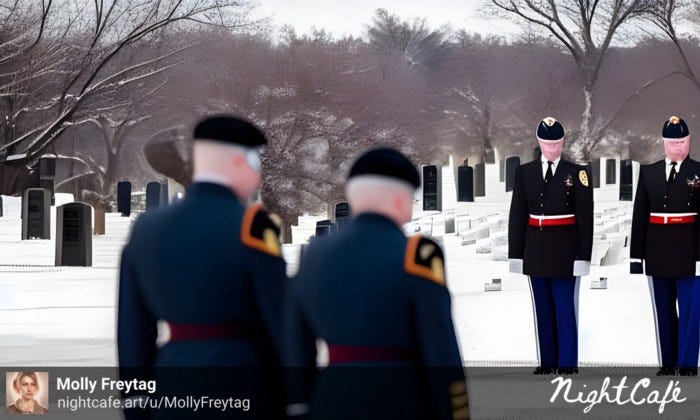
There was a funeral at Arlington for Lance and one of the others. Coffins draped in flags, somber honor guards, grieving parents, and the unbearably poignant ceremony of folding the flags into neat triangles and presenting them to the next of kin. A square-jawed father in Lance’s case holding his emotions in check with both hands as he spoke of a toddler always keen to explore the world, an Eagle Scout sewing on badge after badge, and finally the world’s proudest Ranger.
His son’s medals were on display, including a Bronze Star. I hugged Lance’s parents tightly. His act of selfless sacrifice had saved my life and every sound, every smell, every sight of God’s creation that I enjoyed had come at a terrible cost. Borne by Lance and these two grieving souls.
I sought out the base chaplain when I returned and together we mapped out a plan for me to become more of a Christian, more of a caring, loving follower of Jesus.
“Marion,” I said, “you spoke of paying something forward earlier. I’m doing it every day of my life. Maybe I’m just spinning my wheels financially, but every Sunday I go to church and renew my vow to help others. To pay back some of what I owe. To pay forward to strangers whatever help and guidance and love I can give them. They may learn something about Charleston, and that’s always good but if they feel that they are appreciated and respected for simply being alive and part of God’s great plan then that is something they can take home and hold close, regardless of what their own faith might be.”
They looked at me — grieving parents themselves — and there was something there that linked me to that winter hillside, lines of headstones stretching endlessly out amongst the green grass and occasional patch of snow, flags snapping against the clear blue sky, the buildings and monuments of our nation’s heart across the Potomac.
Brian had indeed excelled himself. There were candles, crusty bread, three courses he’d apparently whipped up while I was lolling in a bathtub, and another bottle of wine, a hearty red to match the thick steaks.
There was something special that evening. It wasn’t just the care they had taken of me in a moment of crisis. It went deeper. I could see it in their eyes and I don’t think it was just the wine making my vision blur just a little.
Next chapter:
The whole story:


