
The dawn of AI powered browsers capabilities that may change how we ‘search’ the Internet.
There are not many write ups about this paradigm shift in ‘Search’ as most of the announcements are less than a couple of weeks old and many people (including me) are still on waitlist to play around with these new features. Some of my details are referenced from CNN, Time, TechCrunch and other publicly available sources.
Let us start with basics: What is a web browser and how does it work?
A web browser is a type of software that allows you to find and view websites on the Internet. It acts as a gateway between the user and the internet, allowing users to view web pages, download files, and interact with various online services and applications.
Are Browsers and Search engines the same?
No. There are three main components of the Search engine:
i) Crawler: Crawlers are software programs which continuously scans the websites ii) Indexing: This leads to Indexing to make the search results more effective and iii) Search Algorithm: The search algorithm is the complete mechanism behind the whole searching process.
Chrome and Edge are browsers while Google and Bing are search Engines.
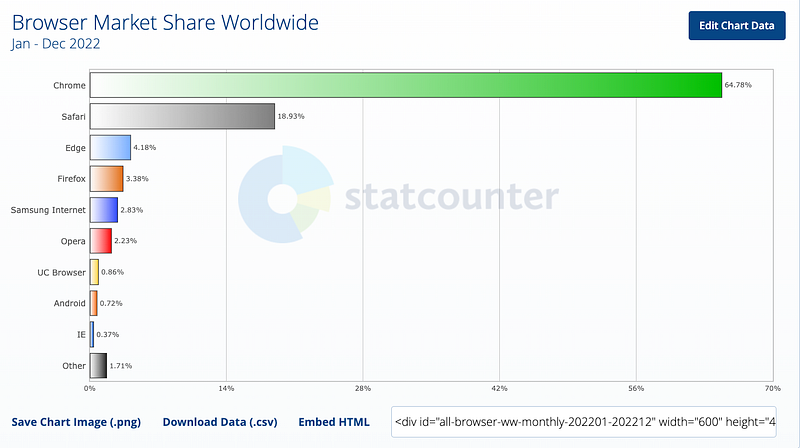
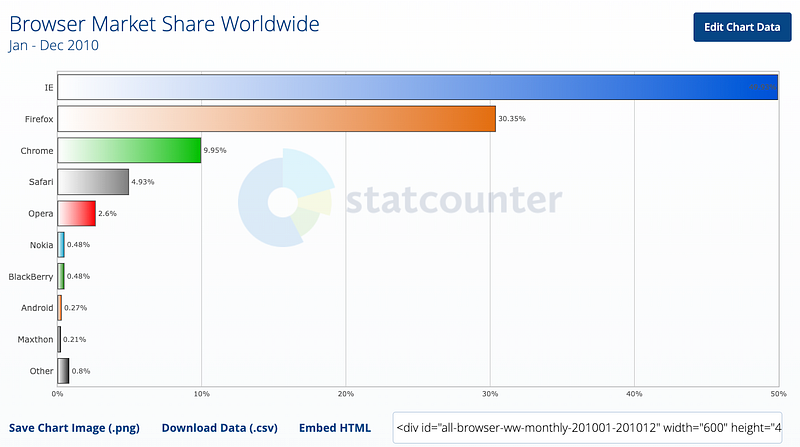
Let us compare the Browser market share worldwide in span of a decade? (source: statcounter)
So, What is going to change in our traditional Internet Searches?

Along with getting a list of search results, the browser will also be able to “chat” with users. So, now we can ask further questions on the search results and get conversational responses to queries from AI powered capabilities.
What accelerated this change recently?
The AI chatbot ChatGPT became mega-popular in just a matter of weeks. Only two months after its launch in November, the chatbot had 100 million monthly active users. For comparison, it took social media platform TikTok 9 months to achieve the same.
A study from Swiss bank UBS noted that “in 20 years following the internet space, we cannot recall a faster ramp in a consumer internet app.”
What is ChatGPT? An AI powered tool which created a sensation:
A chatbot with human-like capabilities to make conversations, respond to queries, write essays or even codes, in a matter of seconds.
One of its key use cases is in writing and content creation. ChatGPT can be used to write articles, blog posts and even entire books with ease. People began to use it to write entire job applications, resumes, curriculums, academic papers, scripts for films.., making it an ideal tool for creative professionals.
In the world of programming and development, ChatGPT can write code in a variety of programming languages, making it a great tool for developers who are looking to speed up their work. Programming and developer software has emerged as one of ChatGPT’s main use cases.
As I write this, there are hundreds (or thousands) of enhanced uses/capabilities of ChatGPT that are being shared on the net. It is MIND BOGGLING!
What does “GPT” in ChatGPT refer to:
In ChatGPT, “GPT” stands for “Generative Pre-trained Transformer.”
- The “Generative” part refers to the fact that the model is designed to generate natural language text (produce its own output based on the input it receives)
- The “Pre-trained” part refers to the fact that the model is pre-trained on a large corpus of text data, which allows it to learn the patterns and structure of language before being fine-tuned for specific tasks.
- “Transformer” refers to the neural network architecture used by the model. The transformer architecture is particularly well-suited for NLP tasks because it allows the model to capture the long-range dependencies and relationships between words in a sentence.
Overall, the combination of generative text modeling, pre-training, and the transformer architecture make ChatGPT a powerful tool for a wide range of NLP applications.
What does natural language processing (NLP) mean?
This is a subfield of artificial intelligence that focuses on enabling computers to understand, interpret, and generate human language. The goal of NLP is to create systems that can understand and respond to natural language in a way that is indistinguishable from human communication.
NLP involves a variety of techniques and tools, such as machine learning, deep learning, and statistical modeling. These techniques are used to develop models that can analyze and interpret language data, extract meaning and context from text, and generate language output based on input data.
What is OpenAI? (Creator of ChapGPT, DALL-E)
OpenAI is an artificial intelligence research laboratory consisting of a team of researchers and engineers who work on developing advanced artificial intelligence technologies. It was founded in 2015 by a group of high-profile technology industry leaders, including Elon Musk, Sam Altman, Greg Brockman, Ilya Sutskever, and several others.
The mission of OpenAI is to create safe and beneficial AI that can help humanity solve some of its most pressing challenges.
Which are the Browsers coming up with AI powered Chat capabilities:
- Microsoft announced the new Bing and Edge browser powered by upgraded “ChatGPT” AI.
https://www.bing.com/new#examples (Here is a question pasted from bing.com FAQ)
How is this different from a regular search engine?
- The new Bing builds on the existing Bing experience to provide you with a new type of search.
- Beyond generating a list of relevant links, Bing consolidates reliable sources across the web to give you a single, summarized answer.
- Search the way you talk, text, and think. Bing takes your complex searches and shares back a detailed response.
- In the chat experience, you can chat naturally and ask follow-up questions to your initial search to get personalized replies.
2. Google launched “Bard” AI search:
Google launched Bard releasing a “lightweight” version of the model for testing purposes. The model uses Google’s own LaMDA (Language Model for Dialogue Applications) to power a conversational AI that can also draw on information from the web. Read more at
https://blog.google/technology/ai/bard-google-ai-search-updates/
3. Baidu working on “Ernie”:
“Enhanced Representation through Knowledge Integration,” is a large AI-powered language model introduced in 2019 by Chinese tech giant Baidu. It has gradually grown to be able to perform tasks including language understanding, language generation, and text-to-image generation, the company said.
4. Opera — building a feature called “shorten” into its browser sidebar:
The company’s testing a new AI-powered ‘shorten’ feature that provides bulleted summaries of the article or webpage you’re reading
It will be amazing to watch how our future will change as AI makes more inroads everywhere.
Note: I have avoided to write anything on the AI race between Tech Giants and which AI has a better training models etc. It not difficult to do an analysis on that. But, my intent here is to get your thoughts and suggestions, on how these technologies are going to shape up our future.
Thank you for reading.