
The Data History: Transforming from a Side-Product to a Rising Economy
Becoming a winner or a loser depends on the steps you take starting from today

What data meant at the beginning of digitalization versus what it means today is completely different. Actually, “data” is a much broader perspective — covering also printed documents, photographs, architectural plans, and so on — but when we focus on “digital data”, the history dates back to the first computer invented in the mid-1900s. Since the beginning, some critical breakpoints expedite the total volume of accumulated data — the spread of computers, enhancements in storage and processing technologies, the internet, mobile, social media, IoT, digital twins, 5G, and I expect many more to come.
IDC predicts the world’s data will grow to 175 zettabytes in 2025.
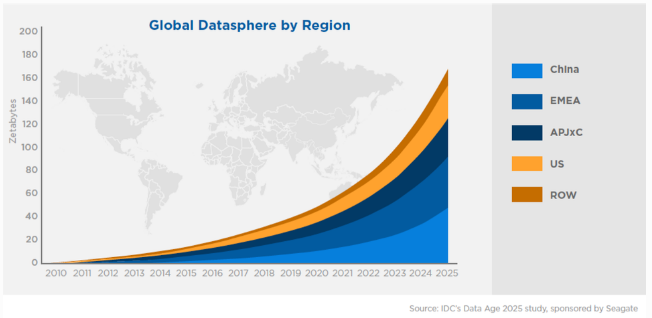
What does all that mean?
At first, data was just a byproduct of our digitalized processes. Moreover, it would even be considered a burden due to the storage cost and operational load. Once we noticed the value potential of data, magically it turned into a strategic asset. And when this driving force combined with the technological developments, it boomed exponentially.
1996 Digital storage becomes more cost-effective for storing data than paper according to R.J.T. Morris and B.J. Truskowski, in “The Evolution of Storage Systems,” IBM Systems Journal, July 1, 2003.
These days, it is the foundation or objective of many business models and creates a new economy with a growing ecosystem in the world.
There is no standardized scope definition for the data economy yet. It is challenging to measure the size of it due to overlapping intersections with many business areas, services, and technologies. The first group is the direct monetization of itself, and the second group covers data-driven services/products and directly data-related technologies. But there is also a third group that includes products, services, and technologies — that are not directly related to data — but that can be realized thanks to data.
To give an indication about the size of the data economy with the available data…
Data economy seems to account for 6–7% of GDP in 2025, with a rapidly increasing momentum.
In September 2019, European Commission stated that the value of the European data economy for the 28 Member States is expected to grow up to €1.054 billion by 2025 in a high-growth scenario based on the right conditions being in place. After Covid-19 and United Kingdom left the EU, in August 2020, EU Commission also stated that the value of the data economy in the 27 European Union countries and the UK is estimated to exceed €440 billion in 2020, close to initial estimations of around €477 billion. So we can still keep the estimates valid. And in the same report, it is estimated that the share of the data economy in EU GDP in 2025 to be 6.3%. Just for a quick comparison, European Commission also states that the turnover generated by the automotive industry represents over 7% of EU GDP.
So the data economy is expected to reach the size of the automotive industry in Europe.
We do not know the multiplier impact yet, but the third group I mentioned above will also gain momentum with innovations and data availability.
In The Economist's special report “A deluge of data is giving rise to a new economy”, it is mentioned that Statistics Canada, a government agency, estimated the value of the country’s data to be between $118bn and $164bn. Comparatively, the value of all the data in America, whose GDP is 12 times that of Canada, could amount to $1.4trn-$2trn. And it corresponds to 6–7% of GDP, similar to estimations for Europe.
McKinsey Global Institute also gives stunning estimations in their report that focus on the impact of AI on the world economy.
AI has the potential to deliver additional global economic activity of around $13 trillion by 2030 — which amounts to 1.2% additional GDP growth per year.
As an insight about the adaptation, regardless of ongoing privacy or ethical discussions, Gartner estimates that by 2022, 35% of large organizations will be either sellers or buyers of data via formal online data marketplaces, up from 25% in 2020. And by the end of 2024, 75% of enterprises will shift from piloting to operationalizing AI.
I only have a minor degree in Economics from college, so not an expert in the field, but there are ongoing discussions that the current economic theory lacks to define data economy dynamics. We will see how data economy will structure its definition. And watch with curiosity what will be the change it will bring to our world from many aspects — economy, humanity, technology… Even today, its potential is obvious and the supply of talent in the field is less than the demand. So there is also good potential from a personal career perspective.
Data Privacy and Inequality Gap Seem to be the Key Concerns

As it becomes in the early stages of any development, the data economy also has skeptics mainly questioning the real value it produces. I suggest you have a look at the MIT Technology Review article “Fair value? Fixing the data economy” to get the main idea. And think which side you are in. Here is mine:
Although there is a fair share, I think the claims are not solely related to the data economy but rather related to the bigger picture of common economic order.
One of the most questioned areas is that data is used for advertising purposes which results in directing income to a tiny group of giants, creating a monopoly, and also a manipulative society. All true! But not different from the raise of any other economy.
It was the railway economy that created the world’s tiny group of riches in history. Can we ignore the value of railways due to that? What about the oligopoly in the oil industry? And all its adverse impacts on the environment — which is the biggest risk for the world now?
From the advertising perspective, it was the same before even digital media. Remember the times that all our streets are covered by billboards and printed advertisements— which also has an environmental impact and leaves limited chance to make them targeted or restricted for some group of people — e.g. for children. And about manipulative society, remember cigarette ads of the past and even for drugs — they are shocking.
I am not advocating the unethical use of data or its power to manipulate society. Instead, I am saying that the response should not be to deny outright but channel our efforts to the right way for the real value for humanity as a whole and individuals — about health, environment, ecology, better business services, intelligence in our actions…
At a larger scale, the adoption of data could widen gaps and inequality among countries. This concern is also fair enough. But so what? What do you think about the wealth created from petroleum and hegemony-race for it? It is a natural resource for the whole world but is it the case from the economic perspective? When it comes to data and the possibility of having much of it, from a reverse angle perspective, countries with a large population (generally undeveloped ones) have an opportunity to turn it into an advantage.
I can see that this will not be the case due to many other dynamics — accessibility and distribution of technology, investment capacity, mindset change from slavery to autonomy, and many more. I am just questioning the right viewpoint.
One way or another the rising data economy is today’s reality — with all its value potential and concerns.
So we should focus on how to solve and regulate its negative power. First of all, we should ponder to define the ground rules. Who is the owner? Who can benefit from it? How to value it? How to differentiate the added value vs just the rent? Who can regulate it? How can we turn it into an asset for the well-being of the public?
From this perspective, I think GDPR (General Data Protection Regulation) is a good response and a good start for privacy concerns. From the government perspective, policies to ban it outright leave you behind rather than a remedy. The question should be how we can govern and regulate and additionally how can we take the leading role to leverage for the sake of the public.
Do You Have a Chance not to Accept It or Have the Luxury not Take Any Action?

It is better to answer this question from the country, business, and individual perspectives.
Countries lagging to adopt new developments or just take the follower role rather than becoming a player, never gain the leap they desire. It seems better to take a proactive role to take your seat in the data economy and get the most out of it ensuring the security and well-being of your country and citizens.
From business perspective data brings a notable competitive power. Based on researches, the companies benefiting from data insights are better at acquiring and retaining customers and have higher profit potential due to better smart decisions.
An IBM research reveals that 62% of retailers create a competitive advantage for their organization with the use of information and analytics
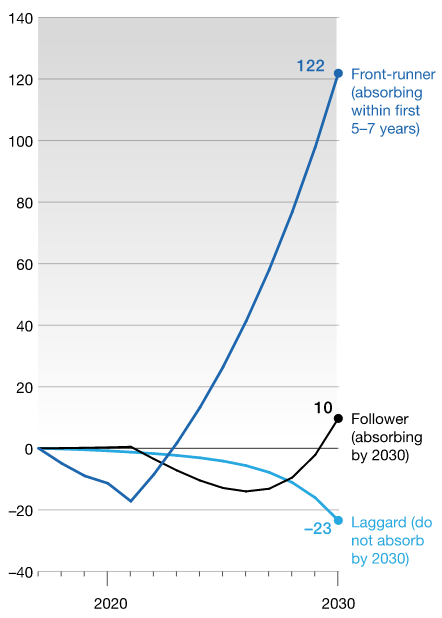
McKinsey research that I referred above, highlights the possible gap between front-runners and late adopters by 2030. At a first glance, it shows that you do not have the luxury not to take any action.
It also states that its impact is likely to build up at an accelerated pace over time, so patience and long-term strategic thinking are required.
As a business, to be able to stay viable and thrive in the new world of data, you need to focus on building talent and competencies in the field and start to discover the value out of it.
There are two sides of individual perspective — one as being the consumer of data-related services, and the second is becoming the talent behind these services. Even just for becoming a customer, you need to have a basic understanding to survive and manage it as you wish and protect yourself. There is much more progress needed to regulate this field. But at first, you should be the one who advocates for your data.
As you can understand from the statistics that I shared, the data economy is a very fast-growing area where diversified competencies are required. There is not enough talent even at its present level. With the expected exponential growth, the talent gap is expected to grow. So if you invest in yourself in this domain from selective diversified competencies, you can create your future.
There is a vast amount of topics to be discussed in this area — the possible applications in different sectors, how to involve government bodies, how to overcome the concerns, how to leverage it for the sake of humanity, further technological developments needed, how to set the ground rules, how to govern the tremendous amount of data and how to decide which one is valuable, how to measure it…
As a consultant working in the domain from both value generation and privacy regulations perspectives, I can see the possible adverse impacts of abuse and the promising value potential that we cannot ignore. I prefer to take the side of focusing on benefits and try to find answers on how to eliminate the adverse side of it — either via technology or governance. And humbly suggest you increase your understanding and talent in this area.