
The Dark Side of AI. Beware of Scams
From Fake Books to Fake Job Offers

As AI continues to advance, it becomes more and more difficult to distinguish AI-generated text from a human-written text. Scammers are taking advantage of this and coming up with various unethical methods to make money online. I’m observing this with discontent.
Many people use tools like ChatGPT to simply aid their writing process, boost their productivity, or overcome writer’s block; they generate ideas, article outlines, etc; while still writing content themselves and checking facts, since AI isn’t always accurate and may give false information.
Aiding the creative process should be the proper use.
However, there is a dark side to AI tools.
A Goldmine for Scammers
Scammers are using AI to generate fake books and job offers, or malware scripts and phishing emails. One scam is more dangerous than the other.
This year Amazon’s marketplace was flooded with AI generated books under fictional names. What’s worse, some scammers were even selling fake books under well known authors’ names.
However, this is only the tip of the iceberg.

What AI scams to watch out for?
Scams are popping up like mushrooms after a rain, but the following are one of the most common right now:
1. Selling fake books on Amazon
Scammers are trying to profit off famous names.
Jane Friedman, an author with 25 years of experience in publishing industry, discovered recently that someone listed half a dozen AI generated books for sale on Amazon under her name.
One of her readers reached out to her via an email to share their feedback on the author’s new book. This alarmed her, since she hasn’t published a new book since 2018. Later, she reported the fake books and after some time they were finally taken down.
Another person that fell victim to scammers was Rory Cellan-Jones, a British journalist and a former BBC tech reporter. In an interview with The Guardian, he said that when he checked his author bio on Amazon, he discovered that someone under the name “Steven Walryn” published his biography.
The biography was most likely AI generated and contained false information. “Steven Walryn” published over 40 books on Amazon, mostly camera how-to guides and fantasy romances.
It’s a perfect example of book spamming:

According to The New York Times, fake travel guides were flooding Amazon’s marketplace in summer. Consumers were being tricked with fake five-star reviews, beautiful well-designed covers and convincing author photos and profiles.
Mike Steves’ “France Travel Guide: Discover the Beauty, Culture, and Charm of France Through an Insider’s Guide,” was one of the examples. The travel guide provided no useful information whatsoever and quickly started gaining one-star reviews.
The Times ran fragments of the travel guide through Originality.ai and the text proved to be 100% AI generated.

2. Posting Fake Job Offers
Job seekers already encounter many obstacles while looking for a new job. However, now they really have to be on their toes while applying for jobs.
Scammers take advantage of job seekers, especially those who would like to have a remote, high-paying job — who wouldn’t? — and create fake job ads, using AI to make them sound more enticing, as Consumer Affairs reports.
Why are they doing it?
To get your money and your personal information.
Scammers post the job offers on websites like Indeed or LinkedIn. Personally, I encountered this kind of offers on Upwork. The fake job offers often seem legitimate, especially for someone who’s never been exposed to them before.
As I mentioned earlier, the fake job postings are usually offers to work remotely, for example as a translator, copy typist, personal assistant, customer service representative, and so on.
Here’s an example of a job offer I easily found on Upwork:
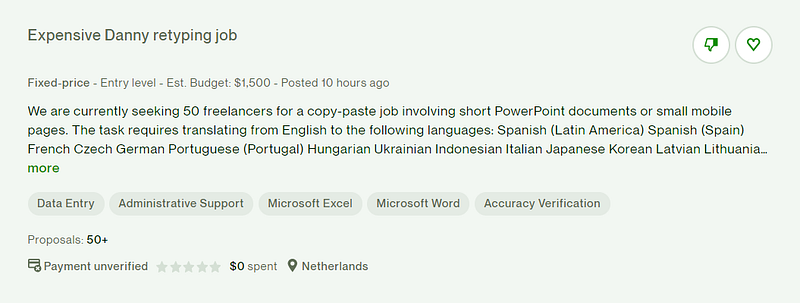
After applying for this kind of job, instead of getting hired, you receive a private message from scammers asking you to message someone on Telegram or WhatsApp, and attaching a suspicious looking link.
Communicating outside of Upwork before getting a contract is is a violation of Upwork’s terms of service. So, not only are the scammers scamming, but also violating the terms of service.

What happens after you contact the scammers?
Surely they will ask you for your email address, phone number, Social Security Number and your bank account number so they can (as they claim) pay you the salary, or may even ask you for a deposit. While in reality they will use this data to steal your money.
Unsolicited Job Offers
As Euronews reports, scammers have targeted thousands of people on WhatsApp and managed to steal even €100 million from their victims with fake job offers.
Scammers were sending personalized unsolicited job offers to their victims, while impersonating recruiters and pretending to work for legitimate recruitment firms and agencies like Reed and Hays. They were offering high-paying jobs, such as completing simple tasks five days in a row, and later on they were asking for a deposit to unlock more tasks.
Be careful about what information you’re sharing on social media and who has access to it.
There are many more AI scams I won’t be able to cover in this article. Such as:
- Phishing Scams with the use of AI
- AI Voice Cloning Scams
- Fake ChatGPT Apps and Websites
- AI Investment Scams
- Social Media AI Scams
Everyday scammers are racking their brains all day to come up with more scams or to perfect the existing ones. That’s why we should keep up with the latest scams and make other people aware of the dangers.
Stay safe.
Hi there, I write about my experiences, interesting facts and living happier and healthier. To see my stories show up on your feed, I’d love for you to follow me!


