
The Dangerous Cost of the Belief That Women Are Sacred…and Men Are Not
It’s no wonder men are facing a mental health crisis
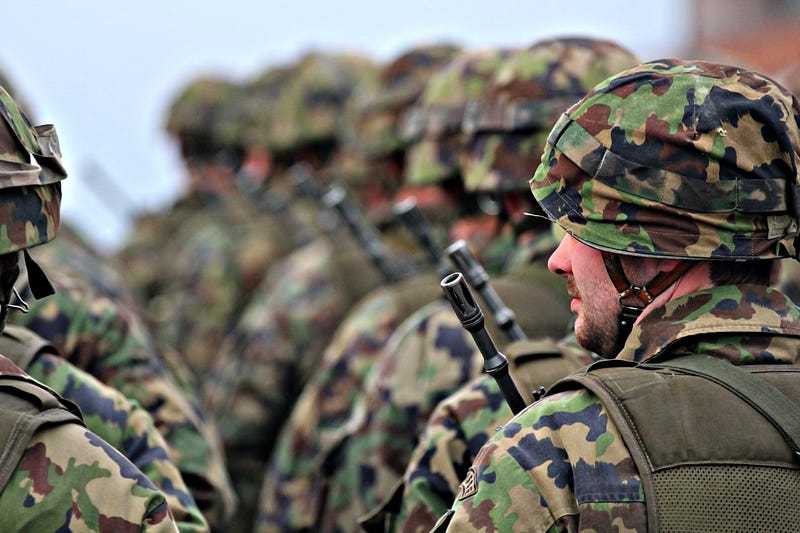
Why do men seem so hellbent to start one war after another? Do you ever wonder that as we witness conflict seemingly every time we leave the house — or certainly every time we see the news?
This is one of the central conversations that takes places in Season 7 of Outlander — or rather, what has been released at this point. (Don’t worry — no spoiler alerts!)
Jamie and Claire, who are now in the thick of the Revolutionary War, have a conversation about why men appear locked into cycles of warfare, while women, by and large, do not tend to go about engaging in collective acts of mass violence.
Jamie’s answer to this is not surprising to Outlander fans who have come to know these characters quite well over the years. He waxes somewhat poetically about how men are just individual beings with nothing to tie them to life or even one another. It’s easy for them to find themselves creating the circumstances of war, making decisions that will cost so many other men their lives — because this singularity, this lack of connection makes men dispensable, in a sense. One man, Jamie says, is no different than any other. They provide, they protect, and these are simple duties, easily performed by any man.
But women, he theorizes with that characteristic romantic philosophizing that Jamie is so apt to indulge, are too important to be considered replaceable. They are the makers of life, after all. Their ability to become pregnant ties them to the world, to other people, and to the cycles of life, itself, in ways that men can never experience.
Women, we are left to surmise, are too sacred for the pointless violence of war.
It might surprise you to hear that I almost got a cramp from trying not to roll my eyes. That’s right. Did you think this was going to be an essay about how sacred women are and that Jamie was right, men are replaceable and expendable? No, I’ll have none of that, thank you very much.
I know this won’t go over well, especially with the die-hard Outlander fans, but the truth is, Jamie Fraser could not be more wrong.
If there’s one thing even the moderate Outlander fans know about this series it’s this: This story is deeply steeped in patriarchal tradition. There are a few reasons for this, I suspect, but the main one is the most important and most obvious: The majority of the story takes place in the 18th century, when patriarchal traditions were inescapable.
Outlander, and books and TV shows like it, often romanticize the patriarchy in ways that can be very confusing for those who aren’t in the process of “de-programing.”
For instance, we’re supposed to think it’s romantic when Jamie is awestruck by how delicate and tiny Claire is and how easy it would be for him to “break” her. Or the many, many times he goes on about his duty to protect her with his “name, family, and body,” emphasizing that he would literally die for her. Or, as mentioned previously, when Jamie ponders the triviality and insignificance of male life when compared to that of a woman’s.
These perspectives are very tricky. They often come off sounding so sweet, so romantic. They even sound quite wise, in many cases. I know many women want to cheer when Jamie goes off on one of his speeches about how important and sacred women are. Isn’t that what’s missing from this world? Isn’t it about time someone appreciated women?
But here’s the problem: These perspectives are still rooted in patriarchal beliefs. And as such they are incredibly dangerous to all of us, no matter how much we wrap them up in pretty paper and try to disguise them as love, romance, and the protection of women.
Men are not disposable. Men are not easily replaceable. Men are not here just to provide and protect, having no other purpose.
It seems crazy to me that I feel compelled to write that out, but the amount of men I hear from who seem to believe some version of this tells me we still have a lot of unlearning in this area.
And let’s go deeper.
Why do we keep talking about women like they are the ones who create life? I mean, yes, we do, but hello! We can’t do it without men. There was only one Jesus, folks, and the rest of us rely on semen to do the job. And where does that come from?
Men are an actual fountain of life. Life is literally squirting out of them. Why do we keep talking about them like they have no participation in the creation of life? Sure, they’ve got the easiest part, but still…they are a necessary component of this process.
So why are men — Jamie’s not the only one — so quick to affirm their own irrelevance? Their own insignificance?
I hate to say it, but there’s a sleight of hand trick going on here. This faux nobility, this fake humility is all a clever smokescreen designed by the patriarchy to support a narrative in which men are the enforcers of our society.
It all sounds so selfless and compassionate the way Jamie tells it, doesn’t it? In fact, it almost sounds like the patriarchy actually values women with all this talk about how men are expendable and women are sacred.
Except this is the language of the enforcer. This is how we keep hierarchical systems in line. Those at the top get to police the rest of us, making sure we all fall in line.
Men are the protectors? The providers? The ones who must guard the women from harm because women are the sacred vessels of life?
The patriarchy wants us to think of it like Jamie and Claire’s conversation — gauzy and romantic, just the way relations between men and women should be.
But the problem is, that’s not how it turns out in real life. What do we end up with? A society in which men determine which women are worthy of protection based upon how she has chosen to live within her body. If a man determines she’s had too many partners (in other words, if he determines she is a slut), she can’t have the benefit of the promised protecting and providing. But if she is a “good woman,” i.e., she is a virgin committed to experiencing sex with only one man, then she will be determined worthy.
This means that, during the course of the patriarchy, women’s worthiness has been determined by men — men who police their sexuality. Women have been forced to strive to behave in ways that men find acceptable in order to gain their approval and ultimately, the validation of their worth. And all the while, men are held to no such standard and can do whatever they want with their bodies.
It doesn’t end with sexual expression and behaviors, either. Women are policed all the way through to the culmination of the sexual act: conception, pregnancy, and birth. The enforcers (men) have been controlling women’s wombs for four thousand years. And even when women finally started gaining control over their own bodies, we are now facing the erosion of those rights as male politicians steamroll over any body that can birth a baby.
Yes, these enforcers are expendable — but not because they are men, because they are pawns of this system of oppression. Just like the women in it.
That’s what these systems do: Turn us into its pawns, its weapons, its toys. And in those roles, we lose our humanity.
Don’t ever forget that any patriarchal norm that affirms the “purest” or “most noble” kind of masculinity is still a patriarchal norm — which means it will harm men and everyone around them.
This kind of mindset, of the “expendable man” and “sacred woman,” will turn even the best of men into a surveillance guard, slowly sinking into delusions of “protector” and “provider” that strip his humanity and prevent him from seeing himself as a whole, complete being.
And from seeing women as whole, real, fallible humans, rather than saintly vessels built solely for the germination of sperm.
Do you see the problem here?
It’s easy to fall into this trap. For one thing, the indoctrination is everywhere. This is what men are supposed to think. This is what it means to be a man. (Or so they say.)
But take a closer look. This isn’t so much telling men how to be a man, but telling men that they are ultimately insignificant and replaceable. It’s literally telling men that it’s manly to believe that their contribution to the human race is basically irrelevant and as such, they are expendable.
No wonder men are having a mental health crisis.
Men are not unholy, animalistic beasts. Women are not godly, pure sacred beings.
Even though this might sound like feminist rhetoric that finally lifts women up…it is not. This is 100% patriarchal propaganda. And its sophisticated disguise makes it all the more dangerous.
We are all humans — something perhaps in between the beasts and the beatified.
Jamie Fraser has been drinking the Kool-Aid — which, to be fair, would have been unavoidable in the 18th century. Had he been the time-traveler, rather than Claire, and ended up in the future, he might have had another perspective.
Perhaps he would have realized that men make war because the patriarchy teaches them to pursue dominance and power at any cost — even in conflicts that will cause mass causalities.
It’s not because men understand how expendable they are, how unimportant they are to the cycles of life. It’s because they’ve been taught that.
There is always the opportunity to regard their bodies as vessels for life, too. To see themselves connected to others, to the world, to life, itself.
But to choose to honor life, creation, and connection is not a very “manly” thing to do. The patriarchy sees that as weakness.
It’s not an easy road to choose, bucking the patriarchy. Trust me, women know.
So what will men choose as we move forward? Will they start to see the same capacity for the miracle of life in their own bodies that they are taught to see in women’s? The same capacity for connection and community?
Or will they choose to believe in their own insignificance, and keep flinging themselves into the literal and metaphorical battlefields of life?
© Yael Wolfe 2023
Yael Wolfe is a writer, artist, and photographer. You can find more of her work at yaelwolfe.com. If you love her writing, leave her a tip over at Ko-fi.
More on men and the patriarchy: