
The Danger of The Feynman Technique
Why Most People are Using it Wrong
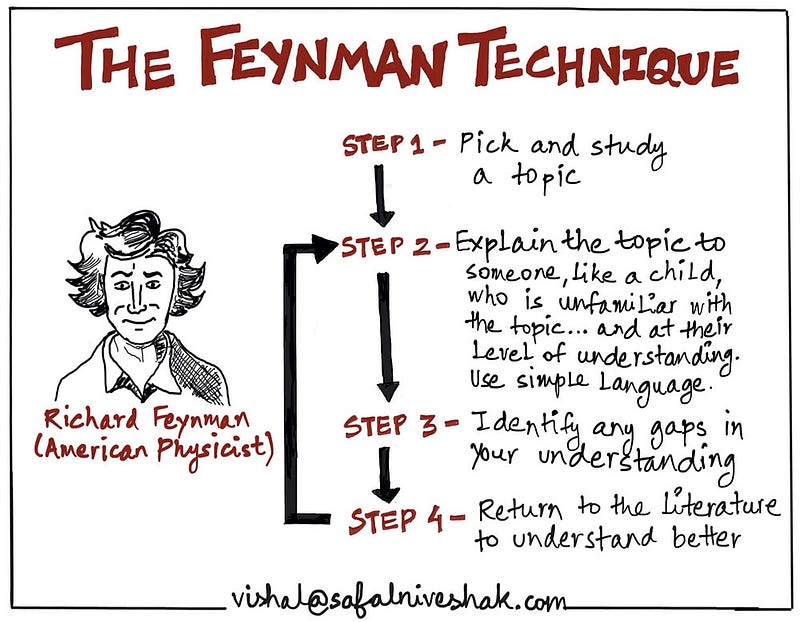
The Feynman technique (pronounced “fine-man”) changed my life. Reviewing all the study methods I have ever used, this technique easily ensures a place as one of my five methods of study.
The bases of the technique are that you try to explain a complicated topic in simplified terms, allowing you to better understand the complex subject.
Quite simple right? I thought.
Over time, we have identified the fundamental principles of Feynman technique, the golden rules. When I started using the technique properly, understanding my subjects not only I deepened, but I woke up to make new connections and sometimes even guessing test questions (it is a good feeling).
What is the Feynman technique?
Richard Feynman was a famous author, physicist, teacher and more. Albert Einstein was present during Feynman’s discussions, when Feynman was a graduate student, and Bill Gates reports Feynman as “the greatest teacher I never had.”
Personally, the feature I admire most in Richard Feynman was his teaching ability. I watched some old videos about him speaking and his lectures and I am always amazed by his ability to read some extremely simple complex. So how do we use this magical technique?
There are three simple steps:
- Identify the information; What you learned?
- How did you learn it? Imagine explaining this information to a 12-year-old.
- How did your explanation sound? Could you simplify it? Study more and try to explain the subject even simpler.
Ok, now we know what it is; Let’s move on to the meat of this post. How can we maximize the potential of this fantastic technique?
1. Understand the topic first
Don’t learn something for the first time with Feynman technique. Remember, what we do with the Feynman technique is to take something complex and simplify it, so that we can better understand the complicated thing.
So, if you take that difficult thing that you do not even understand and try to apply this technique, you may be able to explain impossible. Secondly, and more importantly, you can explain the wrong information.
You don’t want to do this because you store the wrong information in your brain.
This is why I do not learn something with a distance or active recall when learning something for the first time. Actually, I have to understand something before I can explain it, right? So I learn it! I do not open my manual about mitosis and I try to explain anaphan if I do not know what a chromosome is.
You are usually alone, coming with this explanation for you. Make sure you understand the subject by reading the chapter in the book possible, watching a third video or making a friend explain it before trying the Feynman technique.
The bottom line: Make sure you really understand the complex topic first.
2. Long -term storage
So you only read ten dense pages about mitosis, watched a 20 -minute YouTube video and spent 30 minutes drawing every step. Then you practiced the explanation three times until you finally realized a super simple way to explain the mitosis, the lamp you explained -it seems to really understand how a cell becomes two cells.
Ok, bam, mitosis down. Now, why not go directly to learning meiosis and the Kreb cycle and … no! Have you just done so much work? Don’t you want to strengthen this information? Convert the information to the long -term memory.
Studies indicate that we lose up to 2/3 of the information learned 48 hours after learning. We do not want those or two hours that I only spent on Feynman to lose, so what do we do?
We make sure that we use the magic of repetition distanced to keep this knowledge until the test day.
Use Feynman technique
Create a flash book that says, “Explain Mitosis — Feynman”, and in the answer, write exactly the explanation you just perfected. You can use a Physical Flash Book or Anki.
If you want to get a plus, you can create 3–5 additional questions about the main points of the things you just explained, but make sure they are simple flash books, such as:
“The phases of mitosis are interfaces, prophesses,” blank “anaphase, telophase and cytokinesis. “Notice how this flashcard is just a completed.
Ok, now, you can go to study meiosis. How fun!
The bottom line: After improving the explanation, create a flash book out of the explanation and test -regularly.
3. Notes on notes not working
In college, I studied notes about notes about notes. I would like to have some of my posts to read or briefly seek the evidence around the summary (the evidence does not support it) 2. It is not necessarily that this technique is terrible.
There are much better techniques than this. Such as active recall and distance repetition, especially after you understand the information.
Therefore, it does not only rewrite the simplified summary repeatedly to try to concrete it. Instead, make one or two plays for simplification after you have had the initial attempt at the Feynman technique and then convert the information to a flash book, as described above.
Down line: Do not write notes on notes.
4. Choose which topics to use the technique carefully
Do I use Feynman technique on every information I learn?
Not!
This would be a ridiculous waste of time. I use it for general critical topics to establish a basis for understanding.
Obstructive and restrictive pulmonary diseases work beautifully with Feynman technique, as they can be explained simply, and the explanation helps me to learn.
However, with histopathology (which looks at the sick tissue at the microscope), I cannot explain this information in words. Because these are tissue images, I have to study them. I need some photos to understand this information.
Bottom line: Choose topics to carefully use Feynman technique.
5. Spend time
I have chosen carefully that the topics I want to use the Feynman technique. However, I do Feynman technique when I do Feynman technique. Don’t secure it in half.
Here’s the problem: if you do half a bottom, explain half your understanding and, on the test day, you will be a full bottom.
So, to be a non-Ass, it could mean spending two hours on the complex topic before explaining it, but it’s okay. And sometimes, it can only take ten minutes to complete the Feynman technique.
The only person you deceive is you. Make sure you have a solid explanation in your head before moving on to the next thing.
Down line: Spend time to prepare an adequate explanation of the complex subject.
6. Avoid jargon and complexity
The other classic trap is just the simplification of the parts of the explanation. For example, a partial simplification of anaphase could be something like:
The microtubules are attached to the centromeres and detach from the chromosomes to the respective centrosomes at each pole of the cell.
What is a centromere?
Chromosome? Centrosom?
Microtubule?
We are still too complex here. A better explanation using Feynman technique could be:
The anaphase is when the genetic material replicated from the cell, now solidified in the form of chromosome, is pulled to the opposite ends of the division cell, so that each of the newest cells has a copy of the genetic material.
It is better, but I can improve it even better by expanding on it:
So how is the genetic material drawn in each side of the divis cell? A special protein from the cell, called the microtub, is attached to the center of each new chromosome, then the special protein pulls the chromosomes apart from the opposite parts of the dividing cell. This establishes the beautiful cell for telophase, the final stage of mitosis.
The simpler the explanation, the more likely you are to understand it. You can complete the specificity later. You need to understand the overall picture before you deepen. Then, when you deepen, however, keep it simple. The confusion can slip very quickly. And if your explanation is confused, your understanding is confused.
Down line: Avoid jargon and complexity
7. Use it in reality
Do you want to learn a topic certainly? Prepare a real lecture for other students.
So what I would do, well with most of your content, use only the standard method of Feynman. However, for important things, you see if you can find someone to actually learn it.
This could be colleagues, a friendly parent or even your teacher (I guarantee you will know the subject if you practice teaching in front of your teacher).
Down line: Try to teach your subject in real life
8. Simplify -The explanations so you understand it
In total, this is the most important advice.
You have to simplify your explanations so you actually understand them. If at any time of the explanation (remember that this is your explanation), you are lost or you are not sure what is happening, stop.


