avatarDaniel Ruston

Free AI web copilot to create summaries, insights and extended knowledge, download it at here

2856

Abstract

have been tackled before so can be thought of as ‘predictable’.</p><ul><li>Is the problem straightforward, with clear cause-and-effect relationships? = <b>Obvious</b></li><li>Or is it intricate, requiring deeper analysis and expertise? = <b>Complicated</b></li></ul><p id="1c87">In the Unpredictable world fits <i>Complex and Chaotic</i>, these types of situations and problems have limited precedent so you’ll need experimentation and adaptation to create a solution. Problems in these categories are more ‘unpredictable’.</p><ul><li>Does it fall into the realm of unpredictable, emergent solutions? = <b>Complex</b></li><li>Or is it a crisis situation demanding immediate action? = <b>Chaotic</b></li></ul><h2 id="399a">Obvious problems</h2><figure id="f2dc"><img src="https://cdn-images-1.readmedium.com/v2/resize:fit:800/1*3ewFqK8JGjzxjWRWswiSow.png"><figcaption></figcaption></figure><p id="b989">In the Obvious category, there are clear cause-and-effect relationships and problems can be solved with known rules and procedures, these can be defined as “Known knowns”. Obvious category examples:</p><ul><li>Designing a new form</li><li>Creating a user research study plan</li><li>Hiring a senior designer</li></ul><blockquote id="fbfa"><p><b>How to tackle: A</b> <b>good approach here is to categorize the problem, find best practice and implement with efficiency</b>.</p></blockquote><h2 id="5b9d">Complicated problems</h2><figure id="7c4a"><img src="https://cdn-images-1.readmedium.com/v2/resize:fit:800/1*XtIJ3MIJ8vb4KE2oPwUVyA.png"><figcaption></figcaption></figure><p id="f56f">In the Complicated category, there are unknowns but those are often easy to spot, there are discoverable cause-and-effect relationships but not immediately obvious, ‘expert’ opinion and analysis is required, and there’s more than one right answer. Complicated category examples:</p><ul><li>Creating a new design system</li><li>Aligning teams across an organization on a UX proposal</li><li>Developing user research durable insights</li></ul><blockquote id="b230"><p><b>How to tackle: Approach these problems with good practice and identify gaps. Define, structure, analyze to find what is good practice, find the right experts to get advice from and create a roadmap to fill the gaps.</b></p></blockquote><h2 id="696e">Complex problems</h2><figure id="c646"><img src="https://cdn-images-1.readmedium.com/v2/resize:fit:800/1*p2YOhJaoyY_X94gw1dB1ZA.png"><figcaption></figcaption></figure><p id="5872">In the Complex category there is flux and unpredictability, no right answers, many competing ideas, and a need for novel & unconventional ideas — this is means that there are many ‘unknown unknowns’. Complex category examples:</p><ul><li>Integrate new capabilities (LLMs, AI) into the current user experience</li><li>Redesigning a core part of the product / app / s

Options

ervice</li><li>Developing a 3–5 year UX vision</li></ul><blockquote id="996d"><p><b>How to tackle: Approach these problems with curiosity and experimentation — set a direction and learn — use emergent practices. Ask different questions, take multiple perspectives, experiment and learn as you go, try things to see what changes.</b></p></blockquote><h2 id="a0bc">Chaotic problems</h2><figure id="d37f"><img src="https://cdn-images-1.readmedium.com/v2/resize:fit:800/1*RX45XkuQQ76T9fch3-unoA.png"><figcaption></figcaption></figure><p id="805d">In the Chaotic category, people and teams are in crisis, there are no understandable patterns, it is always destructive, and entirely new rules have been created. Due to amount of chaos there many ‘unknowable unknowns’. Chaotic category examples:</p><ul><li>Large scale re-org with layoffs and entirely new focus areas / scope</li><li>Redesigning a product from the ground up with new technology i.e. LLMs / AI</li><li>Major disruption due to unclear or shifting goals midway due to stakeholder misalignment or sudden market shifts</li></ul><blockquote id="6974"><p><b>How to tackle: Establish stability, identify who’s in charge and capture questions. Plan quickly to restore the basics first. Meet in short bursts to gather critical status updates and delegate. Continually come back to: What’s critical right now, and what’s not? Share critical information without holding back.</b></p></blockquote><h1 id="5516">In summary</h1><p id="8c74">By placing your problem in the related Cynefin category, you’ll be better equipped to choose the right design methodologies, manage expectations, and navigate the collaborative process more effectively. This means you can streamline clear-cut tasks, address intricate problems, experiment and adapt within complex scenarios, and act in the face of crisis — ultimately saving time and resources while generating better design solutions.</p><figure id="84fd"><img src="https://cdn-images-1.readmedium.com/v2/resize:fit:800/1*rPPz1dUpXWjOi2IDyCMa_w.png"><figcaption></figcaption></figure><p id="2d0d">By following these tips, you too can use the <a href="https://en.wikipedia.org/wiki/Cynefin_framework"><b>Cynefin framework</b></a> to help you navigate complexity in UX design.</p><p id="f087">Enjoy my writing? Please consider a <a href="https://ko-fi.com/danielruston">coffee donation</a></p><p id="e1b2">More about the Cynefin framework</p><ul><li><a href="https://hbr.org/2007/11/a-leaders-framework-for-decision-making">https://hbr.org/2007/11/a-leaders-framework-for-decision-making</a></li><li><a href="https://en.wikipedia.org/wiki/Cynefin_framework">https://en.wikipedia.org/wiki/Cynefin_framework</a></li><li><a href="https://thecynefin.co/about-us/about-cynefin-framework/">https://thecynefin.co/about-us/about-cynefin-framework/</a></li></ul></article></body>

The Cynefin framework: navigating complexity in UX

Why complexity matters and how to handle it well.

Photo by Max Harlynking on Unsplash

As a UX Lead, my team and I are constantly faced with the challenges of navigating complex and challenging scenarios. Whether it’s designing a new product, improving an existing one, or simply trying to keep up with the latest technology advances, there is always a lot to consdier.

One of the most important things I’ve learned is that it’s important to break down complex problems into smaller, more manageable ones.

When tackling less complex problems, there are several blueprints to follow, helping to identify the key user needs & goals, and developing solutions that address those needs in a clear, concise way.

When faced with nebulous and complex problems there are conceptual frameworks available in this article i’ll cover the Cynefin framework to help think through complexity in a more helpful way.

It’s also important to understand the difference between complex and complicated—something i’ll dive into below. Navigating complexity is not easy, but it’s possible with careful planning and execution.

A helpful tool: Cynefin framework
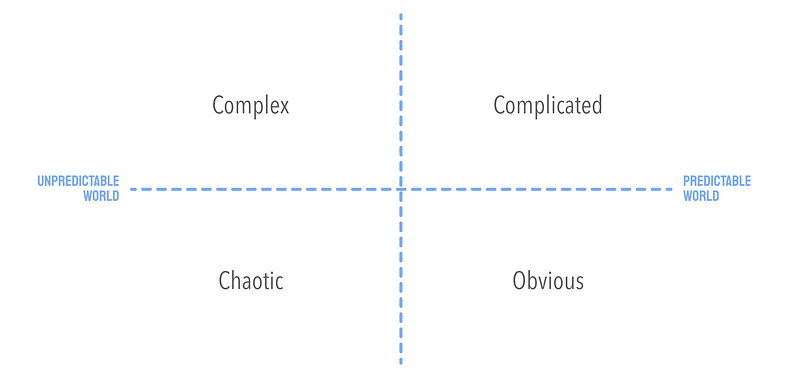
Cynefin Framework developed by David Snowden and Mary E. Boone.

The Cynefin framework is a sense-making and powerful decision-making tool that can bring clarity, it helps you understand the nature of the problem you’re tackling and guide you to find the right approach for different project challenges.

Design problems exist on a spectrum, from the straightforward “obvious” to the highly unpredictable “chaotic”. By understanding where your problem/project falls within Cynefin’s categories (obvious, complicated, complex, chaotic), you can choose strategies and tactics tailored to the situation.

The Predictable vs Unpredictable world

The predictable world is defined by two categories, Obvious and Complicated. These types of problems and challenges have been tackled before so can be thought of as ‘predictable’.

  • Is the problem straightforward, with clear cause-and-effect relationships? = Obvious
  • Or is it intricate, requiring deeper analysis and expertise? = Complicated

In the Unpredictable world fits Complex and Chaotic, these types of situations and problems have limited precedent so you’ll need experimentation and adaptation to create a solution. Problems in these categories are more ‘unpredictable’.

  • Does it fall into the realm of unpredictable, emergent solutions? = Complex
  • Or is it a crisis situation demanding immediate action? = Chaotic

Obvious problems
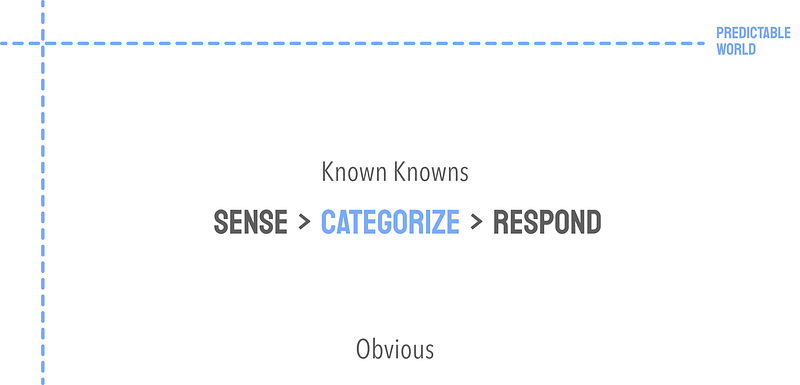
In the Obvious category, there are clear cause-and-effect relationships and problems can be solved with known rules and procedures, these can be defined as “Known knowns”. Obvious category examples:

  • Designing a new form
  • Creating a user research study plan
  • Hiring a senior designer

How to tackle: A good approach here is to categorize the problem, find best practice and implement with efficiency.

Complicated problems
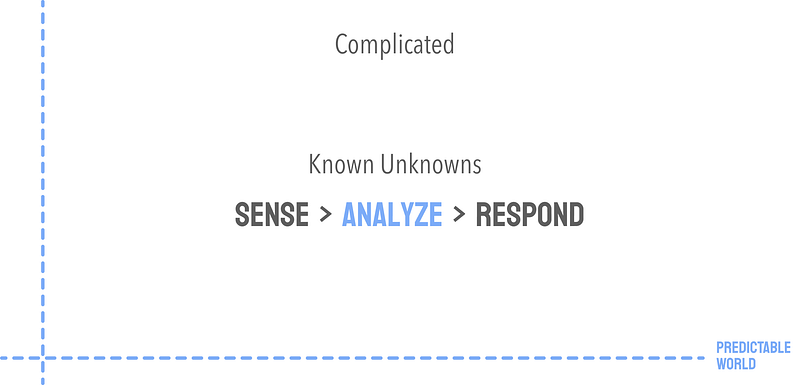
In the Complicated category, there are unknowns but those are often easy to spot, there are discoverable cause-and-effect relationships but not immediately obvious, ‘expert’ opinion and analysis is required, and there’s more than one right answer. Complicated category examples:

  • Creating a new design system
  • Aligning teams across an organization on a UX proposal
  • Developing user research durable insights

How to tackle: Approach these problems with good practice and identify gaps. Define, structure, analyze to find what is good practice, find the right experts to get advice from and create a roadmap to fill the gaps.

Complex problems
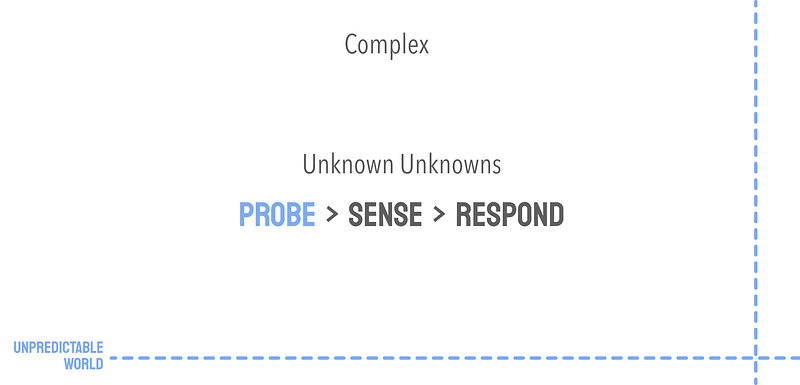
In the Complex category there is flux and unpredictability, no right answers, many competing ideas, and a need for novel & unconventional ideas — this is means that there are many ‘unknown unknowns’. Complex category examples:

  • Integrate new capabilities (LLMs, AI) into the current user experience
  • Redesigning a core part of the product / app / service
  • Developing a 3–5 year UX vision

How to tackle: Approach these problems with curiosity and experimentation — set a direction and learn — use emergent practices. Ask different questions, take multiple perspectives, experiment and learn as you go, try things to see what changes.

Chaotic problems
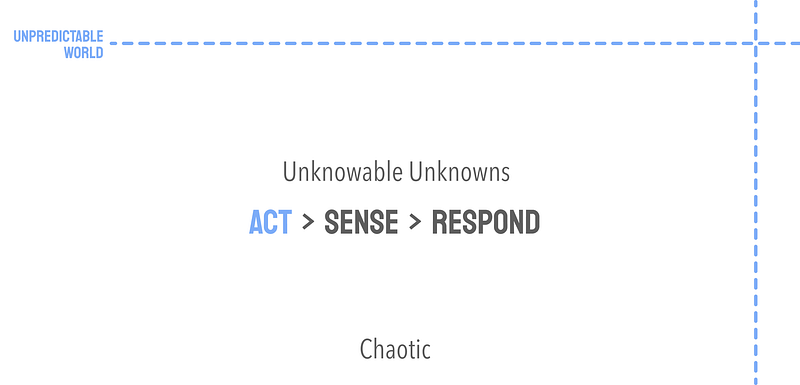
In the Chaotic category, people and teams are in crisis, there are no understandable patterns, it is always destructive, and entirely new rules have been created. Due to amount of chaos there many ‘unknowable unknowns’. Chaotic category examples:

  • Large scale re-org with layoffs and entirely new focus areas / scope
  • Redesigning a product from the ground up with new technology i.e. LLMs / AI
  • Major disruption due to unclear or shifting goals midway due to stakeholder misalignment or sudden market shifts

How to tackle: Establish stability, identify who’s in charge and capture questions. Plan quickly to restore the basics first. Meet in short bursts to gather critical status updates and delegate. Continually come back to: What’s critical right now, and what’s not? Share critical information without holding back.

In summary

By placing your problem in the related Cynefin category, you’ll be better equipped to choose the right design methodologies, manage expectations, and navigate the collaborative process more effectively. This means you can streamline clear-cut tasks, address intricate problems, experiment and adapt within complex scenarios, and act in the face of crisis — ultimately saving time and resources while generating better design solutions.
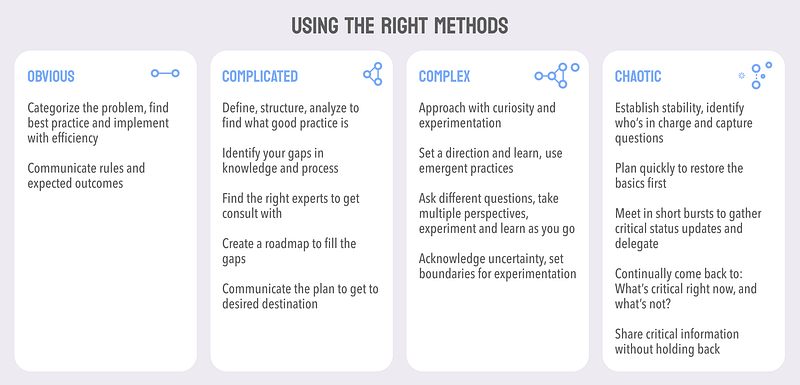
By following these tips, you too can use the Cynefin framework to help you navigate complexity in UX design.

Enjoy my writing? Please consider a coffee donation

More about the Cynefin framework

UX
Technology
Design
Product Management
Design Thinking
Recommended from ReadMedium