
The Cybertruck Might Have A Terrible Corrosion Problem
Musk should have listened to DeLorean.
The Cybertruck is a polarising vehicle, to say the least. But, for the most part, Tesla fans have seemed to lap it up. As I covered recently, the Cybertruck does appear to have a devastatingly short range and charge times that take an absolute aeon. But, weirdly, the owners reporting these problems don’t seem to mind that their $90,000+ EV has a smaller real-world range and, in practice, charges at the same rate as a $35,000 Hyundai Kona Electric. However, don’t be surprised if, in a few months, these Tesla fans change their tune on the Cybertruck. You see, a recent post by MotorBiscuit (read here) may have just found a potentially deal-breaking and annoying flaw with this remarkable machine. Its entire boy could corrode away. Let me explain.
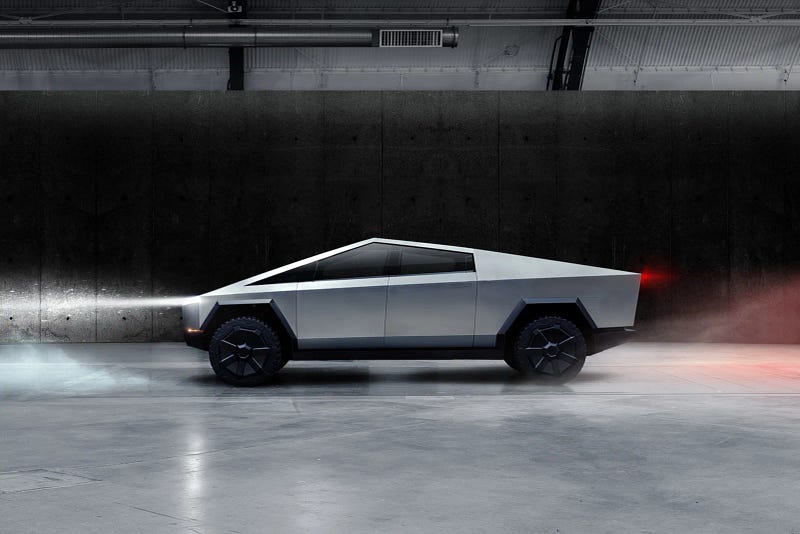
One of the main selling points of the Cybertruck is its bare stainless-steel exoskeleton body (i.e. there isn’t even a clear coat of paint on the body). The metal plates that comprise the body are so strong that they can’t be bent into a flowing shape, hence the truck’s bizarre angular shape. They make the truck incredibly rugged, practically bulletproof and rust-resistant. With the Cybertruck, Musk promised to deliver the toughest, work-ready, and most capable vehicle ever produced.
But, as DeLorean and any boatbuilder can testify, stainless steel is far from this wonder material. It has a severe corrosion problem.
This is where MotorBiscuit’s post comes in. You see, they found the section of the Cybertruck’s user manual that details how the user should look after the bare metal body of the truck. It goes as such:
“To prevent damage to the exterior, immediately remove corrosive substances (such as grease, oil, bird droppings, tree resin, dead insects, tar spots, road salt, industrial fallout, etc.). Do not wait until Cybertruck is due for complete wash. If necessary, use denatured alcohol to remove tar spots and stubborn grease stains, then immediately wash the area with water and a mild, non-detergent soap to remove the alcohol.”
Moreover, Tesla put a brilliant caveat in the manual stating, “It is normal for the stainless-steel exterior to mature over time, resulting in minor changes to the reflective properties and color of the metal.”
Imagine spending the equivalent of an incredibly decent annual salary on a truck that is meant to be rugged enough to survive anything, only to have to immaculately clean it immediately after any use. I live in the UK, and when there isn’t salt on the road, there are bugs, Saharan dust, road grease and plenty of annoyingly accurate seagulls. After just popping to the shops, I’d have to wash almost the entire 18-foot truck.
And, as someone who used to be a boat designer, I can testify how bad Stainless Steel can get if it isn’t cleaned of corrosives. Salt, biomatter and tar can quickly eat away at it, creating pitting and cavities or even thinning and weakening the metal. Some stainless-steel fittings on boats that are regularly exposed to seawater can be entirely eaten away by the salt in a year or two!
DeLorean owners can also testify to this. Their Back To The Future-mobiles also have bare stainless-steel body panels. Again, the original idea was to make the car more durable by being rust-resistant. But as many badly looked-after DeLorean examples will show you, stainless steel might be rust-resistant but not corrosion-resistant, and their body panels are in tatters.
But the DeLorean and Cybertruck aren’t really comparable. The DeLorean used 304 series stainless steel, which is more corrosion-resistant than the 301 series stainless steel used in the Cybertruck. Moreover, the DeLorean’s body panels aren’t load-bearing or a part of the vehicle’s frame, so they can be easily switched out (if you can find a replacement these days). In contrast, the Cybertruck has a stressed skin exoskeleton frame; in other words, those exposed body panels are welded together and make up the frame of the vehicle, so they can’t be replaced if damaged. They also are far more likely to get damaged than those of the DeLorean, either through brute force or corrosive material, as the life of a truck is far more intense than that of an instant classic two-seater sports car.
Now, Tesla could have solved this by using a very corrosive-resistant stainless-steel variant, like the 316 series. But this would reduce the frame’s strength, possibly making the exoskeleton design unviable. They could have also used a clear coat to protect the metal from the elements. But that is the same as painting it, which, for some reason, they didn’t do. In fact, one reaction to MotorBiscuit’s post was “holy sh*t. They actually didn’t clear-coat that. There’s a reason we do that.”
So, will this be a massive problem for Cybertruck owners? We might not know for a while. There aren’t many analogous situations we can draw data from to accurately predict how fast the Cybertruck’s stainless will corrode away. In a few months, we might see some irate owners who wanted to keep their Cybertruck immaculate, but the ‘grill’ and doorsills have been discoloured by bugs and road grime. But it could be a good few years, 4 or 5, before we hear of Cybertrucks falling apart due to corrosion. All I will say is that there is a reason no one else is building stainless-steel exoskeleton frame cars.
Thanks for reading. Content like this doesn’t happen without your support. If you want to support content like this, or read articles early, go and follow me and my project Planet Earth & Beyond or follow me on Bluesky or X.
(Originally published on PlanetEarthAndBeyond.co)
Sources: MotorBiscuit, MotorBiscuit, Ulbrich, PJ Grandy, DeLorean Forum, Inside EVs, World Auto Steel, Gerrmarine, Marline Wire


