
The Curse of Writer’s Nihilism
Forget about writer’s block. It’s overcoming apathy that’s the real challenge.
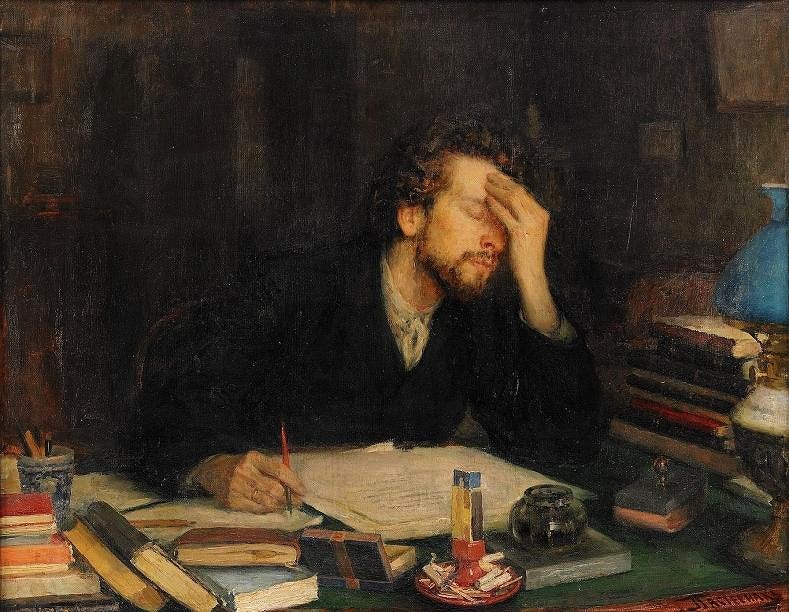
.jpg)
For as long as creative writing has existed, so has its archnemesis — writer’s block. Just as a blocked artery will prevent blood flow and can lead to sudden cardiac arrest, so too can blocked creativity bring all writing efforts to a painful, screeching halt.
Whether writing is something you do for a living or simply as a passion, it’s incredibly frustrating to find yourself staring at a blank page — or more often these days — at a blank screen with naught but a blinking cursor and your own authorial impotence for company. It’s humiliating beyond words (literally) to be abandoned wholesale by a muse who you thought was your faithful and loving companion, only to find yourself sad and alone, feeling ghosted and pathetic.
But perhaps worse than suddenly having nothing whatsoever to say, or to feel like every word you commit to print is unreadable rubbish, is to be stricken — not with writer’s block, but with its evil second cousin once removed — writer’s nihilism.
To be bursting to overflowing with ideas and hardly able to refrain from jotting them down before the next one worms its way into your mental spotlight, and yet you can’t be bothered to because you simply can’t see the point in it. Or to have dozens upon dozens of nearly complete or half complete or at least solidly promising starts of drafts sitting dormant because, again, you can’t see any point in wasting your time on them.
That’s the situation I frequently find myself in, and the cause of it’s as obvious as it is perplexing — stats.
As embarrassing as it is to admit, I’m utterly addicted to checking them. I simply can’t help myself. That dopamine rush you get when the notification bell lights up or when you see your reads chart heading toward the stratosphere is up there with various favored debaucheries in its compulsive force of attraction.
But that being the case, as with everything in life, it has its inglorious counterpart. For every pinnacle of elation you reach when your article generates widespread, enthusiastic engagement, there’s a corresponding pit of despair when your piece falls flatter than the plains of West Texas. It’s heartrending. And if it happens several times in a row, it’s enough to make you want to toss your laptop into an active volcano and then throw yourself in after it. (Okay, not really. Just the laptop.)
It really is incredibly discouraging though. You pour your heart and mind into something, knowing the income it generates will be paltry at best, but hoping beyond hope that it will at least resonate with someone out there in the world, that someone will learn something interesting, or apply something you’ve presented to better their own life, or perhaps, simply feel less isolated, misunderstood, or alone.
But alas. Crickets.
And equally as frustrating is that there doesn’t seem to be any particular rhyme or reason to it. You publish an essay that you spent hours and hours researching, composing, fact checking, proofreading, and revising, and it goes nowhere. And then you bust out some offhand stream-of-consciousness silliness from a barstool while waiting for your tab, and it gets five times as many reads. Seriously?
I think that as writers of the modern age, as online writers, we have it particularly rough. A novelist of yesteryear had no real insight into how well their book was performing until years after they’d finished writing it. And in the interim, they just kept plodding along, committing words to paper, because that’s what a writer does. They could no more stop writing than the ocean can stop being wet.
But now, with the ability to get instant feedback, both the gratification and exasperation occur in real time. This, in turn, tends to feed into a certain neurosis, which, if you let the dopamine deficit get the best of you, ultimately breeds a paralysis of indifference.
Then again, stats or no stats, has anything really changed? Do such externalities really make a difference in the end?
For anyone who truly considers themself a writer — not a “content creator,” not a “side hustler,” but an actual writer, a composer of poetry or prose — the urge to write is innate.
It’s not something that can be turned off by something as petty and temporary as writer’s block, nor even can the darkest depths of nihilism extinguish the burning desire to bring your inner thoughts to life, to give them tangible form, to share them with other minds through what is essentially a “two-step telepathy” as those thoughts go from mind to external medium and back to mind again.
Ultimately, it’s that irresistible urge, that incurable compulsion that keeps us writing despite what the peaks and valleys of the stats chart have to say about it. And for this writer at least, that’s reason enough to shrug off disappointment and get back to the keyboard, week after week — nihilism be damned!

Colby Hess is a freelance writer and photographer from Seattle, and author of the freethinker children’s book The Stranger of Wigglesworth.
If you enjoy my writing and would like to receive stories by email whenever I publish, please click here.