The Culture of Business Excellence
When Passion is The Journey

Business excellence has no single, acceptable definition. It has been mostly product-centred and production-focused as stated in various different ways by different pioneering quality management thinkers: conformance to requirements; total product and services characteristics meeting customers’ expectations; customers’ present and future needs; society’s loss due to bad quality; key product characteristics; and fitness for use. And then some.
The term “business excellence” widens the perspectives of quality by a combination of engineering and humanistic approaches, looking at organisations as a social organism and applying a system view where all activities and processes in every function and every department in an organisation are aligned to meet or exceed the expectations of the customer AND stakeholders along the internal and external supply chain ending with overall stakeholder’s satisfaction impact.
Business Excellence — From Customer to Stakeholders Satisfaction
Conventionally, there is general consensus that the recipient of business activities and efforts is the customer. Quality, therefore, has a dynamic character, given the reality of ever-changing customers’ tastes, demands, and expectations. An organisational passion for quality refers to the total, unflinching commitment and dedication to the cause of total customer satisfaction resulting from expectations met, exceeded, or fulfilled. This focus on the customer experience and his continual satisfaction is the anchor of an organisational discipline devoted to total quality management. In fact, Adam Smith in his “Wealth Of Nations” already predicted, “the real and effectual discipline which is exercised over a workman is not that of his corporation, but that of his customers”.
Today, the “customers” of the corporation in fact refer to its stakeholders, which include employees, customers, shareholders, suppliers, the environment, and the community.
Stakeholders' experience is the driving passion in the management of business excellence.
The growing emphasis on customer and stakeholder satisfaction presents a cultural strain on business organisations comfortable with their historical obsession with profits maximisation from the delivery of products and services. These organisations cry out for a new ideological paradigm and pattern which could provide them with powerful, pervasive, and long-lasting new moods and motivations which make for a better understanding of the ever-changing realities.
The Culture of business excellence provides the philosophical and ideological foundation for the practice of business excellence management (BizXMgt).
As there is no single, consensual definition of BizXMgt, there are 2 definitions that would provide a feel of what BizXMgt means. The British Standards Institute defines conventional Total Quality Management (TQM) as the “management philosophy and company practices which aim to harness the human and material resources of an organisation in the most effective way to achieve the objective of the organisation”.
Another TQM definition from the United States Government states “TQM is both a philosophy and a set of guiding principles that are the foundation of a continuously improving organisation. TQM is the application of quantitative methods and human resources to improve the material services applied to an organisation, all the processes within the organisation, and the degree to which the needs of the customer are met, now and in the future. TQM integrates fundamental management techniques, existing improvement efforts, and technical tools under a disciplined approach focused on continuous improvement”.
Our BizXMgt embraces TQM, and much more. A Business Excellence (BizX) Culture provides the social-psychological “sense” in organisational transformation through its structure of values, beliefs and associated practices. The BizX Organisation is an organisational paradigm that combines social psychology with complex organisation theories to describe organisations in which the envisioned purpose is anchored on the dynamic demands of customers (including other stakeholders), and its ability to engage in rapid and relentless continuous change to define its crucial capability for sustaining growth and survival.
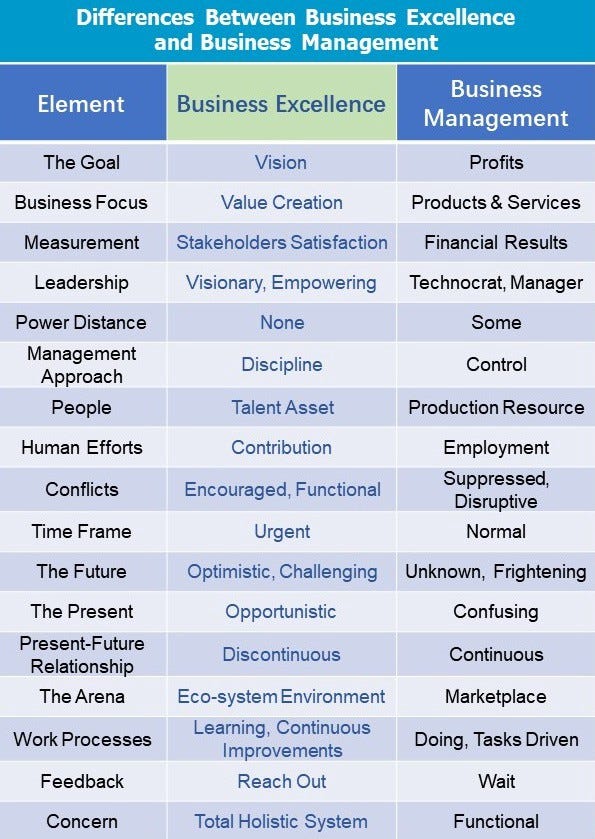
The key business excellence elements in the BizX Culture is compared and contrasted with conventional business management is the illustrated below:
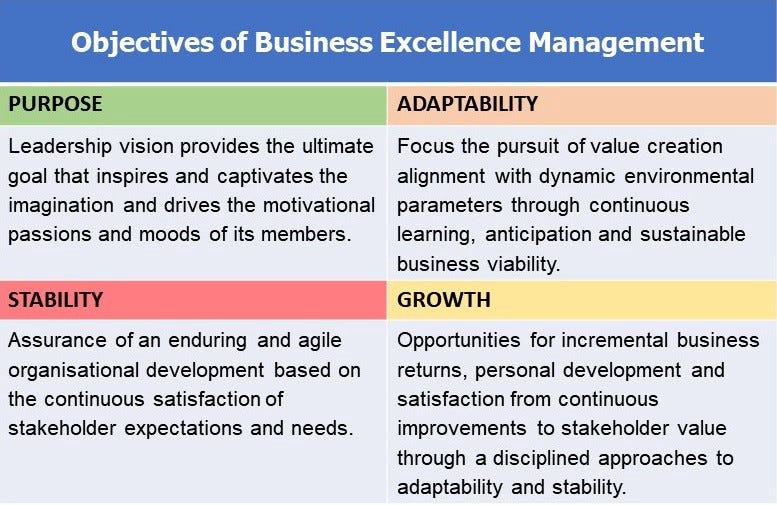
The Culture of business excellence (BizX) addresses four essential concerns (purpose, adaptability, stability, growth) of any organisation seeking an enduring, sustainable process for their management of business excellence. They are illustrated and described as follows:
A Business Excellence Organisation (BizXO) uses its Business Excellence (BizX) philosophy to create a corporate culture that defines the nature of its leadership, provides legitimacy to the pursuit of its purpose, a foundation for a critique of current management, and prescribe the methods, tools, and processes for its day-to-day endeavour. As the cultural foundation for 21st Century management paradigms, the BizX Culture is broad enough to allow for wide variations and forms of practices, and its unflinching focus on the stakeholders enables comparisons and benchmarking with other similar organisations for continuous learning and improvements.
How Your Company Can Benefit from Business Excellence
What business excellence culture are you creating or contributing to in your organization? Are you open and transparent in your communication? Are you celebrating success as well as looking at opportunities for improvement? Are you encouraging leadership by all members of your team? Are you approaching the future strategically? Are you creating an environment of trust? Are you on the road to performance excellence? These questions guide how you are leading your organization.
Please enjoy my recent Articles.
You can also subscribe to my stories and social media posts via your email.
Enjoy more interesting Articles by signing up to Medium here: https://thefuturistoracle.medium.com/membership