
The Culmination of White Rage
Why the Greenwood massacre never made it to grade school history books
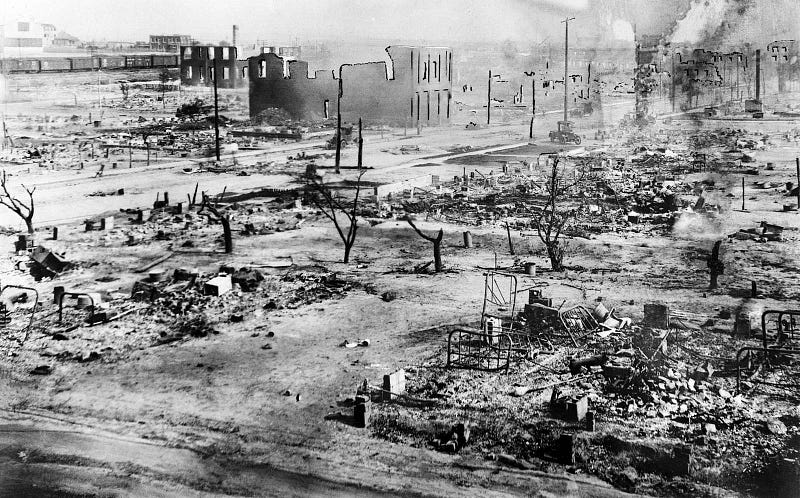
I first learned of the devastatingly destructive Greenwood massacre in college. My father had given me a brief history as a child, but it wasn’t until I took an African-American studies class as an adult that I learned the true horror that took place in Tulsa, Oklahoma between May 31, 1921, and June 1, 1921.
There was no mention of the Greenwood community in any history class I’d ever taken or in any school textbook I had ever read. It was as if the most horrific tragedy of its time had been completely erased from America’s memory. Instead, my classmates and I were indoctrinated to believe that Black American history only equated to enslavement. Had the true story of Greenwood been taught in schools across this country, little Black boys and girls would have had the opportunity to grow up feeling a sense of pride and accomplishment in our history as opposed to being reduced to little more than savages.
The Building of Black Wallstreet
The affluent community of Greenwood in Tulsa, Oklahoma was founded in 1906 and developed on what was then called Indian territory after their tribes were forced to leave their land. Formerly enslaved Black people, who had accompanied members of the Cherokee Nation on the Trail of Tears in the late 1820s and early 1830s, became a part of tribal communities once freed and gained ownership of the land through the Dawes Act. The law was created to break up tribal communities and afford the land to individual owners. It was the only way the U.S. government would allow Native Americans to obtain U.S. citizenship and subsequently became a pathway to authentic independence and financial freedom for Black people.
From 1890 to 1907, the Black population in Native American territory increased from 19,000 to 80,000, creating a community that would later flourish into the most wealthy and prosperous Black district in the U.S.
In 1905, Ottowa W. (aka O.W.) Gurley, who was a landowner, educator, and entrepreneur, bought 40 acres of land in North Tulsa to build a boarding house for formerly enslaved Black people and those fleeing lynchings to come and start their new lives. The house opened in 1906 and is documented to be the first official business in the Greenwood community.
Gurley eventually formed a partnership with fellow entrepreneur and lawyer John the Baptist Stradford (aka J.B.) and the two began the process of creating zoning for residential and retail streets which were sold exclusively to Black people. As more businesses were built, Greenwood began to flourish, prompting renowned educator, author, and orator, Booker T. Washington to refer to the community as Black Wall Street. This endearing moniker has remained the preferred reference to the Greenwood district through present day.
At its height before the massacre in 1921, Greenwood’s all-Black community boasted of 600 businesses, including sole proprietors and unlisted firms. Those businesses included grocery stores, a bank, restaurants, hotels, dry cleaners, beauty parlors, shoemakers, insurance companies, garment factories, movie theaters, barbershops, tailors, cigar shops, real estate, photographers, and many more. To maintain public health, there was a hospital, fire station, dentists, chiropractors, and private practice physicians along with a school system, 6 privately owned airplanes, and thriving residential neighborhoods
The Massacre
On May 31, 1921, the Tulsa Tribune erroneously reported that a 19-year old Black man named Dick Rowland who worked as a shoe shiner had attacked a 17-year-old White woman named Sarah Page who was an elevator operator. Rowland reportedly only bumped into her by accident while in the elevator, but she screamed and told a bystander she had been attacked. After reading the article in the Tribune, the KKK and other white supremacists who had long despised and envied the wealthy, all-Black community, threatened to lynch Rowland and banded together to start a race riot in Greenwood.
During the late hours of May 31 through the morning of June 1, the beautiful, affluent district built, funded, and ran solely by Black people was completely burned to the ground, destroying all the business and personal belongings of its residents. Thirty-five city blocks and approximately 1400 homes were destroyed with damages that were estimated at one million dollars which would be the equivalent of twenty million dollars today.
300 people were killed and over 800 people were injured by fires and bombs that were dropped over Greenwood. History books in American schools teach about the bombing of Pearl Harbor, but Tulsa was the first city in America to be bombed in air warfare. In the aftermath, police officers deputized and armed white lynch mob members making it impossible for the survivors to safely salvage what they could from the rubble. Insurance companies conveniently labeled the massacre as a “riot” to prevent approval of the insurance claims filed by business owners and homeowners. Fifty-six Black men who were victims of the devastation were falsely accused of inciting the riots, unlawful use of firearms, theft, and the death of Walter Daggs, a White man, who was reportedly the first to die before the massacre began.
The great fortunes amassed by the residents of Greenwood that would have served to create generational wealth and financial stability for their descendants were completely destroyed and today, this unthinkable miscarriage of justice has yet to be rectified. Recently, the three oldest survivors of the Tulsa massacre, 107-year-old Viola Fletcher, her brother, 100-year-old Hughes Van Ellis, and 106-year-old Lessie Benningfield Randle, testified before Congress seeking restitution for what was lost 100 years ago. These three survivors and the descendants of those who were lost or have since died after the massacre have yet to receive any compensation or restorative justice for the deliberate destruction of their community caused exclusively by hateful, racist white terrorists.
Greenwood was left out of history — until now
Understanding the history of America helps to paint a clearer picture of why the Greenwood massacre was purposefully left out of primary education lesson plans. How could America teach its children of this brutally racist attack incited and carried out by White men for the sole reason that jealousy of what Black people had acquired independently had become too much to stomach?
This country that frequently revels in vanity and self-appreciation for its ability to prosper couldn’t possibly admit to its never-ending fear of the Black community rising and achieving more than the dominant population and rising to power and prominence. The sheer cowardice, insecurity, hatred, and insidious envy of White men was responsible for destroying the lives of every Black person in Greenwood and robbing their future generations of their rightful inheritances.
It’s not hard to see why American schools, which are dominated by history classes that only serve to uplift and elevate the White population, would try to keep this despicable history in the shadows. In addition to their attempt to protect their “good names,” they also stole the knowledge from young Black children that there were successful Black people in the early 1900s who were self-sufficient home and business owners. Slavery is just a mere part of our history, but it is the main focus of the Black experience taught in schools to keep our youth subservient.
But the tides are turning.
This year marks 100 years since the Tulsa massacre and information about this violent event in American history has been widespread over the past few decades. Recently, new generations have begun to learn of Greenwood and the extraordinary Black people who built this prominent and triumphant community from the ground up that was 100% financed by Black dollars.
The indoctrination of falsehoods perpetuated by white supremacists is no longer the powerful weapon it once was. As more truth is exposed about the true history of this country that was founded on violence, theft, and genocide, more BIPOC are rising up and discarding the lies that have been told.
Greenwood will forever remain in the hearts and minds of not just the descendants of this prosperous district, but in Black people all over the country who have seen what was done by those who began with so much less than we have right now. Though this massacre was the most horrific and violent of its time, looking to the years before the devastation serves as an eternal blueprint for what is possible through widespread unity and partnerships.
“It is a call for Black people in this country to unite, to recognize their heritage, to build a sense of community. It is a call for Black people to define their own goals, to lead their own organizations.” — Stokely Carmichael


