
The Cryptocurrency Conundrum: Jamie Dimon’s Call for a Ban Sparks Speculation on BlackRock’s Role

In a recent Senate Banking Committee hearing, JPMorgan Chase CEO Jamie Dimon reignited his disdain for cryptocurrencies, particularly bitcoin, suggesting that they should be banned due to their alleged association with criminal activities like money laundering and tax avoidance. While Dimon's criticism is not new, the intensity of his remarks has fueled speculation about the involvement of financial giants like BlackRock in a potential collaboration with the U.S. government to curb the influence of cryptocurrencies.
Dimon's strong stance against crypto is noteworthy, given that JPMorgan Chase is deeply immersed in blockchain technology, the very backbone of the rapidly growing $1.6 trillion cryptocurrency industry. Despite the contradiction, Dimon's skepticism aligns with a sentiment shared by other banking leaders brought before the committee, including a surprising unity with Senator Elizabeth Warren, who has traditionally been a vocal critic of the financial industry.
What adds intrigue to this narrative is the growing interest of BlackRock, the world’s largest asset manager, in the cryptocurrency space. Recent signals indicate that BlackRock might be working closely with the U.S. government to explore avenues for restricting or even shutting down cryptocurrencies, especially bitcoin. The confluence of BlackRock’s emerging involvement and the White House’s advocacy for a Central Bank Digital Currency (CBDC) raises questions about a coordinated effort to curtail the influence of decentralized digital currencies.
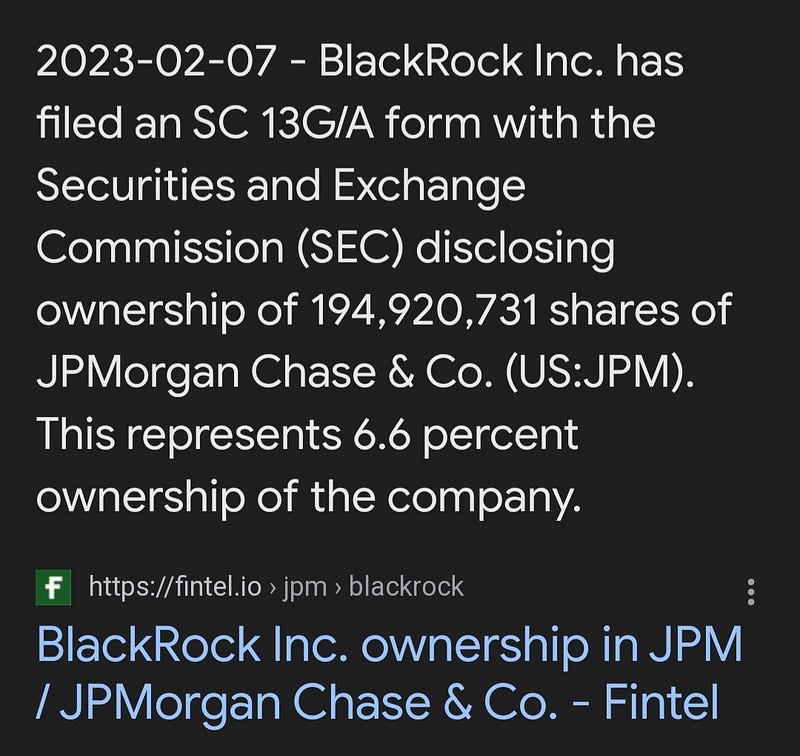
The revelation of BlackRock Inc.’s substantial ownership of 194,920,731 shares of JPMorgan Chase & Co. (JPM) raises eyebrows and intensifies concerns about the potential collaboration between major financial institutions and government entities to influence or regulate the cryptocurrency market. As BlackRock, a global investment giant, wields significant influence in traditional finance, its stake in JPMorgan Chase & Co. further intertwines institutional power dynamics with the fate of emerging technologies like cryptocurrency. This development, coupled with the broader landscape of regulatory scrutiny and the White House’s interest in central bank digital currencies (CBDCs), adds another layer to the intricate puzzle of the evolving relationship between traditional finance, government bodies, and the future of decentralized currencies.
The prospect of collaboration between BlackRock and the U.S. government to regulate or eliminate cryptocurrencies gains credence when considering the regulatory standpoint shared by Dimon and other CEOs. During the hearing, when pressed by Senator Warren, Dimon, along with several other banking leaders, supported the idea that crypto companies should face the same anti-money-laundering regulations as major financial institutions. This alignment of views suggests a common ground among influential financial figures on the need for stringent regulations in the cryptocurrency space.
BlackRock's potential involvement in such initiatives is not without precedent. The company's interest in blockchain and digital assets has been growing, with reports indicating that BlackRock has been exploring opportunities in the crypto space. The convergence of regulatory discussions, strong statements against cryptocurrencies by industry leaders, and the increased attention from institutional players like BlackRock paints a picture of a coordinated effort to shape the future of digital finance.
Moreover, the White House's openness to the concept of a CBDC, a government-backed digital currency, introduces an additional layer to this unfolding story. As governments worldwide explore the idea of CBDCs, the potential collaboration between financial behemoths like BlackRock and the U.S. government gains significance. A CBDC could offer a controlled alternative to decentralized cryptocurrencies, aligning with the government's desire for increased oversight and regulatory control.
Finalky, Gary Gensler, the chair of the U.S. Securities and Exchange Commission (SEC), has added another layer of complexity to the cryptocurrency landscape with his cautious approach to approving a spot Bitcoin (BTC) or Ethereum (ETH) exchange-traded fund (ETF). Gensler’s hesitation and the absence of a clear regulatory framework for cryptocurrency ETFs contribute to the perceived invisible wall hindering the crypto market’s full integration into traditional financial systems. While Gensler has expressed a desire for increased investor protection and market integrity, critics argue that the prolonged indecision on crypto ETFs may inadvertently stifle innovation and hinder broader market participation. The interplay between regulatory caution, industry dynamics, and institutional interests creates a challenging environment that further contributes to the intricate web of uncertainties surrounding the future of cryptocurrencies.
In conclusion, Jamie Dimon's call for a cryptocurrency ban, coupled with the growing interest of BlackRock in the digital asset space and the White House's exploration of a CBDC, hints at a broader strategy to shape the future of digital finance. While the fate of cryptocurrencies remains uncertain, the concerted efforts of influential players underscore the need for continued vigilance and scrutiny in the evolving landscape of decentralized finance.