
The Crisis Report — 18
I am predicting that the next few years are going to be disastrously HOT. That doesn’t make me a “Doomer”.
It makes me realistic about what’s happening with the Climate System.
So,
Last year I wrote a “Climate Assessment Report” in January/February. The report is in four parts with two addendums’.
If we are going to have meaningful votes on Climate Change policy, people need to understand it. Right now, that’s not easy.
How much has the Earth warmed up since the “preindustrial” period? Surprisingly it’s hard to get a straightforward answer to that question.
Global Warming accelerated between 2010 and 2020. It’s catastrophically bad news. Do you know the current “rate of warming” for Global Warming? You should, that number is the NUMBER that controls what the rest of your life is going to be like.
Consider the Earth’s Oceans, that’s where all the heat goes. Global Warming is Actually “Ocean Warming”.
Heat doesn’t “just happen”. Where it’s coming from, and why that matters to all of us.
I’m actually being “conservative” when I tell you that things are bad. Additional notes on Albedo Diminishment.
I wrote this assessment from the perspective of an intelligence analyst doing an independent evaluation of the publicly available datasets. In the run up to COP21 there was a bunch of new papers that greatly refined and expanded our understanding of the Earth’s Climate System.
I wanted to create a briefing paper that answered three critical questions:
- How much has the Earth warmed up since 1850?
- What is the current “RATE” of warming?
- How much warming will occur by 2100?
A paper that didn’t just restate the “official” numbers but looked at where those numbers came from and assessed their reliability. As well as incorporating the latest scientific findings and looking at how these findings supported or weakened the prevailing “Climate Science Paradigm”.
My conclusion was that something “CATASTROPHICALLY BAD” was happening to the Climate System. Here’s what I think is going on.
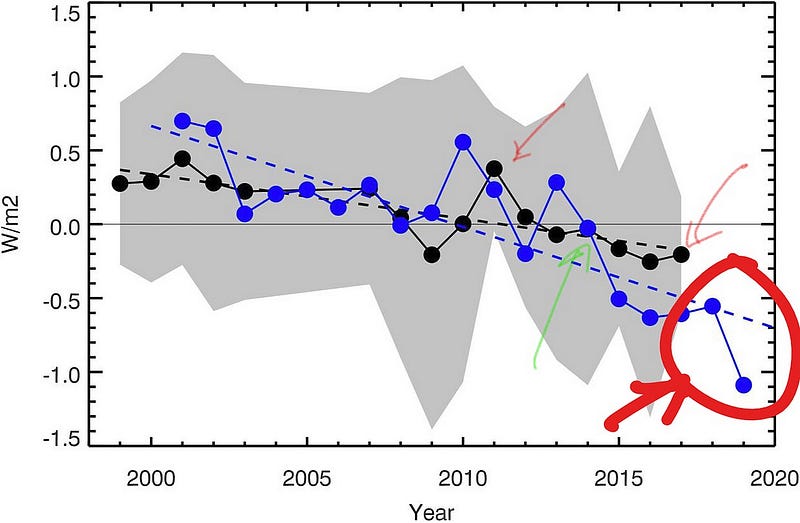
If you don’t know what this graph is, then you don’t know what’s happening with the climate system right now.
This is one of the most important graphs in the history of climate science. It’s right up there with the “hockey stick” graphic.
Learn what this graph means: it’s important.
Here’s the paper it’s from.
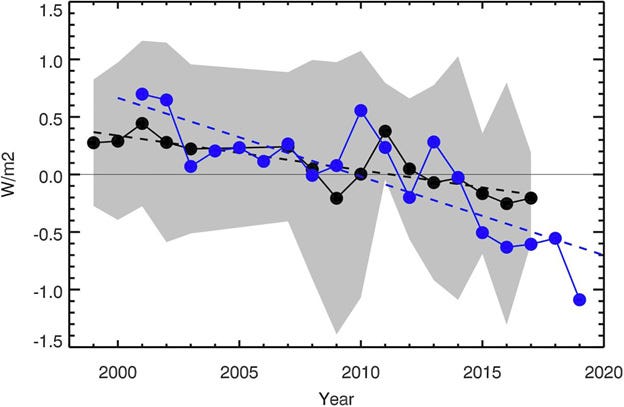
Earth’s Albedo 1998–2017 as Measured From Earthshine pub. Aug 2021
Here are some important things you should notice about this graph.
When Goode says that the Earth’s albedo has declined about 0.6W/m2 since 1999, he’s not referring to where the blue dotted line ends up in “2020”. He’s talking about the black-dotted-line between 1999 and 2017. The one that starts at +0.4W/m2 and ends at -0.2W/m2.
That’s the 0.6W/m2 of additional “climate forcing” due to albedo diminishment that Goode is talking about.
When Goode talks about the unexpected decline in the Earth’s albedo since 2010 he’s discussing the the part of the graph between the two red arrows.
This part of the graph shows the albedo declining from 2010 to 2014, when Goode thought it would then go up again. Goode has stated. “I would have bet my house that those last three years were going to look just like the previous 17. Now we have this really cool mystery.”
What Goode is talking about is what happened in 2014 (the green arrow). They expected that the Earth’s albedo would start climbing again, like it did in 2009. Instead it went down, for the next three years.
Goode’s study stops in 2017 because his 20 year project ran out of funding.
The NASA CERES project did not. In this graph, their data goes out to 2019. They show a decline of 1.8W/m2 in the planetary albedo level from 2000 to 2019 (red circle).
The NASA CERES data indicates the problem is three times worse than Goode is reporting in his conclusions.
“We have reported a two-decade long data set of the Earth’s nearly globally averaged albedo as derived from earthshine observations. …Remarkably, the inter-annual earthshine anomalies agree well with those from CERES satellite observations, despite their differences in global coverage, underlying assumptions to derive the albedo, and the very different sensitivities to retroflected and wider-angle reflected light.”
The two-decade decrease in earthshine-derived albedo corresponds to an increase in radiative forcing of about 0.5 W/m2, which is climatologically significant (Miller et al., 2014). For comparison, total anthropogenic forcing increased by about 0.6 W/m2 over the same period.
The CERES data show an even stronger trend of decreasing global albedo over the most recent years, which has been associated to changes in the PDO, SSTs and low cloud formation changes.
Using Goode’s number for the diminishment of the Earth’s albedo is being “conservative”. The CERES data indicates that reality is probably worse.
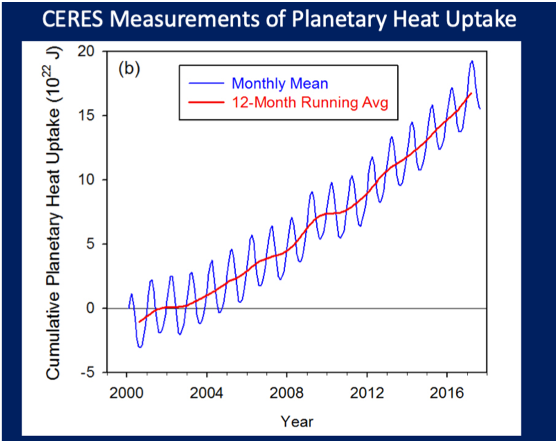
From NASA’s site
That was my conclusion in February 2022. Then Russia invaded Ukraine.
The Ukraine War
In Ukraine, we may be seeing the first war of the “Climate Crisis”.
March 1st, 2022
Here’s what I said was happening.
We are having a 1914 Sarajevo moment.
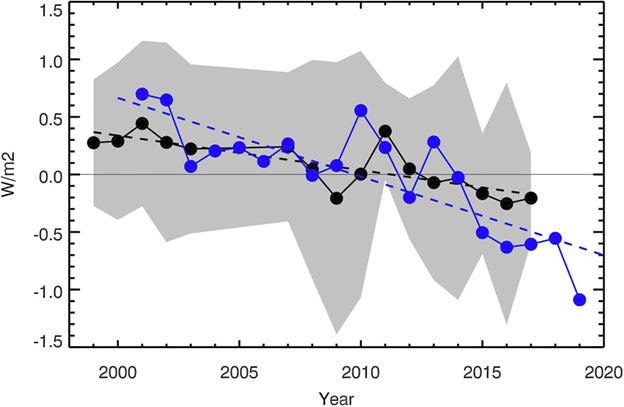
See the graph above, that’s what a “Climate Crisis” looks like.
That graph records the Earth’s albedo declining over the last 20 years. Not a lot, just about 0.6W/m2 (Watts per square meter). That’s the equivalent of a panel with 200 light bulbs on it, having one go out and one get dimmer. It doesn’t sound like much.
Except that the sum effect of all of our GHG forcings during that period was about 0.6W/m2.
Since 2010 the rate of global warming has doubled. If you look at the temperature record you can see this happening.
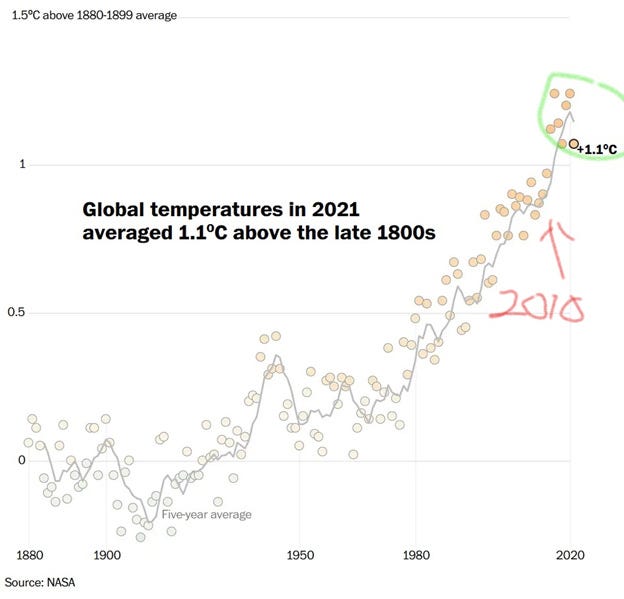
The last seven years have all been above 1.0℃, it will never be below 1.0℃ again in your lifetime
This is the coldest it will probably be for the rest of century. And we are about to have a massive heat spike. Because the La Nina is almost over.
We are in a “La Nina” climate cycle right now. If you are unfamiliar with the term, it means that the Pacific Ocean is literally eating heat right now. Pulling it out of the climate system and dumping it into the waters of the western Pacific. This cools the planet down.
What that means, is that this is as cold as it will get for the rest of your life.
Our starting temperature for this decade is an “observed” 1.1℃ warmer than it was in 1980. The heat surge we are about to get is going to be massive.
Next year, the “La Nina” cooling pattern we are in will peter out. The “El Nino” warming pattern that follows it will make 2016 look mild. As Dr. James Hansen puts it, “the ocean is a huge heat reservoir and can burp up heat”. Right now its absorbing heat at record levels.
Ocean warmth sets record high in 2021 as a result of greenhouse gas emissions
Another Record: Ocean Warming Continues through 2021 despite La Niña Conditions
Heat in World’s Oceans More Than Ever Recorded
Hottest ocean temperatures in history recorded last year
However, that won’t last. The Pacific will inevitably start “burping” up heat. 2023, 2024, 2025, and 2026 are going to be extremely hot. Like “Dust Bowl” hot. Like 1880 hot.
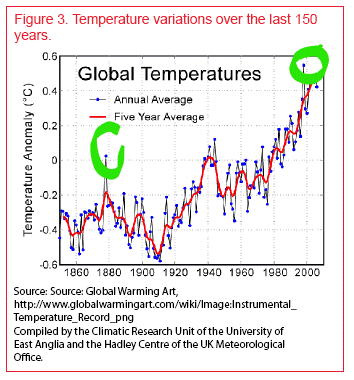
1880 and 1997–98 were super El Nino events and the hottest years of their centuries
As the Climate Warms, Could the US face another Dust Bowl?
A devastating Dust Bowl heat wave is now more than twice as likely, study says
Dust Bowl 2.0? Rising Great Plains dust levels stir concerns
Freakish windstorm brings ‘dust bowl’ conditions to tornado-devastated US states
Weatherwatch: conditions ripe in US for more dust bowl years
This El Nino is going to be turbocharged by a massive decrease in S0x (Sulfur Dioxide) levels in the atmosphere. They are about to start falling rapidly.
Because, in 2020 there was a change in the diesel fuels used by the shipping industry. This was not a trivial change.
The shipping industry is among the world’s largest emitters of sulfur behind the energy industry, with the sulfur dioxide (SOx) content in heavy fuel oil up to 3,500 times higher than the latest European diesel standards for vehicles.
“One large vessel in one day can emit more sulfur dioxide than all the new cars that come onto the world’s roads in a year.”
Cleaner Air in 2020: 0.5% sulfur cap for ships enters into force worldwide
From January 2020, the maximum sulphur content of marine fuels is reduced to 0.5% (down from 3.5%) globally — reducing air pollution and protecting health and the environment.
Here’s the problem, those pollutants were cooling our planet. A lot.
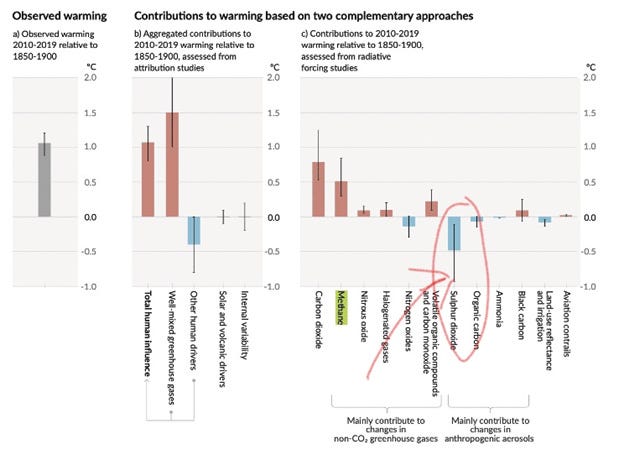
Unlike CO2, which will stay in the atmosphere for thousands of years, S0x washes out in 3–4 years. As we move into 2023 the next El Nino is going to be turbo charged when this “masked” warming begins to be felt. We are going to get all this warming over the next 4–5 years.
It’s not just going to be hot; it’s going to be insanely hot for the next 4–5 years, starting in 2023.
That’s going to have consequences.
Dr. James Hansen wrote in August 2021 that.
We should expect the global warming rate for the quarter of a century 2015–2040 to be about double the 0.18°C/decade rate during 1970–2015.
Think about how much hotter it seemed between 2010–2020. Think about the heatwaves, the wildfires, the hurricanes, the deluge storms, the flooding, the ocean heatwaves, the wild swings in temperature, and the droughts. The rest of this decade is going to be at least twice as bad.
This is our first “Climate Crisis” and it’s very possible 800 million people could die before it’s over. This is going to shake our world to its foundations. Because in the end, it’s always about food. And there is about to be a shortage.
The IPCC is forecasting is that “bad years” are going to start happening a lot more often, in every part of the world, in the decades ahead. They project that between now and 2050 global crop yields will decline by 20%.
Without a major restructuring of global food production, the forecast is that cereal crop production could decline as much as 50% by 2100.
The implications of this are obvious.
The world is going to become hungrier and hungrier in the decades to come, and some places are going to get much hungrier than others. Most counties in the world do not produce enough food to feed their current population without importing food. Currently there are eight “breadbasket” regions of the world which grow and export the food that feeds the rest of the world.
- A “bad year” happens when one of these breadbasket regions, like the US Midwest in 2019, has a production decline. That can cause higher food prices globally, food riots, and even civil unrest in poor countries.
- A disastrous year would occur if one of these regions suffered from total production failure, like the Great Plains during the Dust Bowl years of the 30’s. Millions of people around the world would be unable to afford food and would start starving.
By 2040, projections are that at least one of the breadbasket regions in the world will start failing every year. Even worse, the forecasts indicate that there will be a significant risk of “multi-focal production failure” every year.
This means that about one out of every four or five years the crops in multiple breadbasket regions will likely fail.
Imagine if the monsoon failed in India, drought gripped central China, the Nile failed to rise and the crop failed in Egypt, drought hit Brazil and Argentina, and floods hit the American Midwest all in the same year. Something like this happened in the late 19th century and the consequences are described in the book, “Late Victorian Holocausts: El Niño Famines and the Making of the Third World”.
Between 1876 and 1902, 60–80 million people died from starvation globally, or about 6–8% of the world’s population. There were provinces in China where over 90% of the population died because people collapsed of hunger and thirst before they could walk out of the affected area.
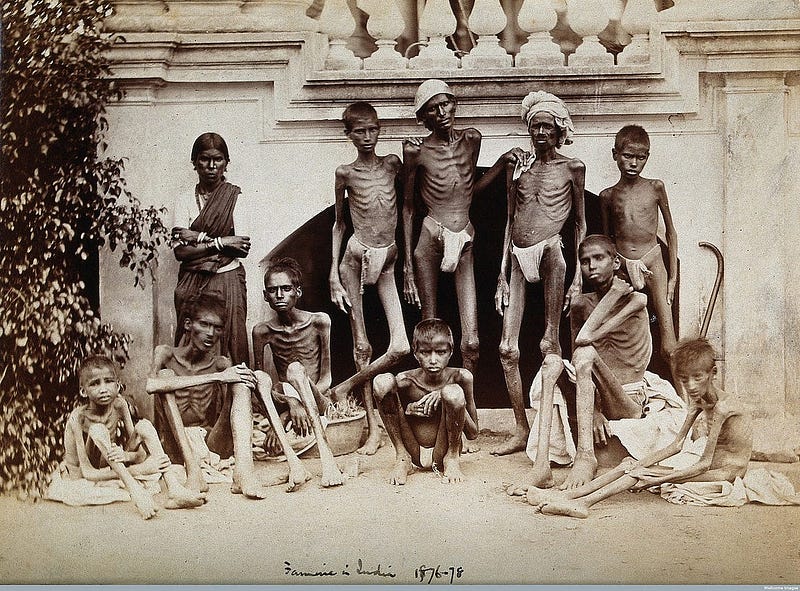
Now imagine it happening in 2048, but instead of affecting 60 million people it affects 400 million (more than the current population of the US). Instead of these people dying “in place” because they have no mode of transport other than their feet. They have access to cars, trucks, trains, planes, and boats.
The scale of the coming disruption is beyond real understanding. Nothing like it has ever happened before and no one knows how it’s going to play out. There simply is no way of knowing how the world is going to handle this crisis until it happens.
Now imagine it happening in 2025.
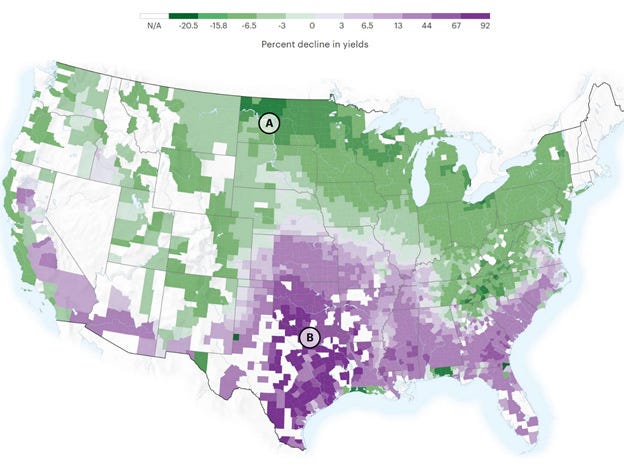
The odds of massive crop failures in the US in the next four years are probably as high as 65% at this point. About 50% of the US agricultural area is already in drought conditions. The soils are dry, and the water table levels have been dropping for decades.
The Western Drought Is Bad. Here’s What You Should Know About It.
Drought, ‘Climate Whiplash’ Leave Farmers Without Water in California’s Central Valley
Citing drought, US won’t give water to California farmers
California’s drought endures: Feds’ Central Valley Project announces 0% water for farmers
As I noted in “Living in Bomb Time — 09”:
“California alone grows 19% of the total food in the US and is the only large-scale producer of many fruits and nuts globally. It produces almost all of the country’s almonds, apricots, dates, figs, kiwi fruit, nectarines, olives, pistachios, prunes, and walnuts. It leads in the production of avocados, grapes, lemons, melons, peaches, plums, and strawberries.
The next time you go to the grocery store walk through the produce section with that list of things that mostly come from California and subtract them from the selection. See how few things are left. Losing the Central Valley growing zone of California is going to be devastating”
I think we are about to have a string of “multi-focal production failure” years. I believe Putin and Xi think so as well. They are acting as if they do.
Before Ukraine Invasion, Russia and China Cemented Economic Ties
Six days before the military campaign began, Russia announced a years long deal to sell 100 million tons of coal to China, a contract worth more than $20 billion. Just hours before Russia began bombing Ukraine, China agreed to buy Russian wheat despite concerns about plant diseases.
China is again drawing close to Russia. This time as the dominant power in the relationship.
As the United States and the European Union have become wary of China, Beijing’s leaders have decided that their best geopolitical prospects lie in marrying their vast industrial might with Russia’s formidable natural resources.
Including wheat from the fields of Ukraine.
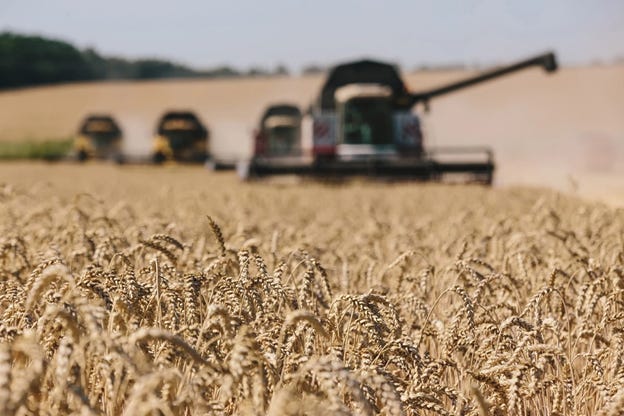
When I said that we are having a “Sarajevo Moment” I didn’t mean in the 1990’s “Siege of Sarajevo” sense. I meant the 1914 assassination of Archduke Franz Ferdinand, heir to the Austro-Hungarian throne, during a state visit to Sarajevo on 28 June 1914. It is traditionally regarded as the immediate catalyst for the First World War.
It signals a massive break in the world order that has endured since 1945.
Pundits, who for the most part know shit about what’s happening with the climate system, are baffled by Putin’s actions. No one can understand why he would take such an existential risk for no obvious reason. They point out that the sanctions are going to cause the Russian economy to wither “in the coming years”.
This is absolutely true. Unless there is no “long term”.
Putin isn’t invading Ukraine because he’s crazy. He’s invading because he thinks food is about to get scarce.
He thinks that in three years no one is going to “give a crap” about Ukraine in a world where 100’s of millions are starving and countries are collapsing under the stress. He thinks that the Russian people will call him “a genius” in three years for securing a stable food supply in a world where agricultural production is collapsing and famine is widespread.
Putin might be right. He’s willing to put it all on the line betting that he is. Because that’s what invading Ukraine is for him. He is putting all of his power on the line.
Putin is betting his life on this. That’s how sure he is that things are about to start getting bad.
Ukraine Invasion Threatens Global Wheat Supply
A Russia-Ukraine War Could Ripple Across Africa and Asia
Russia’s invasion of Ukraine will likely ratchet American food prices even higher, experts say
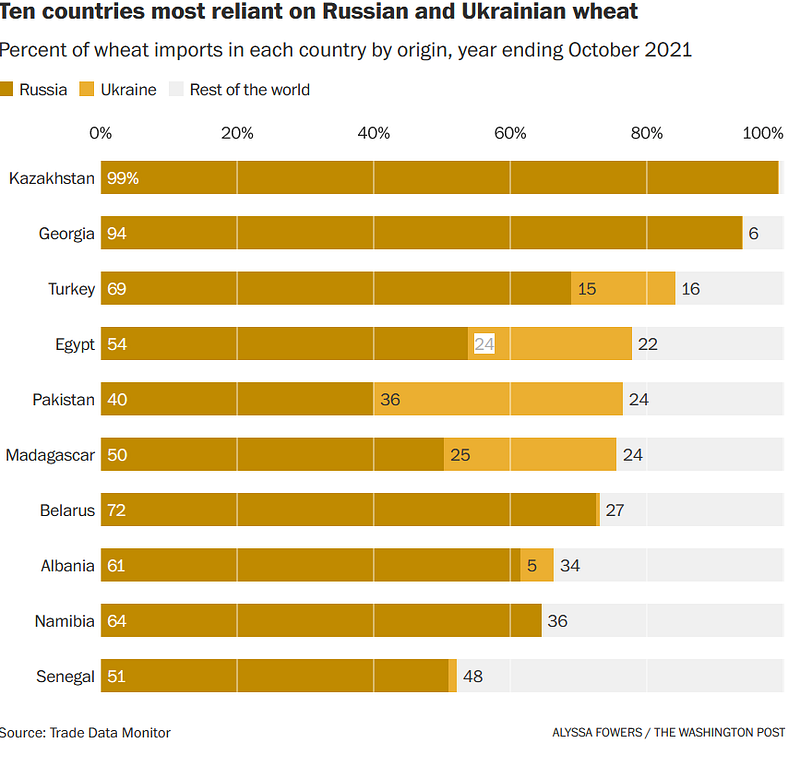
The grain from the Ukraine feeds 100’s of millions in the Middle East and North Africa. If that crop is lost next year, the likelihood of famines killing millions in that region is very high.
This regional shortage might be alleviated by grain supplies from elsewhere. Unless there are global production issues.
Russia is a key global player in natural gas, which is a major input to fertilizer production. Higher gas prices, and supply cuts, will drive fertilizer prices higher.
Russia is also one of the biggest exporters of the three major groups of fertilizers (nitrogen, phosphorus and potassium). Physical supply cuts will further inflate fertilizer prices.
Because of the relationship between energy and agricultural prices, the conflict will impact agriculture and food supplies across the globe and contribute to farmers’ decisions about what, and how much, to grow.
“This is headed for a supply crunch that will be hard to resolve,” said Todd Hultman, lead grain market analyst for agricultural data service DTN.
Corn is an especially fertilizer-intensive crop. Higher fertilizer prices mean that American corn farmers, who largely grow the crop to feed animals, will have a hard time being profitable.
“This year, with new high fertilizer prices, I’m looking at an additional cost of $200 per acre for growing corn,” he said. “In 2021 it was roughly $700 to grow an acre, this year a ballpark is $900 per acre. This will be additional cost for the row crop farmers as well as the ranchers, feed lots and dairy farmers.”
There are going to be global production issues.
Things are about to get bad for hundreds of millions of people. Our global food supply situation was already under pressure.
World food import bill to reach record high in 2021
The situation in the Middle East and North Africa is about to destabilize. Hundreds of millions of people may soon be on the move as they attempt to escape starvation.
The rest of this decade things are going to start falling apart under the stress. Putin is trying to get ahead of that. This is an endgame move.
At great risk for Ukraine and Russia, Putin signals a dark endgame
What if Russia Wins?: A Kremlin-Controlled Ukraine Would Transform Europe
Conclusion
This may be the very last “good” year we are going to get. Starting in about 18–24 months it’s going to be much hotter and droughts are going to start hitting globally. That’s when the shit will really hit the fan.
Now, you might want to write this off as “doomer nonsense”. If you do, I’m not going to be offended. I’m sure that if this was 1913 and I told you that it was the last year of the Belle Époque, that the world order was about to collapse, that two world wars were about to happen, and hundreds of millions were about to die. You would have scoffed.
A year later the world would be at war and millions would be dead. That’s how fast things can change.
I might be wrong. But we are in a very dangerous place right now with the global food supply. Global output peaked in 2013 because of climate change. Our population has been increasing while the gap between what we need and what we can produce has been growing.
Last year a Cornell-led study showed that global farming productivity is 21% lower than it could have been without climate change. This is the equivalent of losing about seven years of farm productivity increases.
The lead author of “Anthropogenic Climate Change Has Slowed Global Agricultural Productivity Growth,” published April 1, 2021 in Nature Climate Change put it this way,
“It is equivalent to pressing the pause button on productivity growth back in 2013 and experiencing no improvements since then. Anthropogenic climate change is already slowing us down.”
We are already redlining the agricultural system and approximately a billion people are still living in a state of food insecurity and borderline starvation. There is no excess capacity, there are no reserves, there is no backup system. We are on the ragged edge and the indications are that there is about to be a massive die back in population.
This is your last warning. “The Long Peace” of the post war world order died last week. The “Climate Crisis” came early and is now upon us. It’s going to be very bad for the rest of our lives.
Alas Babylon.
-rc 03012022
That’s what I wrote in March of 2022.
Today, April 2023
We are about to have an El Nino.
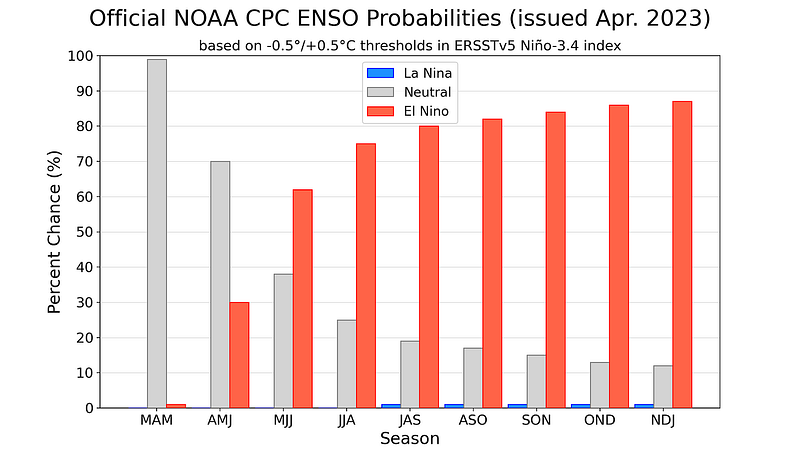
In January their models indicated a 50/50 chance of El Nino this year. Three months later and it’s become a certainty.
Some global climate models are raising the possibility of an extreme, or “super El Nino”, marked by very high temperatures in a central region of the Pacific.
The crucial 1.5C global warming barrier could even be breached in 2023 or 2024
An ‘El Niño Watch’ has been declared — here’s what that could mean for Australia’s weather in 2023
La Niña’s demise was expected as ocean temperatures across the Pacific have been returning to normal for months and was already declared finished last week by the National Oceanic and Atmospheric Administration (NOAA).
However, eastern Pacific temperatures are warming so quickly that, at the current rate, the western part of the ocean will be within El Niño territory within months, prompting the BOM’s quick status shift to “El Niño watch”.
Climate models warn of ‘super El Nino’ later this year April 12, 2023
More catastrophic weather events could be on the horizon with high temperatures forecast later this year.
Australia’s Bureau of Meteorology said in a Tuesday update that all seven models it had surveyed — including those from weather agencies in the UK, Japan and the US — showed sea surface temperatures passing the El Nino threshold by August.
However the BOM stressed that it “does not use the term super El Nino” and “the term has no technical or scientific basis”.
The last extreme El Nino in 2016 helped push global temperatures to the highest on record, sparking floods, droughts and disease outbreaks.
Several of the models suggest temperatures could get this high by October.
Australia faces unprecedented grassfires next summer ‘supercharged’ by global heating
Australia should prepare for grassfires on a scale not experienced before, with new analysis warning spring and summer 2023–24 could see widespread fire risk “supercharged” by the climate crisis. Powder Keg: Australia Primed to Burn
Climate models warn of possible ‘super El Niño’ before end of year April 11, 2023
Climate researchers say magnitude of predicted weather event uncertain but if an extreme El Niño occurs ‘we’ll need to buckle up.
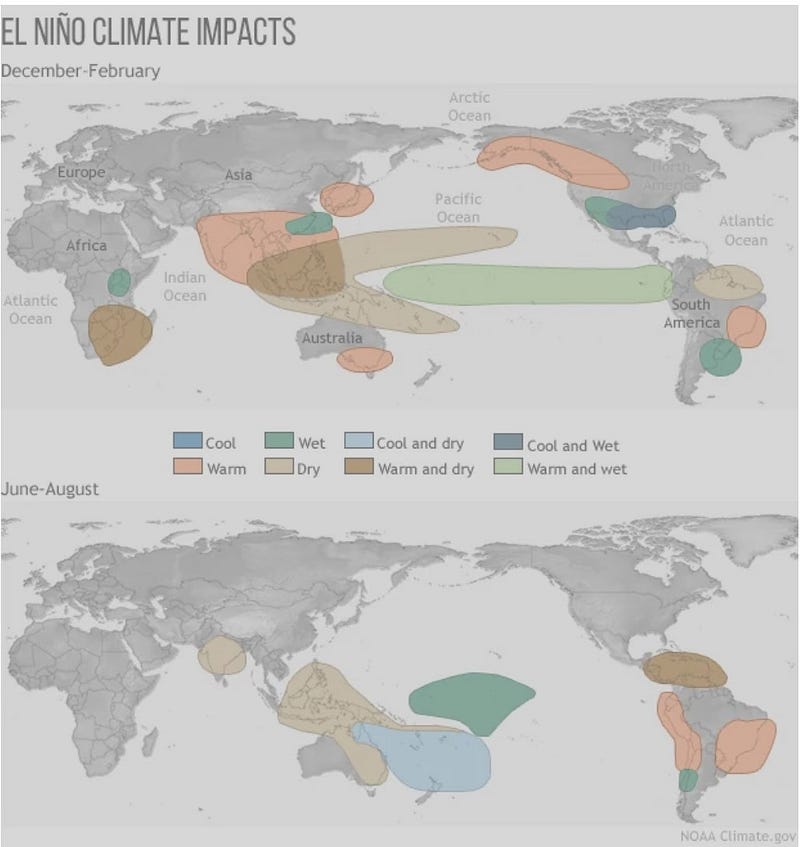
El Nino’s frequently bring droughts to the Southern Hemisphere.
Scientists have watched in astonishment as ocean temperatures have steadily risen over the past several years — even as the cooling La Niña phenomenon had a firm grip on the Pacific. The oceans have been record-warm for the past four years, scientists reported in January. Then in mid-March, climatologists noted that global sea surface temperature climbed to a new high.
A switch to El Niño will almost assuredly bring warmer global temperatures in 23’ and 24’.
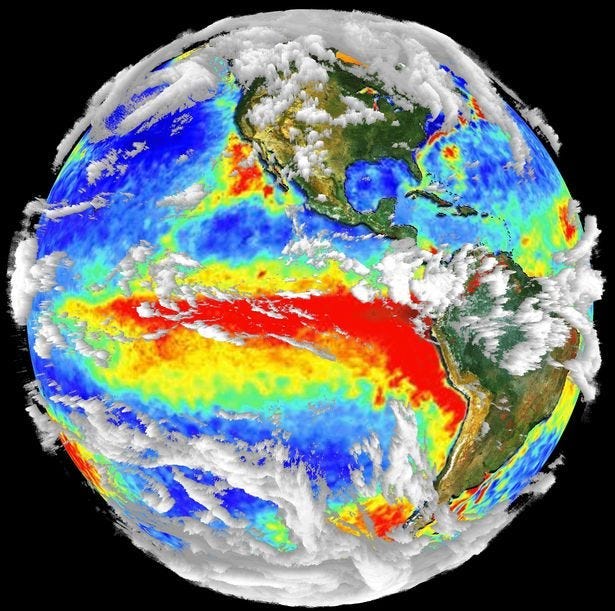
Globally, previous El Niños have:
- Pushed up global average temperatures to record levels.
- Have been linked with floods and landslides in Central America.
- Have caused droughts in South America.
- Have caused failed or delayed monsoons in India.
- The strongest El Niño this century, from 2015 to 2016, was also linked with outbreaks of disease around the globe, including cholera and dengue fever.
2023 has a very good chance of being the hottest year on record.
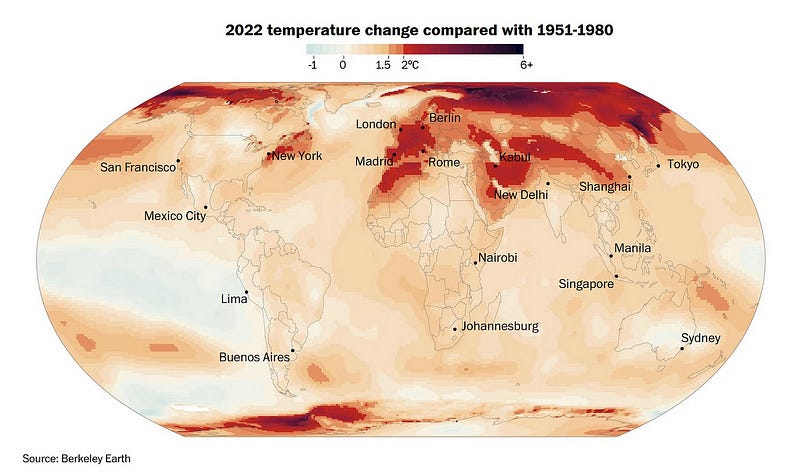
The Global Average Temperature will probably exceed 1.5C for the first time.
A global average temperature rise of 1.5°C is widely regarded as marking a guardrail beyond which climate breakdown becomes dangerous.
In 2021, the “Observable” GMT was 1.2°C above the 1850–1900 average. In 2019, before the development of the latest La Niña, it was a worryingly high 1.36°C.
As the heat builds again in 2023, it is probable that we will touch or even exceed 1.5°C for the first time.
What will this mean?
Record Temperatures Worldwide
The record for the highest recorded temperature, currently 54.4°C (129.9°F) in California’s Death Valley, will almost certainly be shattered.
In the Middle East and South Asia, temperatures could climb above 55°C. The heat could exceed the blistering 40°C mark again in the UK, and for the first time, top 50°C in parts of Europe.
Europe saw its hottest summer in 2022, with temperatures over 40 degrees Celsius (104 Fahrenheit) and Pakistan and India experienced a searing heatwave, where parts of the country reached more than 49 degrees Celsius (120 Fahrenheit).
Ultimately, whether the 1.5-degree threshold is hit or narrowly missed doesn’t really matter. It’s the first time in human history that that value is within reach — and that’s the really significant point.”
Whatever the exact level of heating El Niño brings, some of its impacts — including extreme temperatures — are very likely to be unprecedented, Each time we now get an El Niño, it’s adding on to an ever-larger amount of global warming that we’ve accrued.
-Professor Adam Scaife, head of long-range prediction at the UK Met Office.
There could be drought-busting rain in the American West
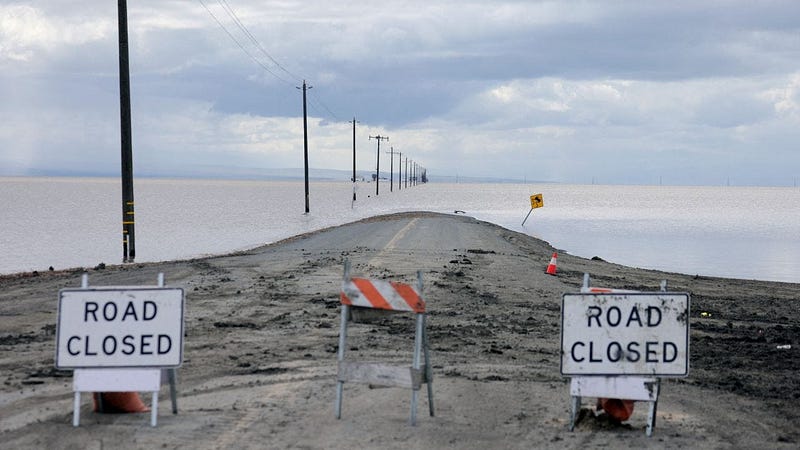
California has seen an onslaught of rain and snow in recent months. That could intensify during El Niño.
Once El Niño kicks in, much of the state will likely see an elevated chance of above-normal rainfall with an increased risk of flooding, landslides and coastal erosion, experts predict.
It could even deliver “meaningful drought relief” to the Colorado River Basin, said Brad Rippey, a meteorologist with the US Department of Agriculture.
“Whereas La Niña is historically a ‘drought maker’ for the continental United States, El Niño is a ‘drought breaker. Although the exact location of drought, or lack thereof, varies considerably from event to event.”
The situation on the Colorado River, which provides water for drinking, irrigation and electricity for roughly 40 million people across the Southwest, has been plagued by overuse and a climate change-fueled drought. The water crisis has become so dire that the federal government announced never-before-seen mandatory water cuts in the last two years.
Drought, heat, and fire elsewhere
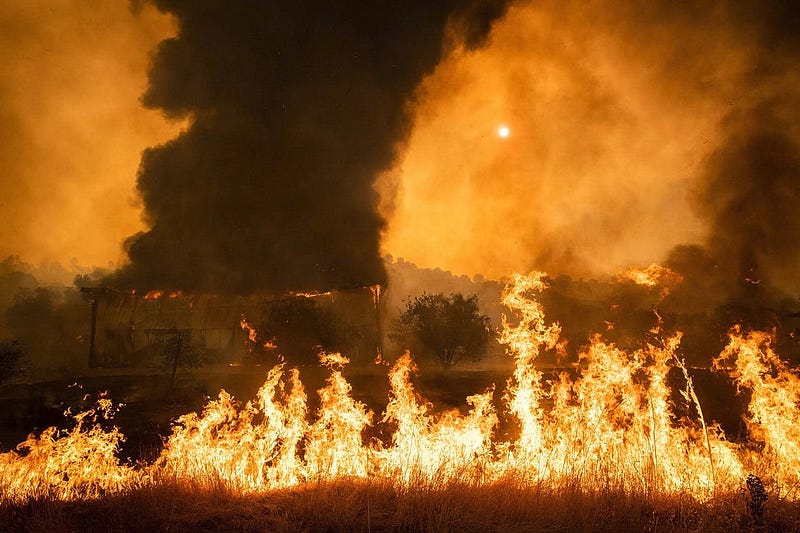
Higher temperatures mean that severe drought will continue, slashing crop yields in many parts of the world. In 2022, extreme weather resulted in reduced harvests in China, India, South America, and Europe, increasing food insecurity globally.
Stocks are lower than normal going into 2023, so another round of poor harvests could be devastating. Resulting food shortages in developing countries could drive civil unrest, while rising prices in developed countries will continue to stoke inflation and the cost-of-living crisis.
South Africa and India are at risk of drought and extreme heat, as are the nations of the Western Pacific including Indonesia, Australia and Pacific island nations such as Vanuatu and Fiji.
For Australia, still reeling from extensive flooding, El Niño is likely to bring much drier, hotter weather, especially in the eastern areas of the country. Since 1900, 18 of the 27 El Niño years have meant widespread winter and spring drought.
India, is bracing for the impacts of the El Niño, which can weaken the monsoon that brings the rainfall it relies on for filling aquifers and growing crops. The monsoon tends to be most affected when there is a flip from a La Niña winter, which we have just seen, to an El Niño summer, which the 2023 summer is likely to be, said Raghu Murtugudde, an Earth systems scientist at the University of Maryland.
“Our models are now indicating the overall [monsoon rainfall] deficit could be as high as 15%”
The El Niño could also push up temperatures in India, which is already experiencing unusually early heatwaves. It’s a “compound hazard because heat waves and El Niño tend to delay the onset of the monsoon,” said Kieren Hunt, a research scientist at the University of Reading in England.
Months of dry spells would “put a tremendous strain on water and food security.”
Hurricanes
La Niña conditions have a tendency to supercharge hurricane development in the Atlantic. So, it was no surprise that the ’22 season saw the formation of three especially destructive storms in the form of Hurricanes Ian, Nicole and Fiona.
As the El Nino builds, Atlantic hurricane activity tends to be damped down. So, inhabitants of cities like Miami and New Orleans might be breathing a sigh of relief. This might be premature.
Destructive Atlantic storms are perfectly possible, even during relatively quiet seasons. Atlantic hurricane activity in 2023 is forecast to be around 15 percent below average, but two or three intense hurricanes are still predicted, any one of which could cause massive damage if it makes landfall in a densely populated area.
Warmer Pacific Ocean fuels stronger cyclones and flooding in Peru
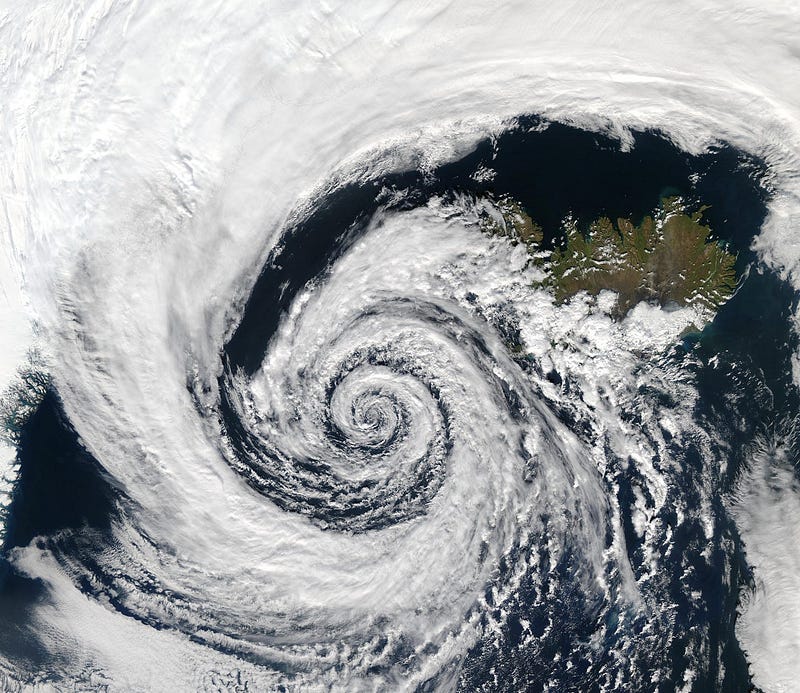
Unlike La Niña, El Niño tends to reduce Atlantic hurricane activity, but creates the opposite effect in the Pacific, where warm waters can fuel more intense typhoons.
Tropical cyclones can form further west in the basin and remain stronger longer, so potential impacts to Hawaii are increased. This means more chances of landfall and remotely driven impacts, such as stronger and longer duration seas, heavy rainfall, and more.
Elsewhere in the Pacific, models show “very warm waters” off the coast of Peru that are already bringing in unusually heavy precipitation and flooding in the deserts. This is a classic precursor to a significant El Niño event.
As the El Niño forms and strengthens later this year, Peru could be at even greater risk of more flooding. The government is already set to invest more than $1 billion on climate and weather measures to prevent the worst consequences.
Coral reefs could see catastrophic bleaching
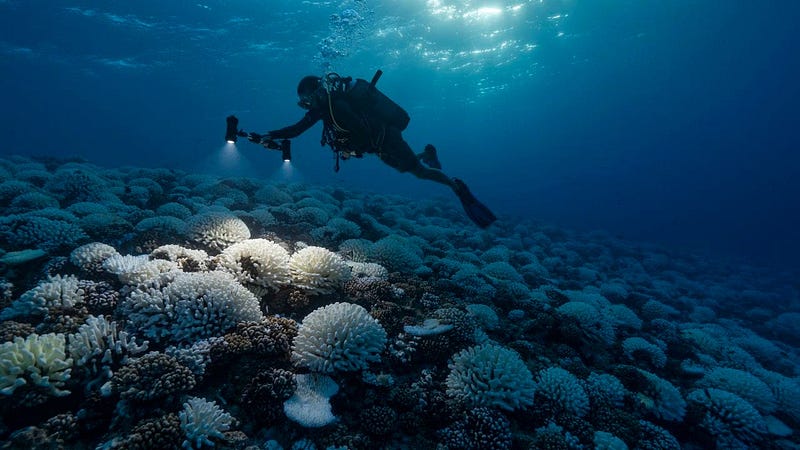
El Niño is an ocean heater, and warmer water is bad news for coral reefs.
When they get too hot, corals will spit out the algae living within their tissue, which provides them with both their color and most of their energy. This causes corals to turn white in a phenomenon called bleaching.
While they can recover if temperatures eventually cool, bleaching puts them at higher risk of starvation and death.
A particularly catastrophic period of coral bleaching happened between 2014 and 2017 — hitting every major reef on earth. Australia’s Great Barrier Reef saw nearly 30% of its corals die in a record-breaking marine heatwave in 2016 — which followed a very strong El Niño that started in 2015.
Unfortunately the world’s oceans are full of heat.
Ocean heat hit another record high in 2022, fueling extreme weather
“What’s being predicted here is very scary,” said Peter Houk, a professor at the University of Guam Marine Laboratory who studies coral in Micronesia. “Every time an El Nino comes, it grows a little bit more in intensity.”
El Niño doesn’t necessarily mean that all coral will be affected, Houk said. Each El Niño is different and there are always other natural climate patterns at play. “But when it does happen, it’s brutal.”
More Antarctic ice melt
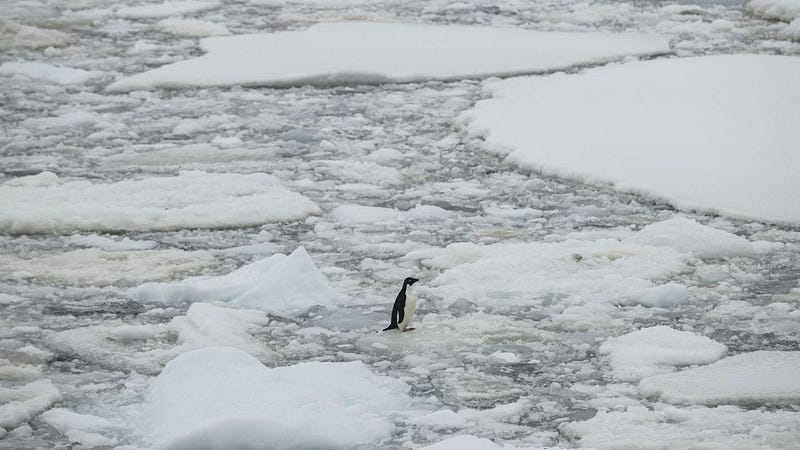
Earlier this year, ice levels on the continent dipped to record-breaking lows for the second time in two years. After years of ups and downs, it now seems to be on a steep downward trend.
The El Niño could help speed up this process, according to recent research, which found a link between the strength and frequency of El Niño events and the speed of Antarctic ice melt.
“Models that project a greater increase in El Niño systematically produce a faster ice sheet melt than models that projected a smaller change in El Niño.”
Wenju Cai, chief research scientist at CSIRO, Australia’s national science agency.
Scientists are watching Antarctica closely because it holds such a catastrophic amount of water in its ice. Though the Antarctic ice sheet is unlikely to melt completely, it has enough water in it to raise global sea level by 230 feet (70 meters).
In the immediate term, El Niño events have divergent impacts across Antarctica, Cai said, with increases and decreases in different areas. But taken together, he said, the trend is clear — “an overall sea ice decrease.”
So, here we are.
Last year I forecast a “super El Nino” and record shattering heat in 23’/24’.
Last year I forecast that Putin would keep the war in Ukraine going because his endgame is the elimination of the Ukrainian people.
Last year I stated that China and Russia were allied and that the invasion of Ukraine is a joint project.
Last year I forecast that “global famines” are coming and hundreds of millions are going to starve in 23’ and 24’.
You might want to start thinking about getting ready.
This is my analysis.
This is what I see.
This is my “Crisis Report”.
— rc 041323


