
The Creepiest Place On Your Next European Travel Itinerary
This Sicilian crypt is eerie, yet reverent
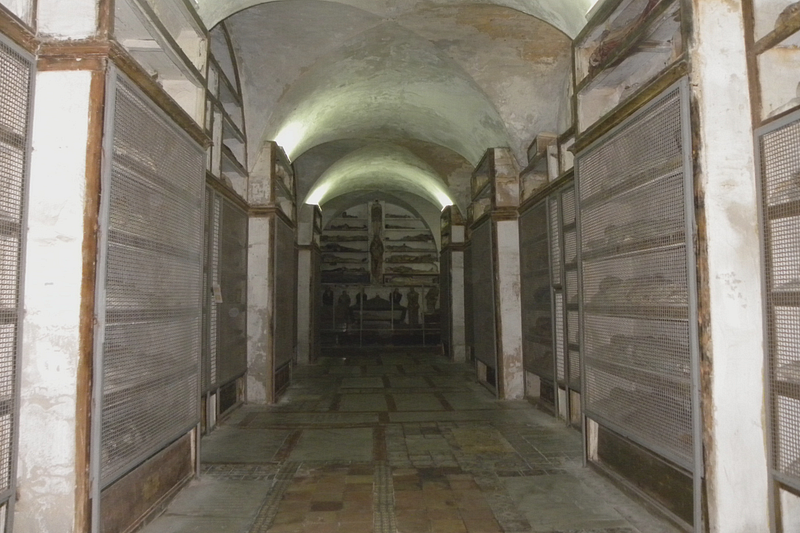
I have a dark little secret. Cemeteries and crypts are some of my favorite places to visit when I travel.
Although some people might find that weird, I’m sure I’m not the only one.
After all, the lines to get into the Paris Catacombs stretch around the block. Tours are given for the fascinating cemeteries in New Orleans and the underground tunnels in Portland. People circle the grave of Evita Perón in the Recoleta Cemetary in Buenos Aires.²
I’ve been to a lot of creepy places. The one that tops my list, though, is the Capuchin Catacombs in Palermo, Sicily.
These catacombs were, by far, different from anything I have ever seen while traveling.
What are they?
The catacombs (Catacombe dei Cappuccini) are located on an unimposing square in Palermo, Italy. There is no huge cathedral or church to mark its location.
The crypt was originally intended only for monks — the first monk was mummified there in 1599. The catacombs were closed in 1880, but some burials continued for a few more decades. During this time frame, approximately 8,000 bodies were put in the catacombs.
The bodies are divided into aisles of men, women, children, priests/monks, and “professionals.” They are literally hung on the walls or laid in cases — with full clothing. Some of the bodies are so well preserved and some are not.
The bodies that were mummified were dehydrated on racks in niches and through the combination of the natural environment and lime, the body was preserved. This was the most common method of mummification. Then, it was washed with vinegar, clothed, and put in its resting place in the catacombs. The resting place was permanent as long as the family could continue to pay.
One of the last people to be put in the catacomb was a two-year-old. If you look past her slightly darkened face, it looks like this sweet little girl is sleeping — she was mummified by a chemical procedure by a doctor who died soon after.
According to the brochure I received in the Catacombs, it said the procedure was lost with his death. However, a Wikipedia search after I visited showed that the process was later rediscovered. According to the entry:
“His process included formalin to kill bacteria, alcohol to dry the body, glycerin to keep it from overdrying, salicylic acid to kill fungi, and the most important ingredients, zinc salts (zinc sulfate and zinc chloride) to give the body rigidity.”
- Wikipedia
Okay, sorry if that was too much detail, but I was fascinated by what I saw.
The location could have been out of a horror movie, but at the same time, there was a reverence that you felt because it was the final resting place for so many people.
It was like a chronology. You could see time pass in their different clothing. You could observe status differences based on where the people were hung and the type of clothes. You could actually see their faces, not just the bones underneath.
You could see that these were once living, breathing people.
You can’t see this site and not say some type of silent prayer or words of respect.
There was an interesting quote in the Wikipedia entry when I looked up more detail about the mummification process:
“Death has always been part of life. And for centuries many Sicilians were using mummification to make sure there was a constant relationship between life and death.”
- Dario Piombino-Mascali, January 2013, Archaeology News Network, Wikipedia
It’s true that relatives would continue to visit their family members here after death. I can’t imagine that. Knowing this fact made the experience that much more impactful.
However, I can imagine that this reverence is lost if you visit during peak tourist season.
When I visited, it was a chilly November day. We were the only tourists there. We had arrived shortly before they closed for the afternoon, as so many things do in Italy. We almost didn’t make it because we had to stop and ask for directions as we tried to weave our way through the city by car.
At one point, I found myself walking alone through the catacombs. The rest of my travel group had gone in different directions, exploring different aisles at their own pace. That may be fine for any other tourist attraction, but in this basement, it was creepy to walk around by myself.
But, at the same time, it also gave me more time to ponder. More time to observe. More time to respect the place I was in.
So a place like this doesn’t have to be macabre. It doesn’t have to be horrifying. You just have to have the space and the stillness to realize that.
¹ Note: I didn’t include any additional photos of the catacombs because photos are prohibited. I snapped the cover photo quickly when entering and then put my camera away. In addition, photos of this crypt could be quite disturbing. If you want to see photos, check out the Wikipedia page that shows some photos of the interior.
² Don’t worry, I gravitate towards non-morbid things too, like local markets, interesting architecture, pedestrian streets, beaches, and underground caves. In case you were worried… 🙂


