
The Cowboy Mystique
Romanticism, culture, and the collective unconscious
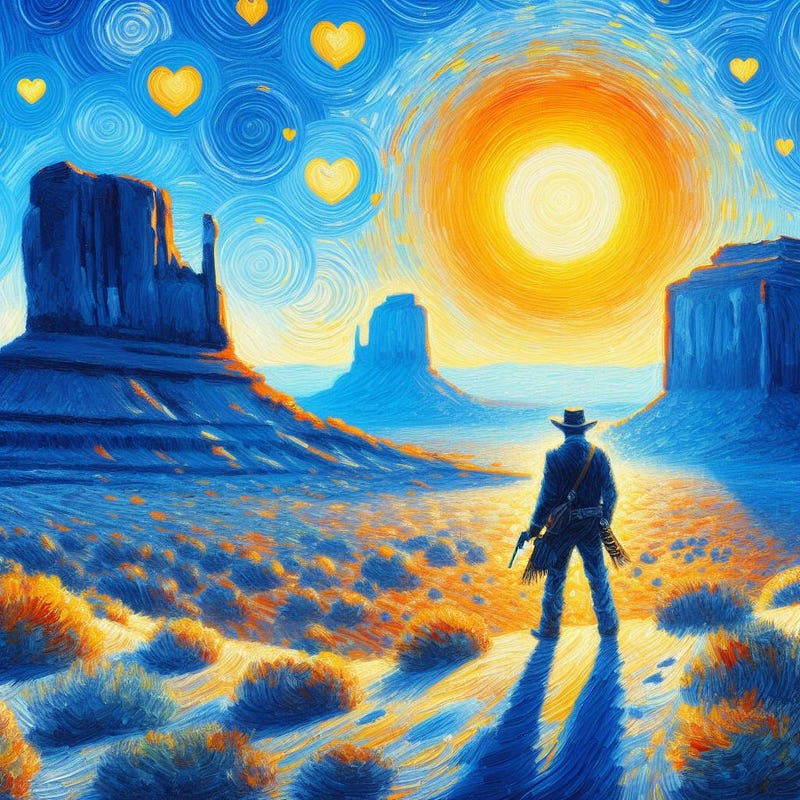
We grew up with cowboys. We knew them, tried to replicate their stories and approach to life, and oftentimes imitated their style of clothing. Cowboys were as close as our television screens, at one time. Actually, my generation may have been the last to claim the Western hero as a close friend, from the earliest days of our lives.
Yet, I cannot even compare my cowboy credentials with my father and the baby boomers. Of course, I am talking about cowboys as we find them immersed in the culture, and I do not mean any real world exploits riding, roping, and shooting (even though my dad could do those things). At one time, westerns were the most popular form of entertainment, by a mile. Television was full of them.
As kids we wanted to be like the men on the small-screen, with cowboy hats, holsters and pistols, boots, and etc. Later, my dad and I watched Westerns together on many occasions. He loved them a little more than me.
I want to talk about that longing for something from the past missing in the present, sometimes called romanticism, and discuss romance both on a personal level and as a mass culture phenomenon. Joni Mitchell sings a classic song with the words: “you don’t know what you got till it’s gone.”¹ This is the beginning of romanticism, for me. In any regard, the message of the lyrics is an excellent way to start to think about why we reminisce about the past.
I have always looked at motifs and characters that reappear over and over, in every form that culture takes, and ponder what makes them so attractive to us. In other words, cowboys show up in movies, television, commercials, advertising, cartoons, books, and songs so much — they must represent something important. This is common sense, in my way of thinking.
Human beings romanticize an era, character, lifestyle, and whatever else right at or after the time we collectively sense that thing has passed. On an individual level it works the same way. That is quite similar to saying we intensify or invent our love for something once we begin to miss it. We all know some person said, “absence makes the heart grow fonder.”
Then, it should not be a big surprise that artists and other people formed the rough outline of the cowboy character starting in the 1890s. Sure there were precursors before, but not the western man fully carved out and brought to life. Around the turn of the century, the “Wild West” had mostly evolved into something new. Cowboys of the flesh and blood-type were few, so it was necessary to create the fictional characters loosely based on those real people.
Romanticism is never overly concerned with historical accuracy. At least, that is not the primary goal. So, the imagined Old West and its lead character have enlivened our stories without furthering our knowledge of History.
Westerns need not be realistic to serve what the public needs or wants. We know who a cowboy is, what he does, would not do, how he looks, etc., because he is a character and not a real person; an archetypal figure with symbols that all understand.
The following could still be true, but I am not sure. Anyway, it was not long ago that people around the world equated Americans to the mythologized, western man. So, in other words, when asked something like “who is an American,” or “what are Americans like,” non-Americans responded with John Wayne or some figure resembling the cowboy.
So far we have looked at culture-wide currents of belief, but let us focus on the individual for a while. On a personal level, it turns out I am a romantic. Many folks are, as well. Like most of my self-discoveries, this should have been obvious a long time ago. Sigh.
Each era of our individual past is like a distinct movie or book, because we have many of them in our lives defined by a look, a feel, a setting, and characters unique to that time. Life is funny that way. I romanticize every movie and mourn those people and those particular circumstances that can never return. I did not realize how good it was, at the time.
This includes graduate school. Heck, it is tough to read, think, and write to such a high standard. Burnout is fairly common. Looking back, though, I miss the fellowship of intellectuals where creative thinking was in high demand. It fit me and my disposition quite nicely. My cloudy remembrances are not congruent with the overwhelming work and stress on the mind and body. This is just a quick summary of my romantic outlook that colors almost everything, and not nearly the whole story.
There was a song several years ago that asked what happened to all the cowboys. I have read or heard so many people make reference to and regret the death of this American-born character. Like I have done in my life, as Americans we romanticize a place and time and leave out the complicated and unlikeable parts of the memories.
So who is this character, anyway, what does he do, and, why do we love him? The cowboy is a descendant of the medieval knight. Yet, he is surely an American creation and has most of the attributes associated with this country.²
He is a man of action who makes things happen. In our stories, he probably lives by an honor code and protects others, but he also has a single-minded purpose of his own. The cowboy is mobile and travels dangerous and wide-open spaces.
He is not perfect and not a “choir boy,” yet the Western hero cannot stand dishonesty and cheating. He represents a certain rural, pre-industrial ethic where a man’s word — or reputation if you prefer — must never be uncertain or disputed. He is not fancy and often clashes with city-folks. The cowboy is driven, has simple tastes, makes his own way in the world, is tough, has no patience for injustice, lives by self-defined rules, and is restless. Oh, and violence is always an option.
We can make the sensible conclusion that we love cowboys, because modern life left him behind. Engine-driven vehicles displaced the horse as the most efficient means of travel. The frontier “closed” and towns, cities, and metropolitan centers quickly consumed the open landscape. Railroads supplanted the cattle drives that gave the cowboy his name.
It is easy and accurate to argue we invented a Western man to take on the attributes we no longer find in our modern selves. This is true, but I believe there is more at work here.
I have always been a person who looks backward in search of…something that I cannot express in words. Life feels incomplete, and ill-fitting — as if this existence was a piece of clothing fashioned for some other person. I put on the clothes the best I can and adapt to them. Sometimes, though, I am overcome with grief born from a mysterious source.
Also, I believe in the collective unconscious as theorized by the great Carl Jung. In my point of view, we have a certain base of information embedded within our unconscious, and all people share it. How does it get there? Do not ask me, but it evidently exists at birth. There are symbols of hope and familiarity along with dangers to avoid, and while they reside in our minds, we are only allowed glances here and there. Some folks might possess the ability and strength to see more.
In short, if I were a robot, my inner workings contain this code to look for some specialness that has been forever lost. This is not an excellence that relates to success or personal achievement, as it is more like some kind of purity and innocence. Many other words come to mind. Safety, security, contentment, and possibly even happiness might also describe the long-sought feeling.
Maybe this makes me a romantic at heart. Also, I truly believe that countless other human beings share their version of that unconscious longing to recover something good. Maybe there is a romantic gene in some human beings more so than in others.
It is not totally unreachable in some dark cave in our brain. Of course it is not, as I am talking about it right now. When folks romanticize the West or any other thing, the mythology exists out of the constraints of time. The stories are indeed timeless, even though the cowboy is so associated with a region and a historical period. This does not make any difference, though.
People are generally not well-acquainted with History. The public knows that folks riding horses and shooting guns are from some time long ago. They also realize that men in wigs shooting different-looking guns also lived, and maybe that was not the same time as the other men wearing cowboy hats. Some guys had swords, spoke with an English accent, and rode horses too, but they are not sure exactly when.
It is not a place or people we hold so dear and seek in our unconscious, it is a thing. As usual I cannot say this applies to everyone, but most people look to the past for something better and less corrupted. People see the good in flashes here and there and reckon there was more of it way back at some unspecified date on the timeline. We just do not know when.
The most ambitious of us pinpoint a period as a superior one for us to mimic in the present. It might be the Old West, but the American Revolution and founding fathers have been quite popular, too. Though, putting brackets around people or a place, denoting a particular time, is problematic.
Once this is done, others chip away at the greatness of the thing. We learn that people fall short of any heroic standard. Surely, this has been the result when anyone has worked to sanctify the founding fathers. A thing romanced is no longer as good once given a shape and characteristics.
Society makes an unconscious agreement that a marvelous wellspring of honest and virtuous principles was once easily accessible. Like a body of water, whatever it was grew more polluted over time. Now, what we see, who we are, and what we interact with is an inferior version of an original…something. It feels like much of the population interprets life as moving further away from the something. We have fallen down as a human civilization, and the object of desire has receded so far that we no longer can view it.
I may be projecting too much of my inner struggles onto everyone else. Although, I feel mostly on the right track. After beginning this article, I realized that I sense the world is getting worse and not better. As far as I can tell, this is the perspective of the majority of people.
I guess my opinions here demand some blind faith. Sometimes, you have to risk being a little wrong in order to land upon something that is right. At least, all I have said is honest, and I am not advertising solutions that are not there. Somewhere, Depression is involved. Mental illness must be an ingredient for the sadness that propels my unfulfilled imagining of better days. Could some treasure be in my future instead of the past? I do not know, but I do know that is just not how I think.
¹Mitchell, Joni. “Big Yellow Taxi.” Ladies of the Canyon. Reprise Records, 1970.
²Moskowitz, Jennifer. “The Cultural Myth of the Cowboy, or, How the West Was Won.” Americana: The Journal of American Popular Culture (1900-present), Spring 2006, Volume 5, Issue 1.
Thanks for reading. If you would like to read more stuff, follow me. You may also subscribe.


