
The courage to admit that you were emotionally unavailable
It breaks people’s hearts to talk about emotional availability because it’s so scarce.
I wrote a previous article in which I explained 2 phases of the relationship and the sweet spot for the beginning of an emotional connection with someone. My experience with the 2nd stage where we start talking about our deeper values and beliefs and we really address issues in our behavior that can be damaging the future of our relationship is that you need to be emotionally available to be able to have those conversations. The other challenge is that every time you overanalyze these things, you lose the grip on the feelings that were allowing and enabling emotional availability. But let’s discuss the 2 different aspects of emotional availability:
1. The psychological dimension
Emotional availability is usually the primary role of our caretakers
During our early childhood, we face problems in the development of a secure attachment style if we are neglected or not seen by our primary caretakers. One of the main revelations for me was when reading the book about codependency of Laurie Weiss was that we grow up with a hard-wiring about emotional availability that we need to become aware of in our adult relationships if we are to be really true to ourselves. Some people prefer to look at the superficial „facts” of emotional availability and never dig deeper until it really becomes painful to see why things are actually not working despite having met all basic „requirements”. But because love is not math and not a transaction, we need to take a deeper look at what we were given as a hard-wiring in our childhood and start admitting that those wounds are still affecting us in the present relationships despite being at an unconscious level. For this purpose, I wholeheartedly recommend the book as it will help you identify some of the very subtle aspects. Moreover, this a good read because of 2 things:
- It’s an empathetic book that really deals with the feelings and helps you awake the feelings from where you buried them with your rational mind as a way to cope better with the stress and pain produced
- And finally, it’s an informative book that has a lot of know-how on both childhood development and development of the self and the hard-wiring of the brain with its untangled and messy paths. It will help you make sense of the world you have lived and the behaviors you have formed in order to protect yourself from your traumatic experiences
As a recovering codependent ( I wrote an article on this here) I had taken a good look at what emotional availability means but mainly from the lenses of what I need from others because my codependency was caused by an emotionally unavailable mother. That „island” is now restored as an adult and the relationship I have with my mother now is much more satisfactory primarily because of the work we both have done to overcome this sense of rejection and neglect and abandonment we felt from one another after having years of disagreements between us. I wrote another article here about the „islands” we need to form our personality on and it’s worth investigating what’s the importance of those when we come and judge someone for their emotional availability. Being able to hear our own needs and wants and our soul's voice will help clarify the intention we have when we judge others for their emotional availability.
Being able to create a safe space for relationships to grow and develop a deeper connection means we are able to cultivate both the build and empty spaces in our relationships. In architecture, we see frequently that the quality of a house on a free site that benefits a lot of space around it for green gardens and leisure is much more appreciated than row housing where houses are crammed next to each other. In other words, good relationships have both space to breathe, and a main „temple” or „castle” built together as the symbol of the stability of the relationship. The more we nurture both, the safer we feel there to create the premises for emotional availability.
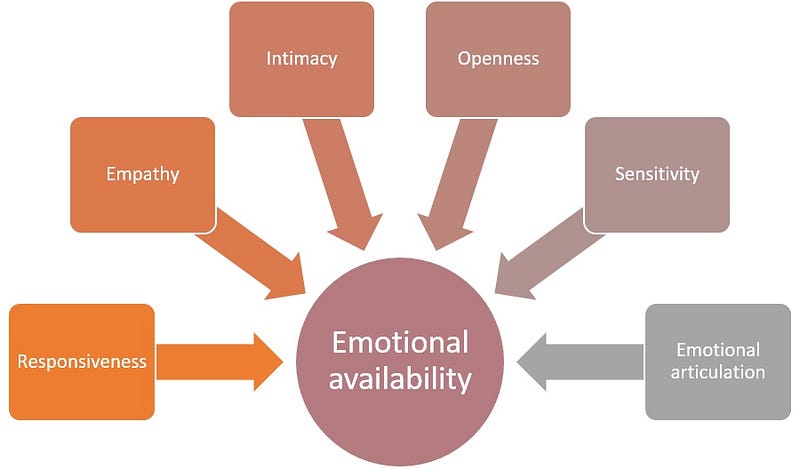
The elements that confirm emotional availability in psychology are:
- Emotional articulation – deals with the vocabulary we learn to use about expressing our needs. Language is often an overlooked aspect that sets a primary limit of our own ability to express how we feel. Sometimes this might mean that we need to feel and name things that we never have named before. It is both challenging and educational to practice expressing needs in different new situations but in the end, it’s rewriting the code about how we take references from the outer world in our inner world and how we translate them to our inner critic. We need to let go of the vocabulary we got from the primary caretakers and take ownership and consciously express feelings into words of our own as adults.
- Sensitivity – we need to develop the ability to sense things around us and listen to the intuition of our body and the signals it sends in order to translate those messages into thoughts we can learn from, analyze or just let them pass. Some people are highly sensitive and that is a super skill. I wrote here an article about how to deal with the overwhelming environments of today that overstimulate us at a sensorial level. But if you are not naturally sensitive, you will have to learn how to pay attention to yourself and others around you and the subtle cues of change from one state to another. This can be very hard but also eye-opening about the number of things that can be still proved if we only pay attention. It takes a certain dose of commitment to personal growth to want to increase this capacity and then it takes discipline to not let the number of new insights gained overwhelm us. But I will talk more about that in the spiritual dimension of emotional availability.
- Openness – this is an essential characteristic of genuine and authentic people. If you have nothing to hide and you’re also curious, your openness will be a natural given. But being open means that you also have to deal with the rejection of others who are less open and might stay away from feeling too exposed next to you.
- Intimacy – the ingredients enabling intimacy are provided by a good relationship with yourself and the nature of your shame education. Shame is one of the biggest enemies of intimacy. It can kill the strongest connection if there are secrets of shame that are never shared. True intimacy is sharing and overcoming together the shame. I know from a long-term relationship with my body image that this is something that stopped me from achieving true intimacy in moments when shame was stronger than all the other ingredients of my emotional availability. More insights into the pitfalls of intimacy and reasons why that doesn’t work can be found by reading Jeffrey Young with his schemas for reinventing your life.
- Empathy – is the ability to put yourself together with the other person in the same boat and feel together with the good and the bad you go through. Being mindful about the feelings of the other person from a nonjudgmental position and being able to nurture a safe space for the other person’s feeling to manifest is the most beautiful gesture you can offer in a relationship that enables deep lasting love and healing of past wounds. Holding that safe space for the hurt person so that they can feel their pain while their limbic brain is not feeling threatened by losing the other person for their openness.
- Responsiveness – is the ability to truly be present and pay attention to the other person’s needs. You can react and pay attention with a jet lag, but that’s not real responsiveness, it’s just a „transaction” or task you fulfill for the other at your earliest convenience. Being able to understand when and how your partner needs you and to react to that is an element that helps build the foundation of trust. If a mother never reacts immediately to a child’s cry, the baby learns that his mother is unavailable emotionally and starts crying louder until the mother finally makes time for the baby. As adults, we pretty much do the same things with our partners, except we can also choose to deal with it in a different way because there is no symbiotic relationship of need between us and our partners so in the absence of responsive partners who feel neglected learn that their needs will not be met and distance themselves, cheat or develop resentment. Also this issue in combination with a lack of emotional articulation ( or simply put awareness, ability, courage, and vulnerability to express their needs) from the partner who is treated with a lack of responsiveness will grow into a huge disconnect between the partners because it doesn’t help the unresponsive partner to correct their behavior and know something is wrong in how they behave.
2. The spiritual version of emotional availability
Our relationship with ourselves will help us untangle the ways to start loving ourselves before we can be emotionally available to love anybody else.
In the book of the Hendricks couple therapists, Gay and Kathlyn give in chapter 4 of Conscious Loving the 7 steps of Co-commitment among which loving yourself is one of them.
One of the most insightful lessons of spirituality as a path to be emotionally available is to be able to stay in your hurt and pain and love it for what it is because it is teaching you a lesson about yourself. And if you are able to do that, then part of the hurt of others will not become your burden when you need to stay with them in their hurt. That will allow you to be able to be there, emotionally available without feeling overwhelmed, and seek the first escape out of the discomfort.
Spiritual emotional availability means being in touch with your own emotions in a deeper sense. Being able to spot your emotional triggers and how they affect you and self-soothing yourself will allow you to be able to be more aware of how a partner can influence or project their own feelings on you and to stay in your own essence without taking over the burden of the other. Not only that it is a defense mechanism but it is also a source of great emotional stability to be able to remain with your own feelings separate from your partner while still supporting one another.
A person who lacks the ability to be emotionally available in a spiritual way is a person who doesn’t yet know what value he/ she carries and the value of their energy for themselves and others. This person is drifting and may not have a true north yet because they look into the values of others as a way to regulate their own internal value. Their self-worth is relying on validation from others and if they are hurt they will hurt other people as well. Their ability to love is relying on how much they can love themselves. And as the famous coach Jay Shetty says, we should not fall in love with people who don’t know how to love themselves because we’ll end up hurt and closing ourselves to love as well in time because we will question our ability to be what was needed to heal the other person and get them to love us back.
But to me, this is also a matter of ethics and spiritual growth. I will not turn down a partner who does not love himself yet. This is sometimes a lifelong process. And as Scott Peck says in his book about The Road Less Traveled,
Most people are quite correct when they say they do not want to achieve such a lofty goal or work so hard in life. […] They may have traveled a short or even goodly distance along the journey of spiritual growth, but the whole journey is not for them. It is or seems to be too difficult. They are content to be ordinary men and women and do not strive to be God. ( page 168 from chapter Love and Psychotherapy)
So in my view, spiritual growth is something we can achieve much better by mirroring each other in relationships and having the courage to „confront” in a loving way the pitfalls and struggles in our partners in order to grow emotional availability together and reach a new dimension of it through a spiritual life.
By all means, both paths are useful, but one without another doesn’t allow us to see the full picture. If we only rely on psychology, we have just fine-tuned robots and we don’t feel love for what it can really bring us. If we only follow the spiritual, our essence is not offering us at all times the answers that bring the most benefit for 2 people. We are made to be individual people but growing together means a series of adjustments in how we use our energy with others and that will eventually shape our essence. It will not be an easy way, but it will bring much more reward to admit the work that needs to be done than to say „I tick all the boxes, the problem is on you now”.
Feelings are part of a mix between conscious triggers from the environment but they go into our perception brain which has both conscious and unconscious biases. As such, feelings can be deceiving and can be mixed and confuse you if you don’t have a strict moral code to evaluate particular triggers that have had a huge impact on your emotional availability in the past.
To sum up, being able to admit you might have issues with emotional availability is a great act of courage and vulnerability in a relationship but it comes with a great reward: you are already more aware of what you need to work on in order to have the meaningful and purposeful relationship you want!


