
The Cost of Belief | Glass (2019)
Warning: The following article will contain spoilers for Glass (2019)
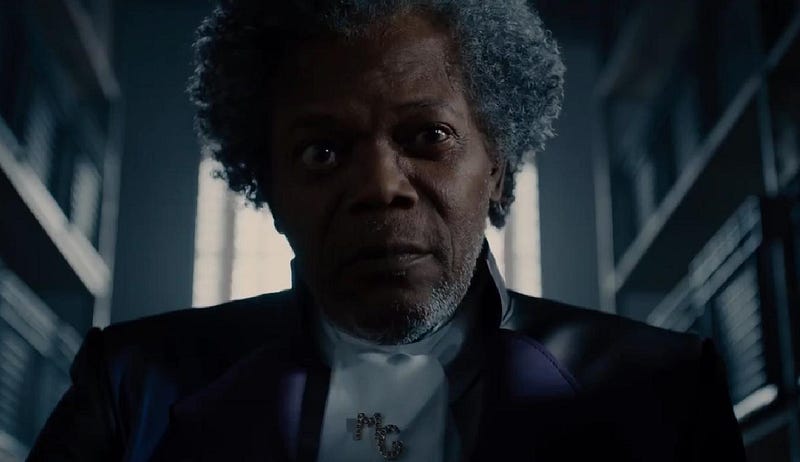
In 2019, Glass, directed by M. Night Shamalan, concluded a surprising trilogy of featuring Unbreakable (2000) and Split (2016). Receiving less critical applause than the previous two entries, it never the less delivers on the shock and surprise we associate with the director when at the height of his powers.
As a film, Glass (2019) ponders questions relevant to a culture saturated with superheroes, and if it becomes derailed from story to ask these questions they remain relevant as critiques of the modern age.
In it’s greatest theme, Glass (2019) questions the cost of belief in the incredible and extraordinary.
Brief Synopsis
Picking up at the end of Split (2016), we find David Dunn (Bruce Willis) from Unbreakable (2000) searching for The Horde (James McAvoy), Kevin a man suffering with dissociative identity disorder. He has been kidnapping young girls to sacrifice for The Beast a personality which is strong as animals and capable of scaling walls with his bare hands.
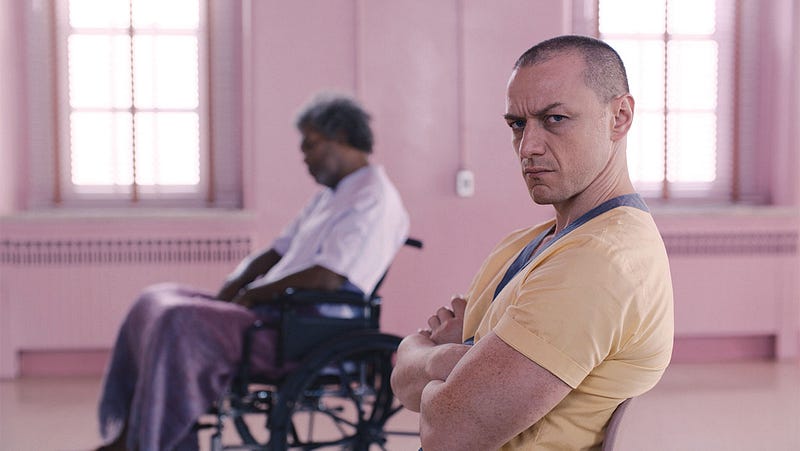
They meet and fight, with the Horde amazed by Willis keeping up with The Beast, but halted from continued battle by a Dr. Ellie Staple (Sarah Paulson) and the Police, who take both combatants into custody. Using security measures tailored to each’s weakness, Dr. Staple has both locked in an asylum for therapy prior to being taken to court for their crimes.
They are not there alone. Elijah Price (Samuel L. Jackson), better known as “Mr. Glass,” the villain from Unbreakable (2000) also resides at the asylum.
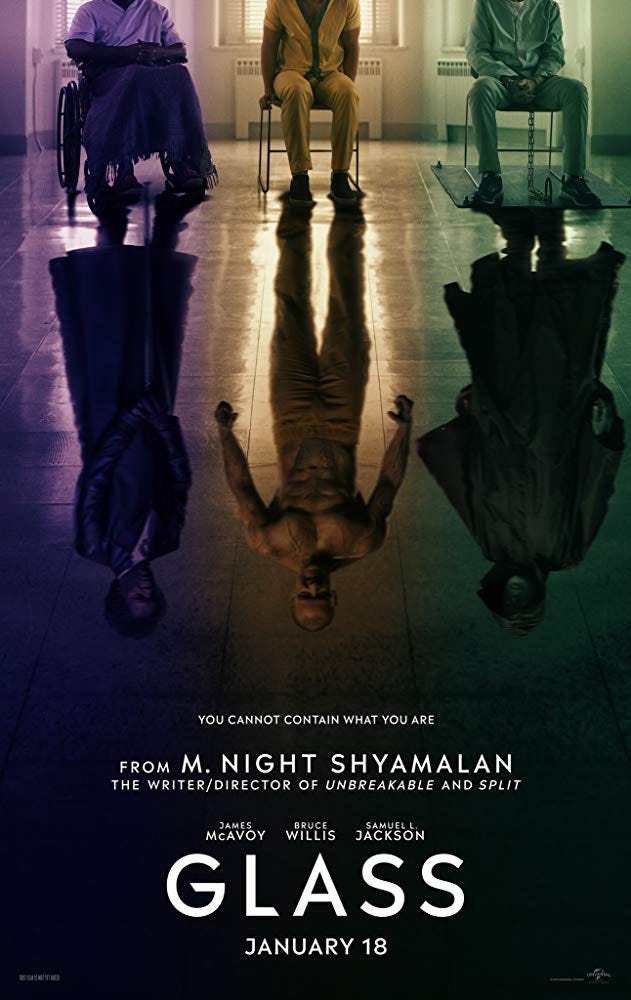
All three receive therapy from Dr. Staple, a specialist in an increasing phenomena, people who believe they are heroes and villains from comic books.
Doubt and Reality
Dr. Staple provokes us to see the characters in the light of reality, a world where delusion and mental illness is a more rational explanation for the events. Both David and The Horde begin to question their abilities in this light, with logic easily siding against them.
Doubt creeps in, not only for the characters, but the audience as rational explanations are given for what we have seen.
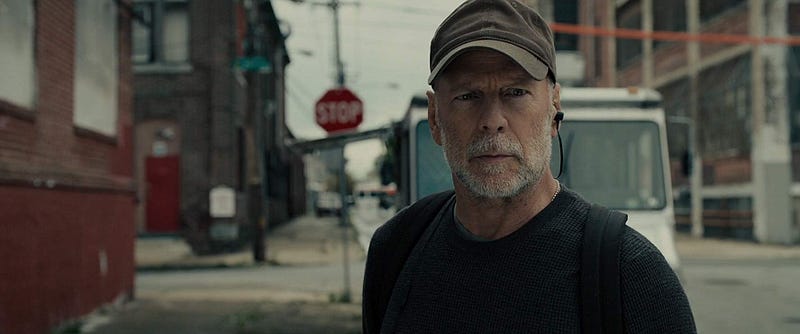
David’s ability to touch someone and see their miss-deeds is written off as a hyper-observation, much like Sherlock Holmes or a stage magician to observe the visual clues often invisible to the average man. An MRI reveals he may have suffered brain damage from the train accident so long ago, possibly causing his delusion for heroic ability.
The Beast, Dr. Staple points out, has a rational explanation also. Bending old steel bars can be done, the gunshot he sustained was from old bullets possibly defective gunpowder. Scaling walls can be done, and there are rock climbers who’ve done it before.
To any defense, there is a rebuttal. The extraordinary becomes ordinary.
Doubting themselves, it is up to Mr. Glass to bring belief back to the characters, reminding them of the extraordinary.
Each character he chooses to encourage differently as their personalities require. For the Horde, he chooses inspiration, promising to accomplish what he has wanted all along, to show the world what they can do.
The Horde “Patricia”: What if [The Beast] can’t do these extraordinary things? What if he is just unwell? Like you.
Glass: Everything extraordinary can be explained away, and yet it is true. Everything we will see and do has its basis in science. But it will have limits. This is the real world, not a cartoon. And yet, some of us don’t die from bullets, some of us can still bend steel. That is not a fantasy.
A similar refrain to any film which tries to ground magic and mystery in the real world, he leaves it at there are some things which science doesn’t have a name for.
With David, he issues a challenge. Mr. Glass calls upon him to be a hero, to save the innocent lives which will be lost when he and The Beast attack the largest tower in the city opening up that day. He challenges him to do what is seemingly impossible, and break down the steel door locking him inside.
The Blood of Martyrs
The epic showdown between hero and villain is conventional. Strong man against strong man they fight at the asylum before they can make it to the tower. It seems as if Mr. Glass and The Beast have been defeated, David takes a knee.
In a stunning plot twist, the police who have arrived kill our three main characters. The Beast is shot, as he becomes his true self, Kevin, one last time. Mr. Glass dies in his mother’s arms. David is drowned, as he drowns Mr. Staple asks if she almost convinced them they were normal people.
It is revealed that Dr. Staple is a part of a secret society which has planted doubt in the lives of the extraordinary and if that didn’t work, they eliminated them. Keeping the world free of “superheroes” and the extraordinary.
Her plans however, are soon shown to have been foiled. Mr. Glass knew he was embarking on a suicide mission, and used the cameras she planted around the asylum to record the fight and upload them online. Now, everyone can know about heroes and villains, the extraordinary is public and shown to be real.
The Cost of Belief
The death of the main characters was a bold choice, but instrumental for the theme of the movie, the power and cost of belief. Belief doesn’t come for free, it requires the death, death of an idea or former belief, in this case the death of a character.
Echoing real world persecution for belief, our principle characters die for what they believed about themselves and their world. Their death however, is the price for others having knowledge of the “truth” about heroes.
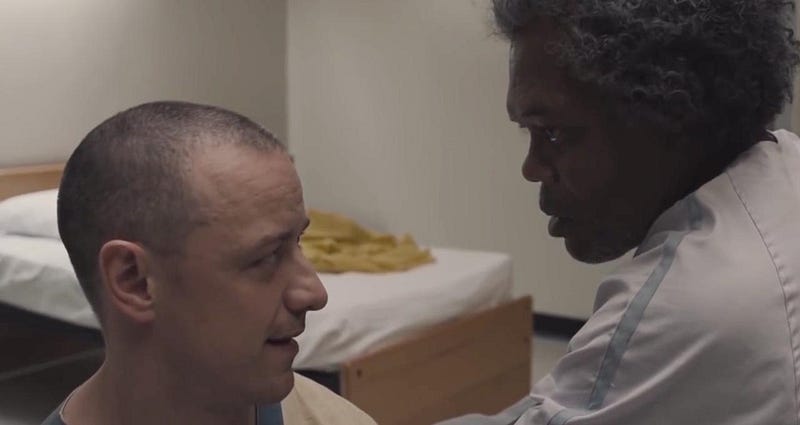
Even in the choice of musical score, there is a religious element to the film. The words of Mr. Glass to The Horde are literally underscored by a swelling of organ music, the same theme of music playing at important points of the film including the reveal of truth to the world.
Conclusion
Glass (2019) may not be a perfect film, or have received the same critical acclaim as the others in it’s series, but does present a thoughtful reflection on the nature of our perception to the extraordinary.
It is far easier to write off what we don’t understand than to belief. To have faith in what is unexplainable can even make you look mad and unwell. The film uses the super-hero as an example of how we put our belief in ourselves in the back seat, to hide our talent instead of sharing it with the world.


